


Sunday February 22, 2026 | VICTORIA, BC [Posted at 10:05 pm PT | Updated 10:40 pm]
Editorial political analysis | by Mary P Brooke | Island Social Trends
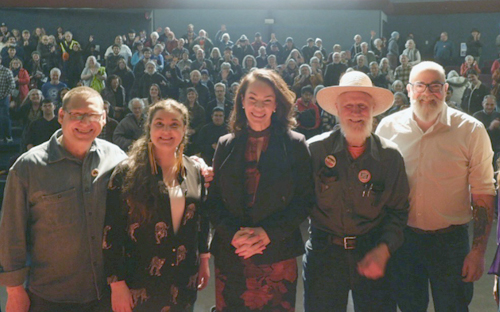
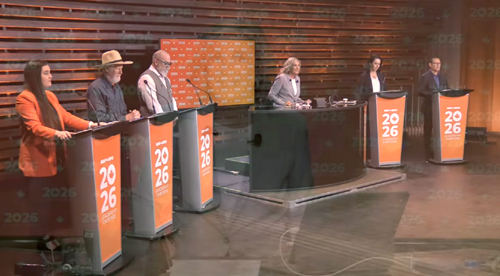
A national livestreamed debate on Thursday night February 19 in New Westminster (in the Greater Vancouver area) and another the following night in Esquimalt (in the Greater Victoria area) on Friday night has stirred up some modest broader national interest in the New Democratic Party (NDP) federal leadership campaign.
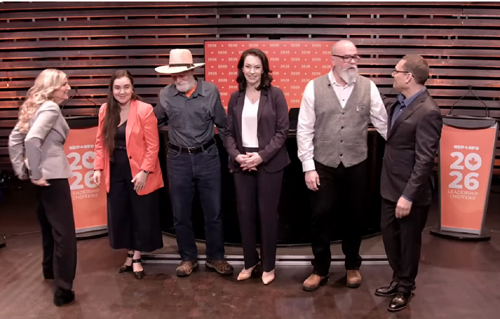
NDP followers have been on top of this, but it’s been a challenge to build greater national momentum for interest in these five candidates: Rob Ashton, Tanille Johnston, Avi Lewis, Heather McPherson, and Tony McQuail.
That the NDP membership itself is following the leadership campaign at this point is important of course. The work of a choosing a leader has been underway for months and culminates with a voting period of March 9 to 29.
But the generally low attention of the national population is largely due to the resounding defeat of the NDP in the April 2025 federal election.
Why it matters who wins:
The next leader of the NDP will have a massive party-rebuilding challenge to deal with.
To some Canadians the choice of an interesting — even effective — leader may generate some hope that Canada has not succumbed to a confrontational two-party system as seen in the Untied States.
Whoever becomes the next leader will be front and centre in Canadian politics. More so if McPherson wins as she is already an elected MP and will have ample opportunity to address Canadians through the high-profile House of Commons media process.
Whoever becomes the leader NDP leader will be interfacing with Prime Minister Mark Carney and Conservative Leader Pierre Poilievre (directly in the House if its Heather McPherson who is already elected, or otherwise outside of official debate) and perhaps even the Bloc and Greens in collaborative ways, taking the lead that the NDP promises to fight for what working Canadians want.

And incidentally, the way Canada’s economy has gone over the last 40 years — if you’re not now financially comfortable or reliably wealthy — you are in the working class.
The middle class dream has for the most part evaporated bit by bit as some benefited from international trade and digital financial investment transactions far more than others.
A party that stands for the working class is for just about everyone who now relies on government and society to provide at least some of their basic needs (hence the importance of maintaining accessible health care, the dental plan, child care, national school food program and Pharmacare though yet in its infancy).

Quick take from the debates:
Generally speaking, each of the five candidates is obviously eager to rebuild the party.
- As an elected MP, McPherson is already embedded within the system, working the long game ‘until the NDP forms government’.
- Lewis has bold new ideas (perhaps too strident for some) but with a capacity to deliver exciting rhetoric that could be what is needed to reignite the party.
- Ashton talks about bold new ideas but frames them within the current system (industry and workers).
- Johnston speaks to the younger generation and likely has a strong future with the party by understanding the grassroots development aspects of practical politics and fluency with digital platforms.
- McQuail does well as a socio-ecological conscience of the party and would be a positive asset within the party going forward.
Talk of ‘the economy’, per se, did not come up but was addressed in various other ways like addressing the needs of workers and how most Canadians are struggling with affordability.
Small party, long road ahead:
In the last election, the NDP was reduced to seven seats (from 24 when the Writ dropped) which consequentially also means that the NDP doesn’t have official party status in the House of Commons. Their funds for operations are minimal compared to what they were.
For people who don’t follow politics in detail, the NDP might seem like a party that is finished.
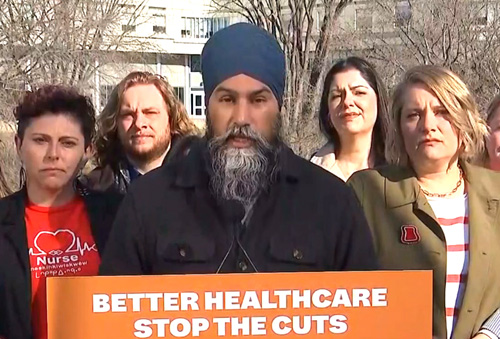
There has been criticism of the NDP having signed a Supply and Confidence Agreement with the Liberals in 2022 (when Jagmeet Singh was leader). But it was precisely because of that temporary party alignment that Canada now has a dental plan, a secure national food program, a continually expanding child care program, and the start of a national Pharmacare plan. It’s precisely because those programs were brought in under pressure from the NDP but strengthened or solidified by a Liberal government (under then Prime Minister Justin Trudeau) that the ‘new’ Liberal government (under Prime Minister Mark Carney as Prime Minister) has found it necessary to keep those programs in place.
So, as a result of the NDP’s productive work during the 2021-2025 term (44th Parliament) to fight for people-first Canadian policies (including suggesting CERB and pushing for the level to be $2,000/person/month), the NDP paid a price at the polls in 2025.
Not because they produced badly for Canadians in the previous four years (quite the opposite) but largely because many Canadians don’t follow the details of politics well enough to understand how the NDP steered the Liberals to deliver for working Canadians, families and seniors.
Where the NDP slipped in the 2025 election (and the year leading up to that crossroads) was in not communicating those successes well enough. The NDP campaign also succumbed to big-party politics as in ‘I’m running to be prime minister’ rather than digging into the issues that might have retained loyal NDP voters (something they changed part-way through the campaign but it was too late).
To be fair, the Trump factor was undeniably fearful enough in early 2025 that even die-hard NDP supporters took some comfort in Liberal Leader Mark Carney’s corporate economist resume — which may not have been wrong at that time and place. Carney’s economic plan for ‘Canada strong’ takes a long-term view to reshaping the Canadian economy, which is needed but will need to be crafted well in campaign-talk to be easily understood by most Canadians (whenever the next election emerges).
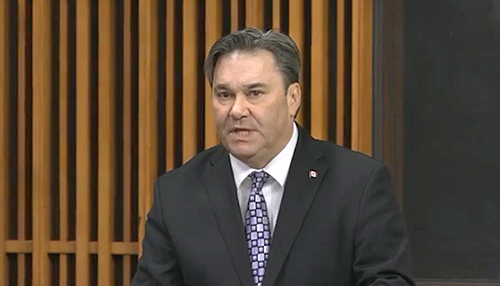
Currently led by Interim Leader Don Davies, the NDP has seven seats (of a total 343 seats) in the House of Commons. For the last year Davies has taken strong leadership for NDP values (including press conferences that get covered by the national media). He has a look and vibe that fits the Ottawa scene and has kept the NDP going through their current ‘twilight zone’ of political shift.
But the lack of official party status has been an encumbrance for the NDP to getting things done. Without leverage in committees, the NDP legislative performance cannot be strong.

Name and profile:
The five people who have stepped forward to run to be the new NDP leader are largely not well known across the general public. That’s where the recent livestreamed debates have helped a bit.
Probably the most recognized name in the race is Heather McPherson (an MP in Edmonton since 2019, re-elected 2021 and 2025).
Also with a recognized name is Avi Lewis (a professional media and film communicator who considered running for the party leadership in 2017, then later ran as a federal NDP candidate in 2021 and 2025).
The other three contestants have distinct spheres of influence: Rob Ashton from the labour union sector, speaking to workers; Tanille Johnston from a social work and Indigenous community background as well as municipal city councillor, speaking to the local social-development side and rural communities; and Tony McQuail who speaks to those who are motivated by ground-level agricultural and climate change issues.

Rise and fall of the NDP:
The NDP as a federal party was on a long and winding road to this current level of demise. Born of the muster of Tommy Douglas in the 1960s (he was 7th Premier of Saskatchewan for 17 years then the first federal leader of the NDP from 1961 to 1971), the NDP worked in the House of Commons to bring in the universal health-care system that benefits every Canadian.
That promise of equal benefits in Canadian society has been the trademark pulse of the NDP ever since.
- By 2011, NDP Leader Jack Layton — driven by the same ‘everyone matters’ approach to politics — brought the NDP to Official Opposition status (facing the Harper Conservative government across the aisle) as a result of his leadership in the 2011 election, including in Quebec.
- During 2012-2015, Tom Mulcair was the NDP Leader, continuing as Leader of the Official Opposition after Layton passed. He brough the NDP closer to the operational side of mainstream politics, but lost much of the grassroots along the way.
- Jagmeet Singh became NDP Leader in 2017. During 2021-2025, Singh pegged the bar of success for everyday Canadians even higher by getting a range of next-level social benefits embedded into the Canadian way.
Time to rebuild:
The NDP are now nearly irrelevant in Quebec, and there’s hearsay that their one Quebec MP Alexandre Boulderice may defect.

Just about half the current NDP seats are held in BC (Don Davies, Jenny Kwan, and Gord Johns), which is good for the party’s movement in BC but for central Canada voters (aka Ontario) it likely doesn’t hold enough sway.
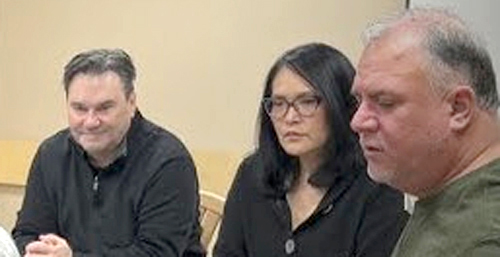
McPherson has been a big part of building an NDP stronghold in Alberta.
The other two NDP MPs are Leah Gazan in Winnipeg (where having an NDP Premier in Manitoba can be helpful) and Lori Idlout in Nunavut (likely benefiting by Arctic issues now trending in the House of Commons).
Perhaps the wide range of backgrounds and perspectives of the current NDP leadership candidates is a sign that the party does aim to serve all of the (working) people. In the debate McQuail proposed there be a ‘leadership table’ (a more generalized version of a party caucus where there would be less focus on one leader).
“Members asked thoughtful and challenging questions about growing the party, strengthening our democracy, and addressing the urgent issues facing our communities,” said former Victoria MP Laurel Collins, the moderator of the February 20 debate. “This is how we renew and build our movement.”
Contenders in debate:
A new leader will be chosen by the NDP membership on March 29 at the NDP national leadership convention in Winnipeg.
In their debate on February 19, topics covered economic security and national sovereignty, future and role of the party, rebuilding the party, foreign affairs, energy and the environment. All the questions were developed by the moderator — former journalist Hannah Thibedeau, who said she developed the questions herself. (The debate the following evening in Esquimalt was moderated by former Victoria NDP MP Laurel Collins.)
What did the five NDP leadership contestants — Rob Ashton, Tanille Johnston, Avi Lewis, Heather McPherson, and Tony McQuail — reveal on Thursday evening that is new or helpful better understanding their positions on current issues and directions of the party?
Essentially, each of them drilled down on what they are already bringing to the table.
Heather McPherson with her experience as an elected MP (Edmonton Strathcona), ready to get working the very next day. She says the “NDP needs to hold this government accountable until we are government”. The NDP fights for what matters, she said on Thursday night, adding that it’s because of the NDP that Canadians have public health care, enshrined worker rights, and a strong public service and drawing a contrast to the United States. More NDP seats translates into doing more for people, she outlined.
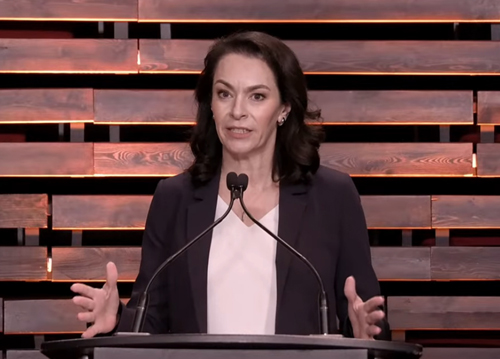
Tanille Johnston was relaxed but forceful, emphasizing her knack for listening to people (to meet people where they are) and turning that into fundraising and base-building for the party. She “understands the urgency for change”, and that the “capitalist system consistently and deliberately fails our communities”. Of all five candidates, Johnston was the only one who twice brought up the idea of a basic livable income (a social support that would eliminate the worst of Canada’s poverty and stabilize the economy).
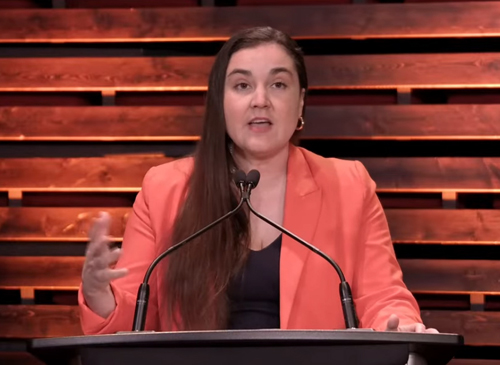
Avi Lewis with quick-thinking on complex issues, drilling down on taking the party in bold new directions. He held up the CCF (pre-NDP) leader Tommy Douglas as someone who could see what people needed and focussed on that — utilizing “support of the many”.That’s similar to how the late John Horgan (who was also motivated by Tommy Douglas) mobilized his support within the NDP to ultimately become the Premier of BC and with that platform made significant changes in BC government to ‘put people first’.
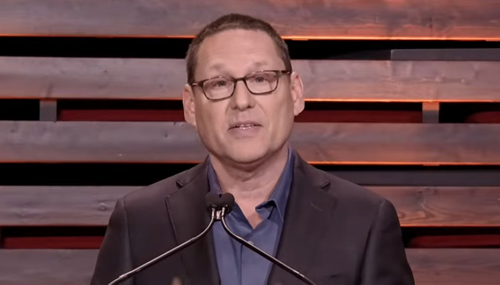
Rob Ashton was unshakably in support of all workers (unionized in particular). He wants to rebuild “the trust that working class people may have lost”. He would want the NDP to take decisions to invest in “industries and job creation” to improve things for people in their daily lives including “homes that people can afford, built with Canadian materials” (arguably that has been launched by Prime Minister Carney over the past year). Ashton said he’s tired of the NDP being Canada’s social conscience — that’s exactly what they are but could be more by being involved more directly in the system, it sounds like.
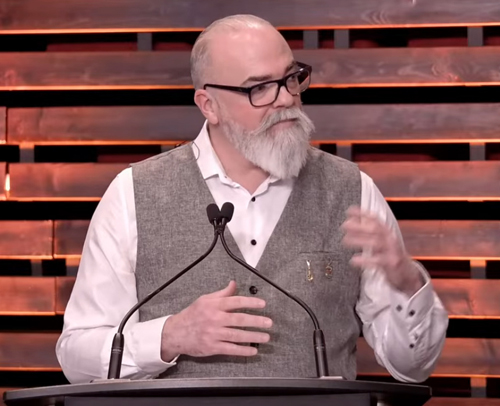
Tom McQuail had the broadest vision for reshaping overall economic directions toward better conditions for humans living on a suffering planet, He is keen to see the party rebuild with that broad awareness in mind. He wants to help people understand issues and needs from a perspective “that maybe they aren’t already feeling”.
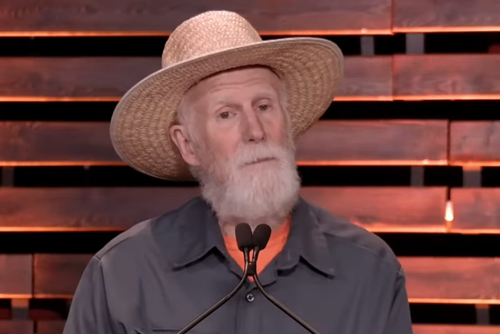
The matter of French:
Very little of the February 19 NDP leadership debate was conducted in French (a debate conducted mostly in French was held previously).
While all the candidates to some degree agreed with the concept that language is a key factor in maintaining culture, at least one candidate said ‘that’s what translators are for’ — which is not as flippant as it sounds when you think about all the conferences where the current prime minister relies on translation services in international venues…. the work still gets done without language being a barrier.
In other words, an NDP leader who doesn’t necessarily speak fluent French might still serve the party well if they truly recognize, value and act to help preserve the distinctiveness of the French culture in Quebec.

Long-range:
If none of these NDP leadership contenders end up being the right fit for the party over the next year or two, there’s always the next federal election cycle to look at.
As well, there are other strong NDP leaders at other levels (such as Manitoba’s premier Wab Kinew) who could excite the party in new directions.

===== RELATED:
- NEWS SECTIONS: FEDERAL NDP | 45th PARLIAMENT OF CANADA
- Five NDP leadership candidates have five weeks to go (editorial analysis – February 16, 2026)
- Federal ministers head to Tumbler Ridge with BC Premier & Safety Minister (February 11, 2026)
- Tributes in the House of Commons about Tumbler Ridge shooting (February 11, 2026)
- NDP MPs visit Nunavut ahead of 2026 House of Commons session (January 24, 2026)
- Carney Liberals still don’t realize they are a minority government, says NDP (December 10, 2025)
- NDP national leadership debate coming up Nov 27 (November 26, 2025)
- Next steps by NDP interim leader Don Davies (May 8, 2025)
- Federal NDP chooses Don Davies as interim leader (May 7, 2025)