


Tuesday April 14, 2026 | OTTAWA, ON [11:06 am PT]
Political news analysis | by Mary P Brooke | Island Social Trends
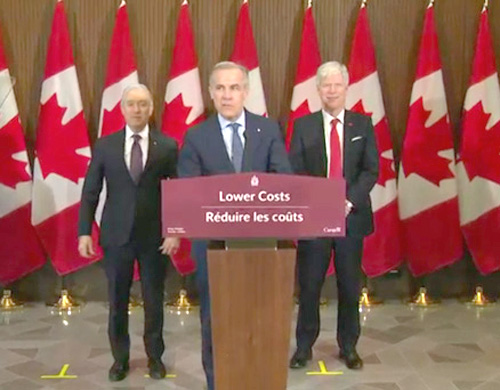
This next-day after the Liberals achieving a majority in the House of Commons, Prime Minister Mark Carney has announced what was billed yesterday as “new measures to bring down costs for Canadians”.
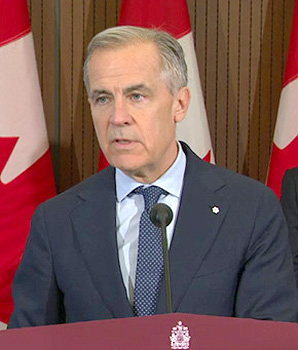
The Liberals now have 174 seats in the House of Commons following three April 13 by-election wins and a series of opposition MP floor-crossings over recent months. “We accept their support with humility,” said Carney today regarding the by-election wins.
The approach of today’s announcement is on the macroeconomic level, not surprisingly from this prime minister.
A more resilient economy is the long-term goal, achieved in incremental steps.
“The global landscape is rapidly changing. In response, Canada’s new government is focused on what we can control – building a stronger, more independent, more resilient economy. We’re building an economy where Canadians are empowered with greater security, certainty, and a lower cost of living,” it was outlined in today’s PMO news release.
Addressing media in Ottawa this morning, Carney outlined the fuel tax approach to softening the blow of fuel price increases due to supply-chain impacts of the war in Iran.

Summer price break:
The price break on fuel will start April 20 and run through September 7, 2026.
Gasoline at the pump is generally higher-priced in summer months — due to the type of fuel (heat adaptability) and also taking advantage of demand (people tend to travel more by car and truck in summer). That’s no guarantee that fuel retailers won’t add a cushion into their prices as a buffer during the Iran supply-chain scenario.
“Cutting the tax on gasoline and diesel until Labour Day is a responsible measure that will reduce operating costs for truckers and businesses in the food, agriculture, housing, construction, and delivery sectors. With lower costs and greater financial strength, businesses can hire more workers, confidently build, and export more products to global markets,” the government says.

How people might be better helped:
“Supporting Canadians who are under pressure,” is how Carney put it today. He reiterated about there being 15 national major projects, investment in aerospace and AI, and 125,000 new jobs. He also itemized about more housing (being instigated by various programs) and infrastructure development (supported by funds in partnership to communities). Doubling the size of the electricity grid and harnessing natural resources are key parts of the plan.
“We’ll build a Canada that is strong,” said Carney today.
The big-picture analysis is sound and no one argues that restructuring of Canada’s economy is essential. Trade diversification is underway but it will take years to produce benefits to the overall economy and people’s financial security.
But whether people will really feel any help by today’s fuel tax relief announcement is another thing. If they’re already cash strapped they won’t be travelling much to begin with, and probably aren’t exercising much ‘disposable’ income at the grocery store or anywhere else.
A bigger help would be to deal directly with credit card companies to financially back programs to help consumers maintain their debt without crisis, as Finance Minister Jim Flaherty put into place after the 2008 financial crisis.
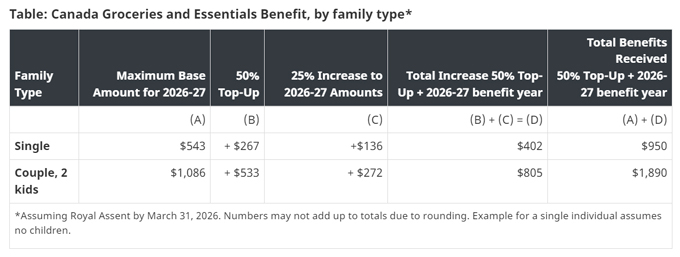
Meanwhile, the low-income GST rebate (renamed as the Grocery and Essentials Benefit) kicks in at a higher level in July 2026.
Adapting the energy sector impacts:
“Global conflict and ongoing supply disruptions in the Middle East are driving up fuel prices around the world” is the government’s position.
Carney was flanked by Energy Minister Tim Hodgson and Finance Minister Francois-Philippe Champagne at today’s press conference.
The prime minister reminded again today about his government having cancelled the consumer carbon tax last year.
But no one really mentions how that left low-income Canadians with a sudden drop in support (being restored as the Grocery and Essentials Benefit but that has taken a year).
“Protecting and expanding vital social programs,” is within Carney’s value system and plan, but it’s a bumpy ride.

Fuel tax holiday details:
Today, the Prime Minister, Mark Carney, announced that the government is temporarily suspending the federal Fuel Excise Tax on gasoline and diesel across Canada. Starting April 20, 2026, Canada’s new government will suspend the full amount of the tax on gasoline and diesel until September 7, 2026.
This is expected to reduce Canadians’ bills at the gas station by 10 cents per litre on regular gasoline and 4 cents on diesel. The government is also temporarily suspending the federal Fuel Excise Tax on aviation fuels.
Political go-forward:
“Canada’s new government was elected to build a more resilient economy – an economy that creates good careers, strengthens our sovereignty, and empowers all Canadians with a lower cost of living,.” the prime minister’s office says today.
“We’re moving with speed and ambition to build a country where all Canadians have greater certainty, security, and prosperity.”
Canadians do seem to grasp the magnitude of this task and continue to afford the Liberals as positive road forward (such as three successful by-elections) to get things done.
===== RELATED:
- Liberals form majority government by winning three by-elections (April 13, 2026)
- BC convenes task force on impacts of Iran war (April 13, 2026)
- Canada Groceries and Essentials Benefit replaces GST rebate to help Canadians with affordability (January 26, 2026)
- NEWS SECTIONS: ECONOMY | AFFORDABILITY