



Wednesday June 11, 2025 | VICTORIA, BC [Updated June 13, 2025]
by Mary P Brooke | Island Social Trends
A new Regional Transportation Service (RTS) will be established by the Capital Regional District (CRD) for the Greater Victoria area.
The move is made possible by the CRD Board’s approval of Bylaw No. 4630 to establish the RTS, as announced today by the CRD.
The bylaw for the Regional Transportation Service has now been adopted by the CRD Board after receiving elector assent through a regional Alternative Approval Process (AAP). That process (which is provincially legislated) essentially allows for automatic approval unless there is expressed dissent by 10% or more from local electors.
The AAP process for Bylaw 4630 closed on May 16, 2025.

Travel across municipal boundaries:
The CRD region has 13 municipalities and three electoral areas, with boundaries that few people take into consideration during their day to day activities. The population of the CRD is estimated at 460,000 (2024).
Transportation responsibilities are current handled by CRD, local governments, BC Transit and the provincial Ministry of Transportation and Transit.

“With a growing population and more residents travelling across municipal boundaries to access work and leisure, a transportation service is needed to support a more connected and efficient regional transportation system,” it was stated in today’s CRD news release.

“A regional approach will improve connectivity across municipalities, strengthen coordination, and ensure our transportation system can meet future needs. A more coordinated system also means better and more accessible travel experiences, whether by walking, bike, bus, or car,” said Sidney Mayor Cliff McNeil-Smith, who chairs the CRD Board.

“One cohesive voice on transportation will better attract provincial and federal investments, ensuring our communities receive the infrastructure they need,” said Saanich Mayor Dean Murdock who chairs the CRD Transportation Committee.

How things will change:
The new service will create a unified regional transportation vision, develop new programs, expand data and analysis, coordinate regional policies, and manage regional trails and infrastructure.
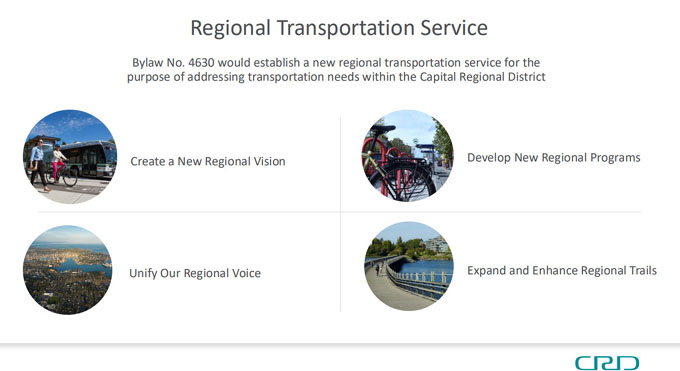
The first step following the service establishment is to integrate existing transportation functions under one umbrella, including transportation planning functions and regional trails management. The new service will develop a new long-term Regional Transportation Plan to identify regional transportation priorities.
The CRD will continue to work with residents, First Nations, local governments, and transportation providers on the management and planning of regional trails and transportation networks, ensuring they continue to serve as vital, well-maintained connections as the region continues to grow.

Cost to taxpayers:
The service cost for transportation will increased from $4.7 million in 2025 to $5.89 million in 2026 and reaching $10.22 million by 2029.
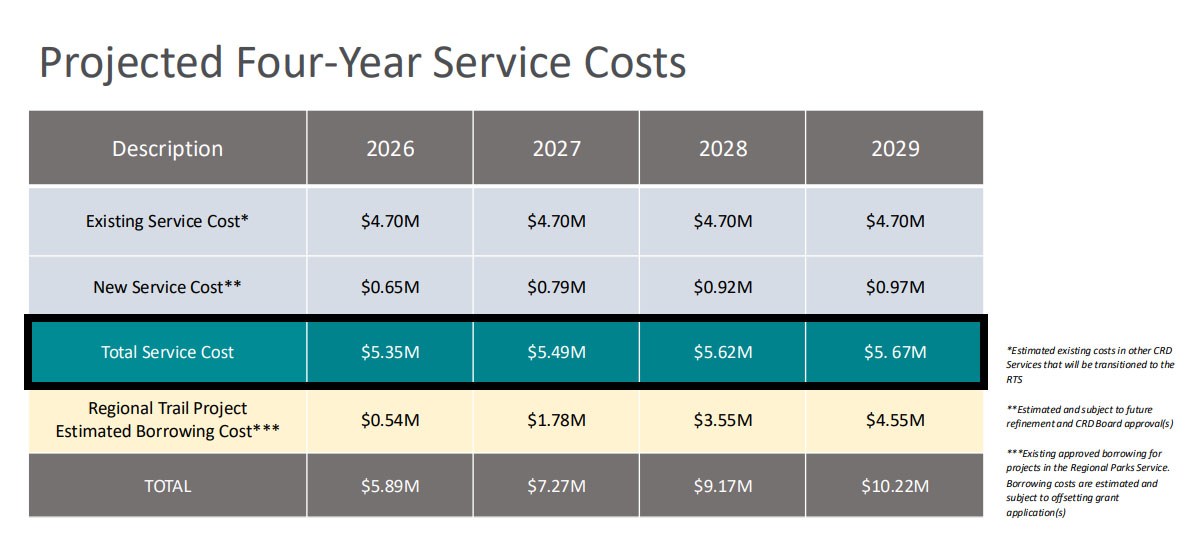
According to a CRD document from 2024, the new Regional Transportation Service can be financed as either a fixed amount ($20 million per year) or as a property value tax amount ($0.10834 per $1,000). That approach represents the long-term capacity for the service, not the proposed budget. “There are no plans to reach the proposed maximum recognition,” it was stated by a CRD spokesperson this week.
“Any costs related to this service will be included in the CRD’s annual planning process and must be approved by the CRD Baord as part of the CRD Financial Plan Bylaw,” the CRD states.

Regional services in the CRD:
- Regional water supply
- Solid waste
- Wastewater treatment
- Regional parks and trails
- Housing
- Regional Planning

===== CRD LINK:
Regional Transportation Service visit www.crd.ca/transportation.

===== RELATED:
NEWS SECTIONS: CRD/Greater Victoria | TRAVEL & TRANSPORTATION