


Wednesday November 19, 2025 | LANGFORD, BC [Posted at 11:58 am | Updated 12:21 pm]
Editorial news analysis by Mary P Brooke | Island Social Trends
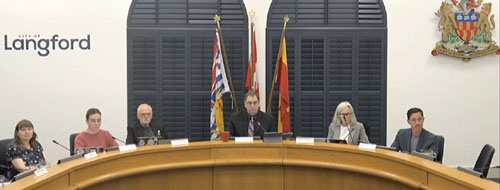
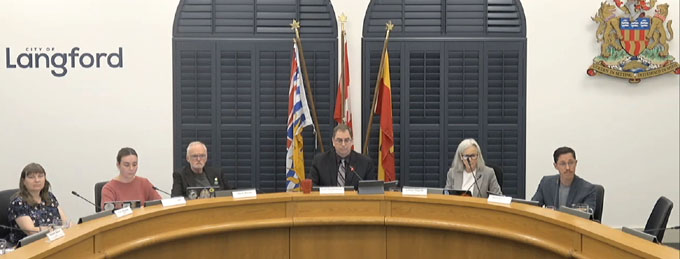
On Monday evening, City of Langford council heard from one public participant that town halls might be a better way for council to engage with residents on key issues.
This comes quite late in the public engagement process — two or three years into a strategic planning process by which the council that was elected in October 2022 has been reshaping the path forward for the fast-growing municipality.
In fact, fast if not steady growth of the City of Langford population is embedded in the name of the public engagements… effectively looking to a “population 100,000” as the overarching theme of all the strategies beneath the OCP including transportation, active transportation, parks and trails, arts and culture, and more.
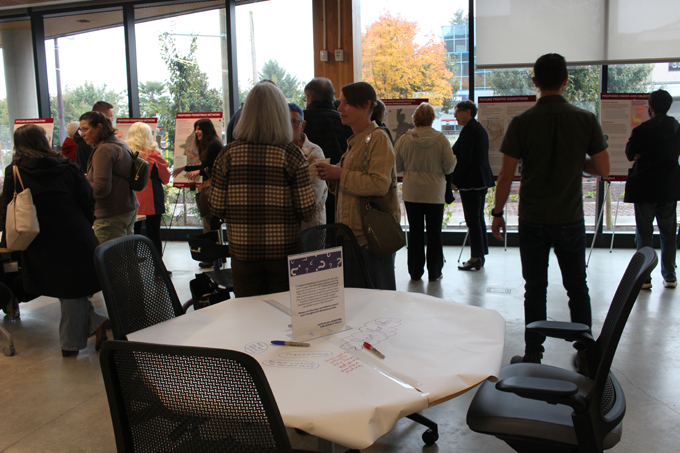
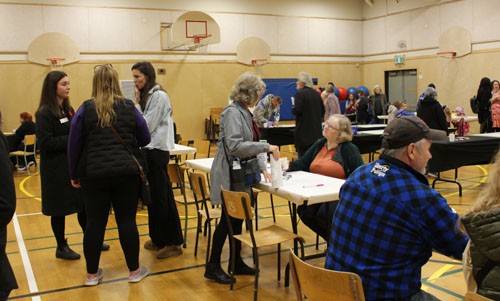
A current-standard engagement process has included speaker presentations, idea fairs, and online surveys — all of it supported by extensive documentation and presentation boards/PDFs by staff and consultants.

But along the way the missing piece seems to have been town halls. One of the first OCP consultant presentations — held about two years ago at the Langford Legion and which attracted a good crowd — did not allow questions from the floor (except through an online app which didn’t work for everyone). There were complaints at the time about that.
For the suggestion of a town hall forum to come up from the public at a Council meeting this late in the process does first show that most of the other means of public input were satisfactory to most people. And it may now lay bare the issues that have been brewing or are otherwise not resolved.

The suggestion about town halls did come within an often-heard complaint that Public Participation at council meetings is a one-way process — i.e. the public presents statements or questions are heard from the public as an intake process. This is a standard municipal meeting format, not unique to Langford. The fact that some members of the public were trying to politicize a process that most residents well-understand is evidence of election season to come.
It’s understandable that a brand new council may has felt that they didn’t have the political breadth and depth to handle town halls early in their four-year term. But now it’s likely to the benefit of council — and the public — to hear some of the strategies discussed back and forth in an open town hall format.
The timing does present a two-edged sword. There is now less than a year until the official start of the October 2026 municipal election campaign season. In some ways it’s almost too late to explore or integrate any new ideas into strategic plans (though with enough political pressure it could be done).
One of the problems with the strategic planning process is having brought in consultants from places beyond Langford. The conventional wisdom is that ‘eyes from outside’ might have a clearer big-picture view. But frankly Langford is uniquely distinct enough and dynamic enough in its various community substrata that the important threads and nuances of moving Langford forward could easily be missed by ‘non-local’ consultants with the best of intentions.
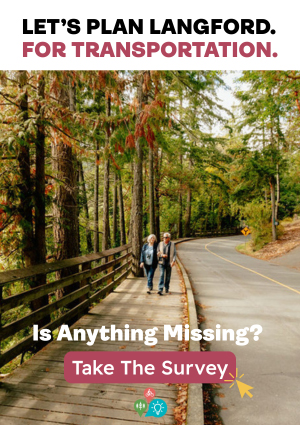
Details gleaned from public engagement are intended to fill in the pieces and guide consultants. But frankly, the volume of detail from such a massive public engagement process will be a monumental challenge for staff to process. That is no critique on the capability of staff but rather the volume of material, and the load of the process by which is it sorted, condensed and summarized. Things can get lost in process.
This same point was made recently by the Mayor of View Royal in his concern about how that municipality’s OCP process around intake from public engagement. And the same thing was seen many years ago in the District of Sooke when after more than a year of public engagement the final report from staff was at first delicately critiqued and then finally entirely canned by council and things had to start from scratch.

Again as no critique of staff at any municipality — the current OCP and strategic plan process is executed with reliance on staff as a way for politicians to stand back from the process (either for political reasons or workload). Politicians may argue that they can still finesse the process with what they are presented with from staff, but they can only work with what is there.
Reliance on staff to do political work needs more attentive guidance from the people who are elected. Mayors and councils are clearly are full loaded with responsibilities, obligations and workloads. So what a heck of a time it is to bring in town halls — a process that normally kick starts a public engagement process. But it may be exactly what Langford needs for straightening out some twists and turns that have — through no one’s faults or intentions — have evolved in the work of reshaping Langford’s key documents and directions.
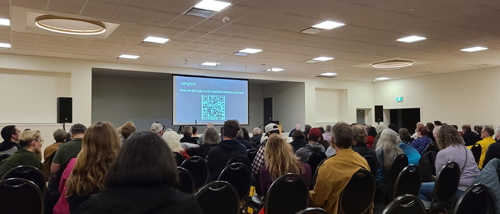
It’s been a massive undertaking for which this current council — headed by Mayor Scott Goodmanson — should be commended by residents and local businesses — even those who profess to protest.
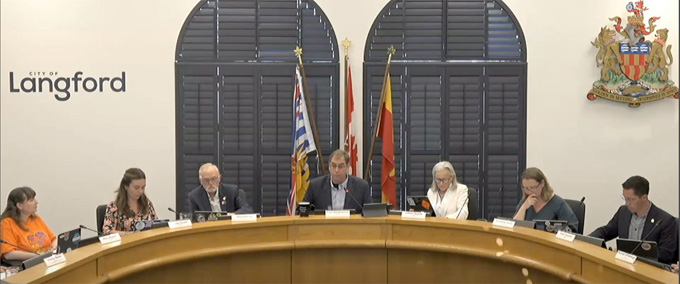
And let’s no lose sight of why the considerable revision of the OCP was undertaken in the first place. Yes, the province at one pointed mandated this for all BC municipalities. But for the City of Langford in particular, this was a gutsy and strident process — with the weight of the world in particular on staff — as this town was taken fro ‘Dogpatch’ to ‘shining city on the hill’ in just 30 years by the previous Mayor Stew Young and his nearly unchanging council over three decades.

When you’re working at breakneck speed and not only breaking barriers but setting new horizons, there is much less incentive or perceived need for documented plans, strategies and two-way engagement. In fact, the former mayor took pride in what worked for his preferred method of public engagement… spending time one on one in the community to see how things were working on the ground. He rarely if ever attended Capital Regional District (CRD) meetings at the regional level.

By contrast, Langford Mayor Scott Goodmanson is not only involved more broadly across the west shore (meeting regularly with west shore mayors) but also regionally for Greater Victoria (now as vice-chair of the CRD Hospital Board). Goodmanson and council have relied on staff to pull the load of preparing the strategic master plans and other documents that council has directed.
But the insert of a few town hall meetings at this juncture between the collection of massive amounts of public input by staff and the work of consultants might be just what the political doctor ordered. Filling in that gap of hearing what may have been missed — but more likely fine-tuning what is not yet quite right — could cap a strident and detailed three-year process.
Results might just satisfy both those in the public who doth protest and the politicians who head into year-four of their current term.
More broadly, the community might appreciate the summary of information and/or broad strokes that might lift out as public discourse.
===== RELATED:
- City of Langford adopts new Official Community Plan (July 2, 2025)
- Casual community get-together with Langford council (January 25, 2025)
- Upbeat participation at Langford OCP Refresh Phase 2 open house (November 3, 2024)
- Langford population to double by 2050 – public survey to Sept 15 (August 25, 2024)
- Opinion: Langford OCP refresh faces some challenges (January 26, 2024)
- NEWS SECTIONS: LANGFORD | WEST SHORE LOCAL