


Saturday February 21, 2026 | VICTORIA, BC [Posted at 3:57 pm PT]
Political analysis by Mary P Brooke | Island Social Trends
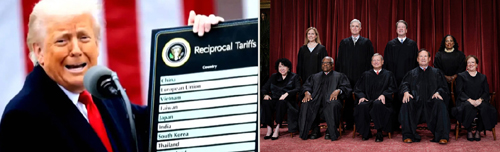
Yesterday the US Supreme Court released a ruling that Trump’s tariffs imposed on numerous countries last year using IEEPA (International Emergency Economic Powers Act) as the reason, does not in fact authorize tariffs.
Of the nine justices on the US Supreme Court, six ruled against the President’s tariff decision, saying it was unconstitutional for Trump to unilaterally set and change tariffs because the power to tax lies with Congress.
This is politically significant — it’s a chink in the armor of getting tariffs rolled back, especially if Republicans lose seats in the upcoming November 2026 mid terms.
After the Supreme Court decision was released yesterday, Trump retaliated by adding a 10% global tariff that would go into effect “almost immediately” (later upped to 15%).
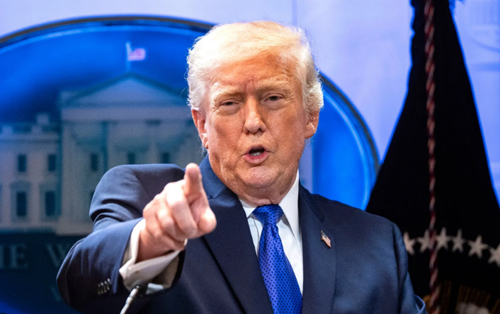
Trump’s announcement today about a 15% tariff threat is the latest sign that despite the Supreme Court’s check on his powers, he intends to still impose tariffs in an unpredictable and disruptive way.
Trump said yesterday he will use Section 122 of the 1974 Trade Act to implement tariffs across the globe— however, that duty would only stay in place for 150 days, unless Congress votes to extend it.
Trump has said for years that his favourite word in the dictionary is tariffs — he feels they are easy to implement, are easily understood and easily levied, and he’s met with some arguable success in using them to rewrite rewrite the rules of global commerce by applying economic pressure essentially worldwide.
Losing Canada’s trust:
Trump is trying to protect his country’s economy through a custom-style strategy from the top of US power,
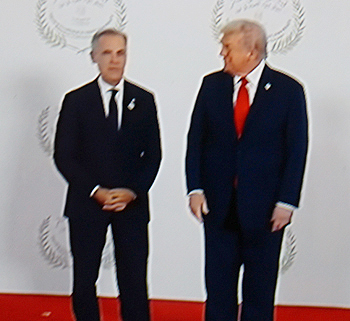
But he may have underestimated the regard with which the rest of the world held the United States as a leader of the free world. That aspect of US relations is — at least with Canada — damaged in some ways that are non-repairable. Broken trust is rarely something that can be restored.
It will make Canada extremely cautious going forward, both in the immediate sense of negotiating the CUSMA agreement, but also in terms of longer term alliances including defence.

A step in the right direction for Canada:
The US Supreme Court tariff decision announced February 20, 2026 is a step in the right direction for Canada’s economic interests.

It demonstrates some success of the ‘elbows up’ political approach by the federal and provincial governments, as well as businesses and business sector stakeholders that have spoken up.
Every Canadian who has expressed concern about the tariffs and has tried to ‘buy Canadian’ in the past year can take some small sense of victory in hearing the court’s ruling.

Major-sector tariffs still stand:
Most tariffs imposed by the US against Canadian goods entering their country still stands — as targeted against certain sectors like steel, aluminum, auto-manufacturing and softwood lumber products (and the suspension of duty-free de minimis treatment for low-value shipments continues).
CUSMA-compliant goods are exempt from all of this (allowing about 80% to 90% of Canadian goods to continue to be traded tariff–free across the border into the US).

Small gain for the pro-Canadian interest:
But the US Supreme Court declaration is a crack in the stronghold of US tariffs on the Canadian economy, being a strategic political win political for the Canadian federal government (as well as provincial governments) have been chipping away at.
- BC was among the first provincial jurisdictions to protest against Trump’s tariffs using blockage of the sale of US liquor from BC liquor store shelves.
- Ontario notably ran a TV commercial knocking the US for not taking the late US President Reagan’s advice on tariffs, after which Trump paused all tariffs negotiations with Canada.
- Canadians, overall, have been ‘voting with their dollars’, by not buying US-produced goods and not travelling to the United States for vacations or business.

BC response:
Here in BC, Premier David Eby was pleased about the US Supreme Court ruling.
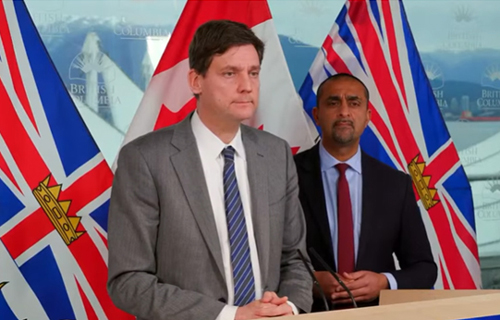
“This is a very important decision on a couple of levels for Canadians and British Columbians,” said Eby yesterday in a press conference from his office in Vancouver.
Eby said that Canadians, British Columbians and people around the world “knew that this process is wrong and should not be happening,” said Eby, further defining Trump’s approach as being “not being consistent with the role of the United States as a jurisdiction of predictability and respect for law and order and way of international relationships”.
“For those of you who felt that way, you were right. And the Supreme Court of the US has confirmed that,” BC’s premier said yesterday.
“It’s an important decision even if just to restore some of our confidence in one of our closest friends and allies and trading partners, here in Canada,” said Eby.
Eby also says it will “open the door” to a potential challenge related to the softwood national security tariffs.
Having confidence in the US:
Eby added that the court’s decision “underlines why we have had confidence in the US over the years”.
“The vote by the US House of Representatives recently to condemn the tariffs that have been imposed on Canada, are two important signals to us, here in British Columbia… that there may be some thawing in the challenge that we’ve faced and the willingness of those that hold the checks and balances of power in the United States to stand up for the relationship that we have valued over the years,” said Eby, in further explaining his sense of optimism at the Supreme Court decision.
“When this threat started, one of the initial thoughts we had was the potential of using the US courts in actions that were already underway, much as what has happened today,” said Premier Eby.
Eby says he’s grateful to the businesses that launched the court challenge in the United States, and to “Republicans in the House that crossed over to vote to condemn the tariffs on Canada”.

Continued trade diversification:
Eby admitted yesterday that the US Supreme Court decision will “have limited meaningful impact in terms of the challenges that we’re facing”
He reiterated that getting rid of trade barriers between provinces in Canada will be helpful, something that was discussed by Canada’s Premiers at the last few meetings, including in Ottawa in January, which wrapped up with a joint federal -provincial statement of alignment on economy, trade and sovereignty.

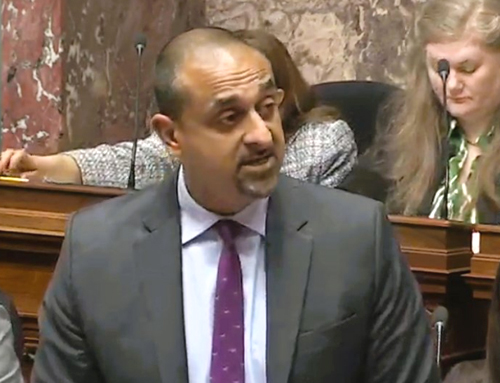
A few days ago Minister Kahlon tabled Bill 5 in the BC Legislature to facilitate the dropping of trade barriers that presently operate in BC.
Alberta’s response:
Alberta Premier Danielle Smith said yesterday that she hopes CUSMA talks can now ‘get back on track’.
===== RELATED:
- Carney & premiers present a united front on economy, trade & sovereignty (January 29, 2026)
- Canada’s premiers in Ottawa to discuss economy, projects & trade (January 28, 2026)
- NEWS SECTIONS: COUNCIL of the FEDERATION | TARIFFS & TRADE | CANADA-USA | CANADA-NATIONAL