


Thursday July 31, 2025 | VICTORIA, BC
Editorial by Mary P Brooke | Island Social Trends
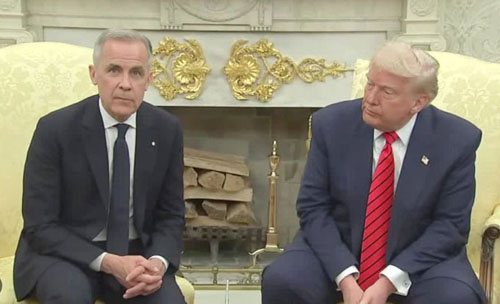
On this particular day, Trump seems slightly filibustered by Canada’s stance to declare support for a Palestinian State.
Trump posted in social media today that Canada’s move in that political direction might make it difficult for the US to make a trade deal with Canada.
The current ‘deadline’ for making a trade deal with Canada is tomorrow, August 1.
Carney could well be making a sly move here. By announcing the stance on Palestine just two days ahead of the August 1 deadline (and taking an educated guess at how Trump might respond), it could buy Canada more time for sorting out a trade deal and for the economy to adapt.
CUSMA still counts:
However, it is worthwhile to remember that Canada does already have a trade deal with the United States, i.e. CUSMA (USMCA) which was negotiated in 2018 and comes up for renewal or revision in 2026.
Though CUSMA only protects certain sectors and Trump is talking about an across-the-board tariff of 35% on on non-CUSMA goods.
All this talk about having a deal for August 1 is something to suit Trump’s economic agenda to shift more trade advantage back to the United States.

Must be good for Canada:
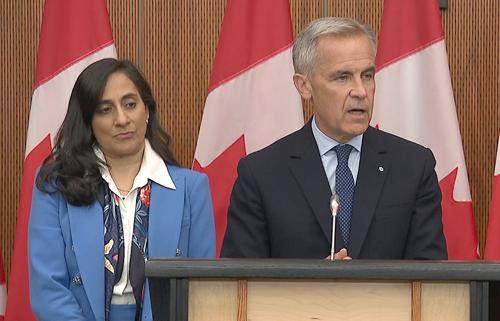
Prime Minister Mark Carney has said over the past few months that Canada will only accept a deal that is good for Canada, not just any deal. In fact, he essentially got a strong mandate in the federal election at the end of April, to go strongly to bat for Canada.[ Political footnote: The NDP suffered their worst-ever election loss as progressive voters flocked to the Liberals in support of the mission that Carney promised to undertake.]
Given that CUSMA is still on the books, technically speaking Canada doesn’t need another deal with the United States at this time. The economy could just stumble along (particularly in key sectors like steel, aluminum, potash, lumber and auto manufacturing) — not easy, and not without damage to jobs and communities, but doable.
If Carney sticks to his stance on waiting for a good deal, Canada may, in the short term, end up seeing a 35% tariff on all non-CUSMA goods presumably starting tomorrow. That would clearly not be helpful to the Canadian economy.
Frankly, it’s never been made clear from Carney or the federal government as to where a ‘new deal’ would fit within the reality that CUSMA is still up for review (technically by July 1, 2026). Is the desired ‘good deal, a new deal, the right fit’ something that lasts for a short term, or leads to replacing what CUSMA provides.

Tariffs are detrimental:
Yesterday, Bank of Canada Governor Tiff Macklem said that essentially any level of tariffs are detrimental to the Canadian economy. At the very least, trade activity slows down.
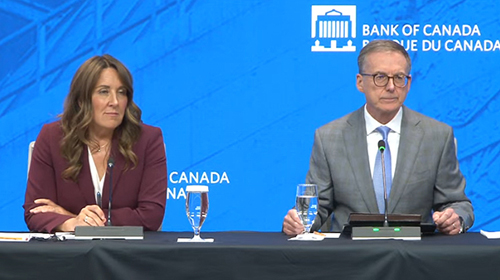
The uncertainty imposed by tariff threats has meanwhile disrupted the Canadian economy in various ways. In that climate, the central bank has kept interest rates unchanged at 2.75%… evidence of a ‘wait and see’ stance.
Global context helps Canada stand apart:
This is happening in a broader global context. This week, the European Union (EU) appeared to acquiesce to a 15% across-the-board tariff on most EU exports to the United States (along with a commitment by Europe to invest $600 billion US in the American economy and spend $750 billion on US energy products).

And Japan has made a similar deal — 15% across-the-board tariffs and a Japanese commitment to invest $550 billion in the US.
And today, Mexico gets a 90-day extension to avoid 35% tariffs on non-CUSMA items. Mexico will continue to pay a 25% fentanyl tariff, 25% tariff on cars, and 50% tariff on steel, aluminum, and copper.
This helps push the timeline closer to a legislated CUSMA review, of benefit to Canada and Mexico.

But also, Trump is also buying himself more time — he is probably trying to psychologically play Mexico against Canada. Canada also falls into disrepute with Trump over fentanyl, vehicles, steel, aluminum and other products that the US buys in large quantity from Canada.
This may be one of Trump’s first obvious misjudgements about Canada. Carney and Mexican president Claudia Sheinbaum have had a few ‘productive’ discussions; Canada and Mexico have more to gain by banding together than working separately with the USA on the fringes of CUSMA.

Canadian situation is unique:
Those sorts of deals with larger economic powers don’t seem to help the Canadian cause in standing up to Trump. But Canada’s situation is unique. Our country has a highly integrated import/export and manufacturing sector (including the all important export of oil and electricity from Canada to the United States). The US has more to lose by treating Canada badly.
The current scenario might just be of benefit to Canada in maintaining this country’s distinct stance to determine a deal that works best for Canada. Presently the political direction on that is to create ‘one Canadian economy’ instead of the long-standing reality that Canada’s economy operated with 13 distinct regions (governed by provinces and territories).
If Carney continues to take the long-view on this goal, things might be rough for a few years (or a decade) but we’ll get there. As the prime minister at this pivotal time, Carney will go down in history as being the captain of the ship as Canada turned direction amidst the big waves of economic change.

Short term advantage:
If Trump decides not to impose the 35% across-the-board tariffs on Canada tomorrow it’s probably a good thing in the short term. It opens up more time for negotiation and for Trump to see that Canada will stand on its own feet economically.
Canadians are possibly now beginning to have a clearer idea of how hard this is going to be. As the trade war continues (or deepens) not only will the price of many things go up but many products may no longer be available.

Heading into the new economy:
The good news is that Canada has — by Trump’s desire to rule the global economy — been given a good boot toward building our own made-in-Canada economy. That could take many years, but this is the time and place to start.
The new economy will first see a shift in the types of jobs people do and some big projects ‘of national interest’ come into actionable development. The new economy will offer strong opportunities for First Nations.
The new economy will also be embracing artificial intelligence (AI) which has obvious impacts for business as well as governance and education.
===== RELATED:
- Canada to recognize the State of Palestine at United Nations in September 2025 (July 30, 2025)
- Bank of Canada holds key interest rate at 2.75% as US tariff deadline looms (July 30, 2025)
- Carney and Sheinbaum discuss economic cooperation (July 15, 2025)
- NEWS SECTIONS: CANADA-USA | CANADA-NATIONAL | EDITORIALS | TARIFFS & TRADE