


Sunday April 26, 2026 | VICTORIA, BC
by Mary P Brooke | Island Social Trends
Forestry continues to be a challenged sector in British Columbia.
For too long the sheer muscle of cutting timber and shipping it to mills outside of this province or further to out-of-country destinations for value-added treatment has been the way of forestry in BC.
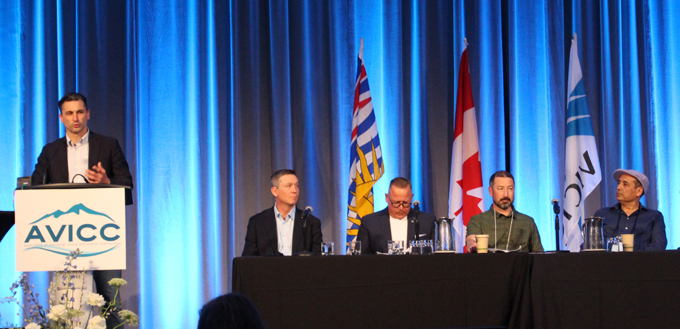
and Dr Younes Alila. [Mary P Brooke / Island Social Trends]
A panel of forestry sector representatives tackled what is likely only the surface of a multi-faceted problem. They looked at how to protect forests for all the right ecological reasons (including impacts on human livability, such as flooding and reducing carbon capture) while still maintaining or even strengthening the wood-production sector for the benefit of jobs and the economy.
The panel was asked to assess and explore the economic, social and environmental realities of the forestry sector with a ocus on communities, climate resilience, wildfire mitiation and long-term community impacts.
The 90-minute panel and discussion was attended by an audience of about 60 municipal leaders including Nanaimo Mayor Leonard Krog and Paul Manly who was elected as a Nanaimo City councillor in 2022 (he was a Green MP 2019-2021) who asked two questions at the microphone. BC Hydro Vancouver Island community relations rep Ted Olynyk also attended.
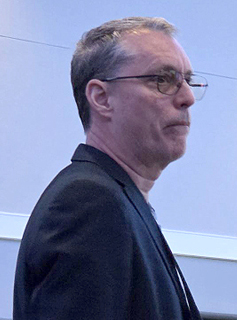
Introduction by North Cowichan Mayor:
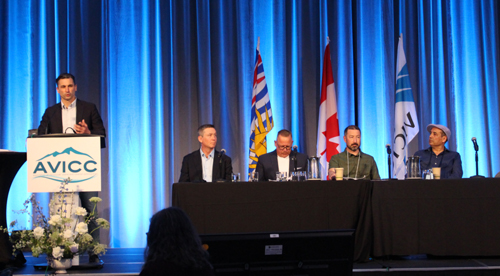
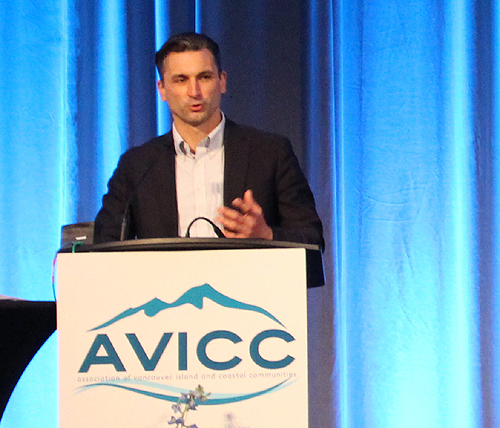
In Victoria on Saturday April 25, the panel called The Future of Forestry on Vancouver Island and Coastal BC at the annual convention of the Asociation of Vancouver Island and Coastal Communities (AVICC) , was chaired by North Cowichan Mayor Rob Douglas.
In context: vast forests attracted settlers and businesses which led to the establishment of logging towns, mills and railways. Chemanius, Port Alberni and Campbell River were built around hte forest industry with mills and logging operations driving their growth through the 20th century, as outlined by Douglas in his introduction of the panel.
But the sector is shifting to modern times. Many forests have been depleted, there is a sense of responsibility about ecosystem balance as well as the removal of trees as a carbon sink, and economies both local and regional are being impacted negatively as the supply of trees and wood fibre is depleted.
Douglas said that there has been a steady decline in the forestry industry over the past few decades “particularly in coastal BC”. He tallied off the loss of 30 mills and a 40% decline in overall employment levels.

There has been an increase in automation and the decline of labour-intensive activities on the land base. There has been an increase in environmental regulations in recent years including old growth deferrals. Changes in the global market for wood products were mentioned as well as the US softwood lumber duties as that country tries to protect its own lumber industry.

Across most of BC the forested land is crown land. But on Vancouver Island the bulk of forest lands fall under private forest lands classification with Mosaic Forest Management being the primary landholder. The long history goes back to the latter part of the 19th century when the provincial dominion government decided to grant more than 800,000 hectares of forest land to coal baron Robert Dunsmuir (known as the E&N land grant).
“We’re still dealing with the repercussions of that day — that decision impacted about 20% of the total land base across Vancouver Island,” said Douglas.

Of course, Mayor Douglas mentioned the closure of two mill closures as the biggest employers in the Cowichan region which has had a significant impact on the municipality’s tax base (millions of dollars worth). About 500 working people in the community were impacted. Contractors, suppliers and small businesses are impacted as are families if they can’t pay their mortgages or other expenses which Douglas says can impact marriages and have mental health impacts include falling into the use of drugs.

Panelists:
The four panelists who over nearly 90 minutes addressed the audience of about 60 municipal leaders and answered questions, were:
- Klay Tindall, general manager, Lilwat Forestry Ventures and a First Nations Forestry Advisor at BC First Nations Forestry Council
- Geoff Dawe, former national president of the Public and Private Workers of Canada and formerly the Domtar Crofton pulp mills.
- Chris McGourlick, registered professional forester and operations manager with the Forest Enhancements Society of BC.
- Dr Younes Alila – Professor of Forest Hydrology and Watershed Management, Dept of Forestry Resources Management, Forestry Faculty, UBC
The panel did not have a representative of the BC Council of Forest Industries (COFI) or any provincial government forestry representatives.
The panelists heard some delegates express concern about what they consider to be a lack of effective action by the provincial minister of forests, as to moving the forestry sector forward.

What is the future?
The panelists delivered their views on various challenges:
- Will there be a steady decline of the forestry sector? Is there a way to pivot and learn from Scandinavian countries that have maintained employment despite having liquidated their old growth forests many years ago.
- How will climate change impact the future of this sector?
- How is a changing landscape going to change relations with Indigenous communities?

Sustainability going forward:
Overall, the panelists acknowledge and support the idea of sustainable forest practices, and expressed a desire for BC government to make more progress in that direction.
Broad clear-cutting is obviously a thing of the past. That’s both in terms of preserving a continued resource as well as working within a social contract of today’s society that expects responsible land management as part of a healthy planet.
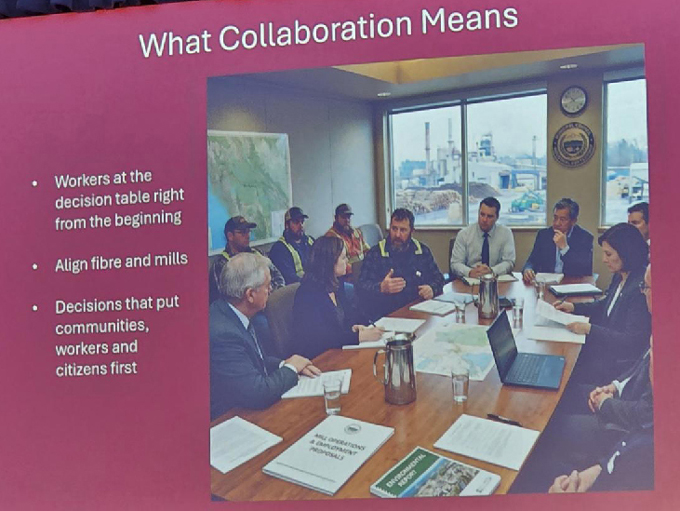
In the short term, responsible management of forested land should include reduction of fuel loads (e.g. trimming dead branches that would fall and easily be ignited in or exacerbate a wildfire situation).
In the medium term, there should be improved productivity of plants for food and medicines including berries and mushrooms. This is not only important for Indigenous cultural reasons but tends to keep bears and other forest animals within the forests instead of making their way into human settlements in search of food.
In the long term, the goal is for sustained local capacity including jobs. A blueprint for including cultural burns could be part of Indigenous reconciliation. Using scientific data to study the forests is part of the future of forestry as well.

Recommendations for making progress:
More than 50 new regulations in the past five years have been a challenge for the forestry sector, said Klay Tindall. He encourages the federal government to become more involved in shaping the forestry sector.
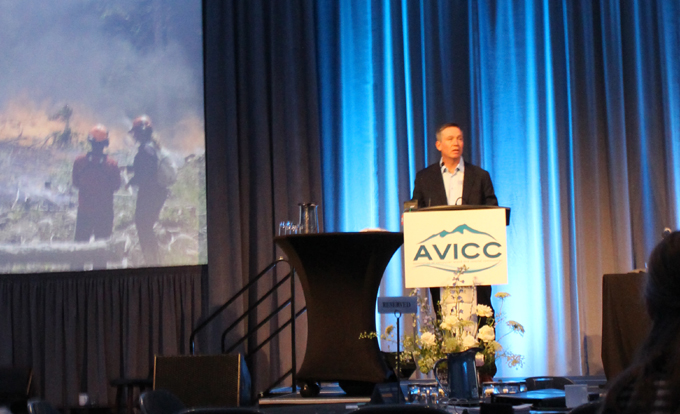
What Geoff Dawe calls an “unplanned unfair transition” of the forestry sector as a result of tariffs and rising costs, is the key challenge. He feels that climate change has also contribute to the availability of fibre supply. Climate resilience and work force resilience are both needed.
“Every log out is a job lost,” said Dawe in the AVICC panel. He feels that no raw logs should be exported from BC, but that all value-added work shoudl be done here before products are shipped.
Chris McGourlick said that investment in forestry is an investment for all British Columbians. He said that forest management needs to be more than harvesting. There is a need to build forest resilience as a better way to the adapt to the future. Forests should be able to “produce for us in perpetuity”, said McGourlick.
Just a few specifics mentioned by McGourlick included leaving large tree stubs for wildlife ecosystems, planting or restoring cedar (including for cultural values), and paying attention to other land needs like building pools to breed salmon and bring back bears.
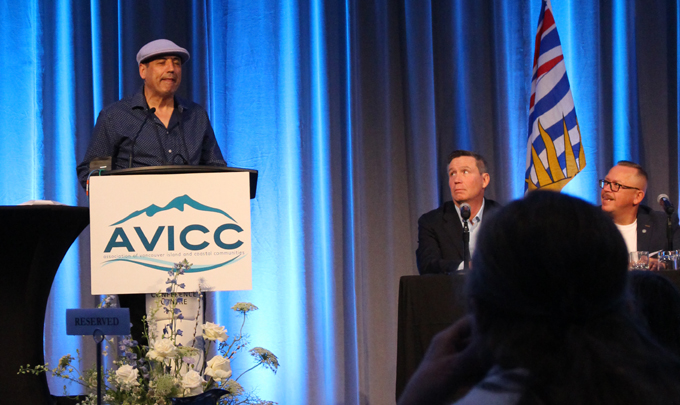
Dr Younes Alila emphasized how a reduction in forests leads to flooding problems — the root causes are ‘upland’ of the flooded area. In the 1980s and 1990s clear cutting were the cheapest way to get wood out of the forests. The pine beetle infestation of the 2000s reduced lumber supply. Floods are now more severe and occur over a longer duration.
Alila emphasized the need to focus on enhancing community watersheds (which includes maintaining forests) and adapting downstream agricultural practices as required.

===== RELATED:
NEWS SECTIONS: FORESTRY | ENVIRONMENT & SUSTAINABILITY | WEATHER IMPACTS | WILDFIRE MANAGEMENT | LIVING WITH CLIMATE CHANGE