



Wednesday September 24, 2025 | VICTORIA, BC [Posted 8:20 am | Updated 9:04 am]
by Mary P Brooke | Island Social Trends
A panel about restoring economic growth in BC was held on Tuesday afternoon during the Union of BC Municipalities (UBCM) convention in Victoria.
The context of “Modest Growth and Big Challenges: The Road Ahead for BC’s Economy” plenary session was that BC currently has a deficit of nearly $12 billion, which is expected to continue for another year or two amidst increasing debt and GDP that is falling.
There has been some credit downgrades recently, such that BC no longer has a triple-A credit rating with agencies which assign those ratings.
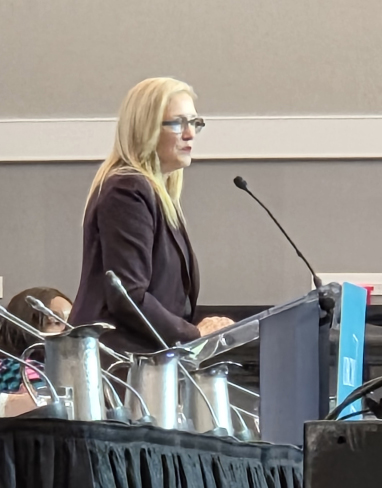
All the speakers at Tuesday’s plenary panel saw there is no quick way out of the structural financial situation, as stated in the UBCM summary to the delegates this morning.
However, BC’s finance minister says there are “two kinds of deficit”, and she promotes the one that BC is following right now, which is to use provincial funds to invest in building the foundations of a stable future economy.

Finance Minister Bailey:
The lead speaker on the panel was BC Finance Minister Brenda Bailey who reinforced the BC NDP government’s view that building a strong economy — especially where there is population growth and innovative industrious people in the workforce — that investment in long-term infrastructure is key.
That would include schools, hospitals and transportation infrastructure. Under the Eby government there is a standalone Infrastructure Ministry, led by Minister Bowinn Ma.

Bailey highlighted to delegates that two of the first five major projects selected by the federal government for economic nation-building are in BC (LNG Canada Phase 2 and the Red Chris Copper Mine). She feels this bodes well for the new restructured Canadian economy of which BC is anticipated to be the ‘economic engine’, as per Premier David Eby who has pitched to Ottawa about ‘looking west’ for economic prosperity as Canada aims to diversify away from reliance on the US economy.
Bailey says BC is ‘diligently partnering’ with the federal government, through the Major Projects Office.

BC’s economy is highly diversified, Bailey pointed out. She highlighted the bio/life sciences as a growing area of the BC economy and noted how US scientists are coming to Vancouver to work in this field. New economic areas like this will “unlock more value in our economy”.
In facing some challenge about the $11.6 billion deficit that Bailey unveiled in the First Quarterly Report last week, Bailey told the UBCM delegates that “there is more than one kind of deficit”. BC’s current deficit reflects investments in people including infrastructure development that will serve more steadily and reliably the growing and future population.

Four panelists:
The Tuesday afternoon panel held at the Victoria Conference Centre featured:
- Brenda Bailey, BC Finance Minister
- Warren Lovely, Managing Director Economics and Strategy, National Bank of Canada
- David Williams, VP of Policy, Business Council of BC
- Tamara Vrooman, President and CEO, Vancouver International Airport

In the numbers:
The two economic speakers delivered their thoughts to the delegates.
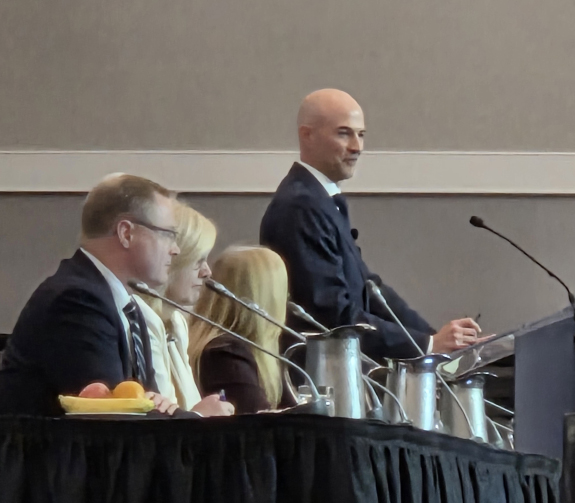
In his economic analysis, Warren Lovely of the National Bank highlighted the $11.6 billion BC provincial deficit.
He suggested that BC drop their 5% PST as a way to help spur economic activity. However, the Province does rely on that provincial sales tax income to help maintain revenues. He insisted that a ‘good crisis not be wasted’ in terms of using the current sense of economic urgency to create a new BC economy. He encouraged investment in government bonds.
Lovely said the BC government back to back surpluses of 2022 and 2023 was a “never to be repeated phenomenon” that resulted from the rebound following the COVID pandemic. He noted that interest rates moved up in that time period which came long with the Bank of Canada cooling the economy “by design”.

David Williams of the Business Council of BC noted that increased economic productivity leads to increased living standards. He urges BC businesses to innovate, export and operate at scale. He feels that includes looking at provincial policies and taxes, while noting that provinces (unlike municipalities) are allowed to run budget deficits.
Williams said about fast population growth and extended public spending that “neither is sustainable”. He noted a 35% increase in public sector job growth compared to a five percent increase in private sector growth.
“We are not controlling spending the way we should,” said Williams.
He said it’s important to create a province where businesses can afford to employ people.
Airport perspective:
In her remarks, YVR President Tamara Vrooman says the BC economy needs to “train, develop, innovate and invest” and that British Columbia should not underestimate how many people look to BC as a leader.
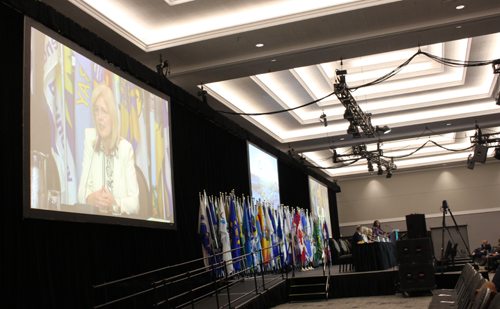
She highlighted how the Vancouver International Airport handles billions of dollars of cargo port trade each year. She implied that people feel more certainty with a landing point in Canada as she sees Vancouver being the point of choice compared to the United States.
She encourages BC to use its “natural advantage” and that the provincial government “has a big leadership role to play” in guiding the new economy.

UBCM convention:
About 400 delegates attended the feature event during the five-day UBCM convention.
About 2,000 delegates from about 1,200 local governments (elected and staff) are attending the convention overall, seemingly with a keen interest in those one-on-one scheduled meetings with cabinet ministers (of which there are hundreds of meetings).

Premier Eby will address delegates on Friday.
Federal housing minister Gregor Robertson will also address delegates on Friday.
===== RELATED:
- Housing as human right gains momentum at UBCM 2025 (September 23, 2025)
- A tale of two libraries: for books, for community (September 23, 2025)
- BC urban mayors want more provincial funding to address housing gaps and homelessness (September 22, 2025)
- BC municipal leaders gather for 2025 UBCM convention Sept 22 to 26 in Victoria (September 21, 2025)
- Carney announces five major projects to fast-track Canada’s economic transition (September 11, 2025)
- NEWS SECTIONS: HOUSING | UBCM