



Saturday June 6, 2026 | OTTAWA, ON [Posted in VICTORIA, BC – 11 am PT]
by Mary P Brooke | Island Social Trends
Bill C-263, The Silver Alert National Framework Act, passed second reading in the House of Commons yesterday, June 5.
The private members’ bill will now be referred to committee for further study.
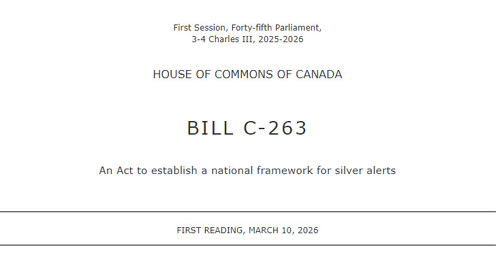
Introduced by Conservative MP Raquel Dancho (Kildonan—St. Paul) on March 10, 2026 (with second reading on May 6, 2026), Bill C-263 seeks to establish a coordinated national framework for Silver Alerts to help quickly locate vulnerable seniors who go missing, particularly those living with dementia or other cognitive impairments.

Bill C-263 proposes a national framework to coordinate “silver alerts” for missing seniors living with dementia. The bill aims to establish standardized protocols across provinces and territories to utilize existing emergency alert technology to locate vulnerable seniors quickly.
An aging population is a major demographic trend in Canada and across the industrialized world and advancing age is considered to be a strong risk factor for dementia — a condition which includes lapses in memory or other cognitive functions.
By 2030, nearly one million Canadians are expected to be living with dementia, creating a growing public safety challenge when vulnerable seniors go missing. Rapid public awareness can be one of the most important factors in locating someone safely.

Over 63% of seniors in long-term care in BC have some form of dementia — an indication of how cognitive function relates to a need for supportive care.
“This is a topic that transcends party lines, and it is no exaggeration to say that dementia impacts every community across Canada,” said Ginette Lavack, Parliamentary Secretary to the Minister of Indigenous Services, yesterday in the House.

Positive for families:
“Today’s vote is an important step forward for vulnerable seniors, their families, and communities across Canada,” said Dancho. “When a senior living with dementia goes missing, every minute matters. Bill C-263 is about ensuring that Canadians can be alerted quickly and responsibly so more people know how to help and more families have a better chance of bringing their loved ones home safely.”
Bill C-263 was inspired by the tragic disappearance of Earl Moberg, a Winnipeg senior living with dementia who went missing in December 2023 and was never found. Following his disappearance, the Moberg family led a national petition, sponsored by Dancho, calling for a Silver Alert system in Canada.

The petition received more than 7,300 signatures from Canadians across the country.
“For our family, this has always been about making sure others do not have to go through what we went through, and what we continue to live with every day because my dad was never found,” said Britt Moberg, daughter of Earl Moberg. “When someone living with dementia goes missing, minutes and hours can make all the difference. A Silver Alert would empower people in the community to help.”

Technology:
Canada already has the technological capacity to issue rapid, geotargeted emergency alerts through the National Public Alerting System, which distributes alerts to mobile devices, television, and radio.
The Conservatives feel that Bill C-263 would help ensure that the existing infrastructure can be used more consistently and effectively when vulnerable adults go missing, while respecting provincial jurisdiction over policing and emergency management.
“The tools already exist. What has been missing is coordination,” Dancho added. “I am grateful to the Moberg family for their courage and tireless advocacy. Because of their leadership, this bill is now one step closer to helping protect vulnerable seniors across Canada.”
The bill will now proceed to committee, where parliamentarians will have the opportunity to hear from experts, families, law enforcement, and other stakeholders on how a national Silver Alert framework can be implemented effectively.

Opposition and concerns:
The Bloc Quebecois said there is already existing provincial leadership in this area. The Bloc highlighted that Quebec already has a successful silver alert system and cautions that a federal framework could add unnecessary red tape to a functioning regional process. The Bloc says it will be voting against the Bill.
The Liberals expressed concerns about privacy and system effectiveness, The party highlights the importance of protecting the privacy and dignity of seniors while balancing public safety. They also aim to prevent alert fatigue through precise geo-targeting and careful coordination with local authorities.
“We must therefore ensure that alerts are only issued when necessary, in order to maintain the public’s high level of responsiveness in the event of an emergency. Clear thresholds must first be established and would have to be met before such alerts are issued,” said Liberal Parliamentary Secretary Lavack.

===== RELATED:
- Most Canadians hope to age in place (March 12, 2026)
- Rethink and embrace aging says new BC Seniors Advocate (January 26, 2024)
- Majority of seniors in long-term care have dementia, says Dix (March 22, 2023)
- People with Alzheimer’s experience more isolation & uncertainty during COVID (September 13, 2021)
- NEWS SECTIONS: SENIORS | 45th PARLIAMENT of CANADA