



Tuesday July 22, 2025 | HUNTSVILLE, ON [Reporting from VICTORIA, BC] [Posted at 3:45 pm PT | Updated 3:58 pm]
by Mary P Brooke | Island Social Trends
The premiers of Canada’s 10 provinces and three territories are gathered in Ontario’s cottage country for a summer meeting to discuss a range of topics to bolster Canada’s economy and protect this country’s sovereignty and resources.
Ontario Premier Doug Ford chairs the Council of the Federation (Canada’s Premiers). He was joined by Quebec Premier François Legault for a press conference after today’s meetings.
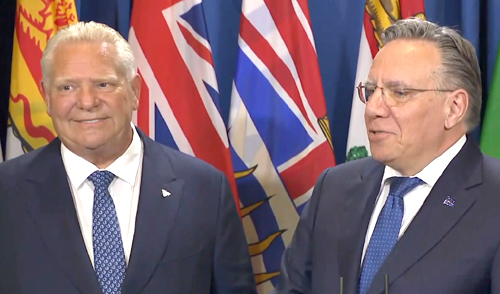
The Premiers issued a statement today (see below) that has three major sections:
- Emergency Management and Wildfires – importance of collaboration and resource sharing among governments
- Building Canada – advancing projects of national interest that will unleash the full potential of Canada’s economy, including Arctic defence and sovereignty.
- US Relations and International Trade – a Team Canada approach to develop a new economic and security relationship with the U.S.
The premiers also met with Premier Mark Carney today, who also delivered remarks.

Moving things faster:
Ford outlined today that he wants to see projects get moving with as little impediment as possible from government regulations. This aligns with the Prime Minister’s mission to create ‘one strong Canada’ which includes removing inter-provincial trade barriers.
Ford says other countries are interested in the resources Canada has to offer including critical minerals, energy and small nodular nuclear reactors. “We want to invest here in Canada but we can’t be waiting around with all the regulatory burden on our backs”.

Advice that was by premiers today from two economic advisors — David MacNaughton (former Canadian Ambassador to the United States, 2016-2019) and Gary Doer (former Canadian Ambassador to the United States, 2009-2016) — was “the same advice as I’ve heard prior from them”, essentially to be protectionist but that free trade boosts the economy and GDP”, said Ford in a response to media today.
“Creating the environment and conditions for companies to come here and invest,” is what’s important to Ford. He said 409 companies invested in Ontario last year for a total of $39.78 billion and creating 25,000 jobs.

“They look at us as a safe haven to invest their billions and billions of dollars,” said Ford about foreign investors who come to Canada to invest.
Endless decades of regulations and bureaucracy are the biggest impediment, Ford said today. He added that Carney is “playing cleanup (after 10 years) and we’re there to support him”.

Ontario and Quebec are key, and BC too:
“When Quebec and Ontario prosper the whole country prospers,” said Ontario Premier Ford today.
This might generally irk BC Premier Eby who many times in recent months has pitched the BC is the new ‘economic engine’ of Canada. That stance is mostly based on the strength of ports for shipping to and receiving from Asian-Pacific countries as well as critical minerals and clean electric energy.
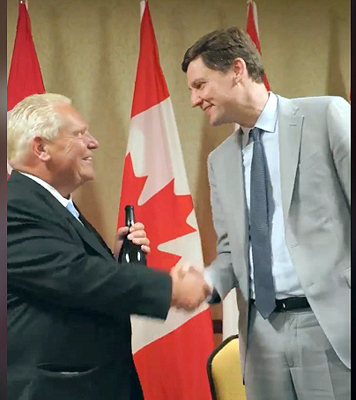
But today British Columbia reached a trade agreement with Ontario, said Eby. “This will make it easier for people to work in both provinces, provide producers easier access to markets, while giving consumers more choice.”
Eby also posted in social media today: “Thank you Premier Doug Ford for your leadership as chair for the council. We’re ready for your visit anytime.”

===== RELATED:
NEWS SECTIONS: CANADA-NATIONAL | CANADA-USA

Premiers discuss building a stronger and more secure Canada
Statement by Canada’s Premiers – July 22, 2025
Canada’s Premiers are working together to defend and promote Canadian interests. This includes bolstering national security, defending Arctic sovereignty, supporting trade diversification, responding to tariffs, advancing projects of national interest, developing economic corridors, and enhancing energy security.
Emergency Management and Wildfires
This year’s wildfires across Canada are top of mind for Premiers who expressed concerns for everyone impacted. Premiers highlighted the importance of collaboration and resource sharing among governments to prepare for the growing frequency and impact of these fires, including the need for enhanced planning, preparedness, mitigation, and recovery support for different types of emergency events.
Premiers emphasized the need for adequate and flexible federal funding to support provincial and territorial community planning, preparedness, adaptation, and mitigation in response to and recovery from climate change impacts. Premiers noted the proposal by Canada’s fire chiefs to establish a national fire administration and have tasked provincial and territorial ministers responsible for emergency management to consider the proposal.

Building Canada
Premiers are taking action to build a stronger and more secure Canada by advancing projects of national interest that will unleash the full potential of Canada’s economy
It is critical to Canada’s economy that major projects are built quickly and responsibly. Premiers welcomed the Prime Minister’s commitment to ensuring all federal assessment decisions are rendered within two years and insist the “one project, one review” process must eliminate overlap and duplication and defer to provincial and territorial jurisdictions and processes. Federal project approval processes must also address ongoing issues including with the federal Impact Assessment Act, the Coasting Trade Act, the Canadian Nuclear Safety Commission hearings, and the Department of Fisheries and Oceans. They also agreed that major projects must be done in consultation with Indigenous peoples with opportunities for equity partnerships and benefit all provincial and territorial economies.

While prioritizing major projects, the federal government must also work with provinces and territories to provide a new specific envelope of predictable, adequate, and flexible federal infrastructure funding that can address unique provincial and territorial infrastructure pressures. Expanded funding is also needed for housing and housing-enabling infrastructure. Premiers call on the federal government to commit to early engagement with provinces and territories on future infrastructure and housing programs.
Premiers are dedicated to working alongside the Prime Minister in positioning Canada as a global energy superpower. Provinces and territories are able to meet growing domestic and international demand with energy, critical minerals, and other resources that are responsibly produced to high sustainability and ethical standards. Canada’s energy landscape is diverse and includes oil and gas, liquified natural gas, uranium, renewable electricity, and hydroelectricity, as well as emerging opportunities such as onshore and offshore wind power, hydrogen, biofuels, small modular and large-scale nuclear reactors, and critical minerals. Developing pipelines and corridors that can get energy, oil and gas, electricity, critical minerals and other products to market within the country and to ports connected to tidewater, including to key Asian and European markets, will strengthen energy security and drive economic growth. This must be done while ensuring impacted provinces and territories experience direct economic and social benefits from these projects to the satisfaction of the province or territory concerned.
This is also an opportunity for Canada to further strengthen sustainable Arctic defence and sovereignty, coordinated with provincial and territorial governments and Indigenous partners, that will address the acknowledged infrastructure gap in the North. Premiers are united that federal actions related to Arctic security and sovereignty must be done with northerners and Indigenous peoples and directly benefit the communities in which they live. Premiers continue to emphasize the benefit and importance of dual-use infrastructure in this area. Investments made in Arctic sovereignty are investments made for the security of all Canadians.
Premiers commended the Prime Minister on joining the new NATO Defence Investment Pledge of 5 per cent of GDP to broaden defense and security related spending and the commitment to achieve 2 per cent of GDP for core defence spending by the end of this year. This is a critical opportunity to invest in Canada’s industrial base, natural resources, and dual-use infrastructure. Premiers identified federal investment opportunities that will create new and good-paying jobs across the country and contribute to a made-in-Canada defence industry.

U.S. Relations and International Trade
Premiers support a Team Canada approach to develop a new economic and security relationship with the U.S. They continue to call for the removal of the unjustified and unpredictable tariffs imposed by the U.S. government, including longstanding softwood lumber duties, auto tariffs and levies on Canadian steel and aluminum. Premiers stressed the importance of a strong economic partnership underscored by the mutual benefits of free trade between Canada and the U.S.
Premiers also call on the federal government to prioritize work towards the removal of Chinese tariffs on Canadian canola, peas, pork, and seafood and emphasized the critical importance of regular and ongoing engagement with China to improve the overall trade relationship.
In order to ensure no region of the country is disproportionately impacted by federal responses to U.S. tariffs and that impacted workers and businesses receive appropriate and immediate federal supports, Premiers call on the federal government to engage meaningfully and work with provinces and territories in designing federal supports. This includes ensuring federal duties that have been or will be collected are distributed to workers and industries affected by ongoing or new trade disputes.
Premiers remain committed to taking action within their jurisdictions and working alongside the federal government to support advocacy with U.S. leaders and officials. Premiers call on the federal government to fully partner with provinces and territories in the upcoming CUSMA review and economic and security negotiations, as well as on future engagement opportunities with the U.S.
To ensure Canada’s economic resilience, Premiers are taking action to diversify Canada’s economy and expand and broaden trading relationships. Premiers discussed opportunities to expand trade, including in the Indo-Pacific region, the United Kingdom, and the European Union. The federal government must ensure provinces and territories are meaningfully engaged so that their interests and priorities, including provincial-territorial jurisdiction over natural resources, protecting cultural distinctiveness, and safekeeping supply management in the agricultural sector, are fully represented in current and future trade negotiations.