


Thursday February 26, 2026 | TORONTO, ON [Posted at 2:01 pm PT]
Political reporting by Mary P Brooke | Island Social Trends
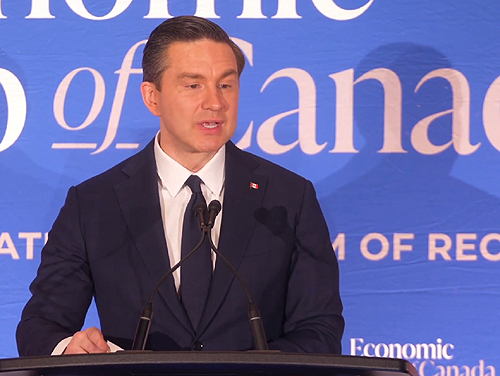
Conservative Leader Pierre Poilievre today addressed an audience of about 300 people at the Economic Club of Canada in Toronto.
Key takeaways for political observers are that Poilievre was more direct and perhaps more fluent about what the Conservatives would do about protecting Canada’s sovereignty and building Canada’s economy– both the same as now as well as differently to what the Liberals are doing.
He seemed relaxed in front of a business audience of the Economic Club of Canada in a way that gave casual nation-wide viewers a better sense of how he explores broad issues and thinks on his feet.
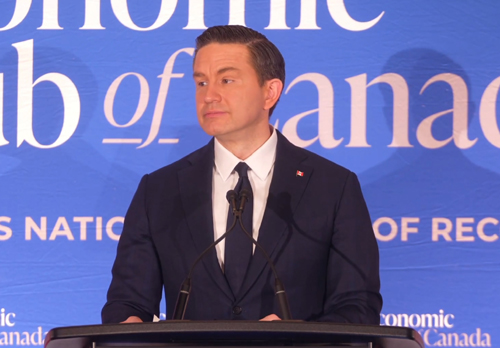
He quoted or highlighted the work a lot of political influencers through the course of his speech, including an Emperor from ancient Rome to US president Abraham Lincoln and at least two former Canadian prime ministers — Pierre Elliott Trudeau (Liberal) and Stephan Harper (Conservative). He added a little ‘jazz’ to the weight today’s topics by referencing MacGyver (a fictional TV series 1985-1992 in which the lead character prefers non-lethal resolutions over conflicts).
He elicited applause from the audience at least five times, on emphatic statements like “there is zero chance of Canada ever being part of the United States” and “Canada’s destiny will be built by Canadians here at home”.

Poilievere was blunt about what he sees as Canada’s errors over time with regard to the economy, but also Trump’s mistakes: “Some of this transition was overdue (within Canada) but (the US President) missed the target by going after Canada”.
“And let’s be clear about another thing: the President’s talk of 51st statehood, whether it is a joke or not, is unacceptable,” Poilievre declared today.
Overall this was a more statesmanlike speech than what Canadians may be used to hearing in short clips from back-and-forth in the House of Commons. He pointed out where he agreed with Liberal Prime Minister Mark Carney and proposed a joint committee where all the parties might contribute to economic strategy for the country. He did not take direct swipes against the three Conservative MPS (d’Entremont, Ma, and Jeneroux) who in the last four months have departed over to the Liberals.

Some of the trademark Poilievre rhythmic wording was there today, such as rhetorically asking if Canada wants to be “solid or fragile, dependent or self-reliant, drift or build”. He motivated in saying that Canada as a country is “unbreakable”.
As Leader of the Official Opposition Poilievere outlined the importance of that role: “We will work together where we can. We will oppose where we must. Because Loyal Opposition is not just our job title, it is in our national interest.”
Some statements stand well as excerpts for future campaigns: “Sovereignty is not declared; it is built – decisively, deliberately, and without excuses…. by a country that stands on its own feet; that is master in its own home; that bows before no nation; a country that is unbreakable.”

Timing:
This speech is at the start of a reset of Pollievre’s trajectory with the Canadian public, with the January review of his leadership by the Conservative membership now behind him.
He as the Conservative Leader and the Conservative Party itself are presently behind the Liberals in various national opinion polls.

BNA & post-WWII:
Poilievre mused that Canada was born by insight for national self determination, that the founding British North America Act (with 147 clauses) had ” no grand deals or big distractions but was, rather, an “instruction manual” of responsibilities that he described as a “who-does-what document”.
The BNA Act at the time of inception, it should be noted, involved only four provinces within a relatively easily-transversed geographical area (Ontario, Quebec, Nova Scotia and New Brunswick) but allowed for addition of new colonies; later on adding a railway to the Pacific Coast was a whole other level of endeavour.
Post-World War II has been a period of complacency, Poilievre points out. He says that contributed to under-investment in military and allowed for a growth in bureaucracy.
“We made ourselves unnecessarily dependent,” he says about Canada’s relationship to the United States in particular.

Critical minerals are key:
Poilievre drilled somewhat on the need for commercialization of technologies and protecting Canada’s fortuitous natural supply of critical minerals and using that for leverage against the United States — not to cause strife but to continue doing business with the most robust economy on Earth.
Prime Minister Carney has — from the start of his ‘new government’ in May 2025 — clearly identified the need to a focus on critical minerals. Virtually everyone of the Major National Projects is about resourcing, supporting or transporting critical minerals and other energy-sector resources.

Fireside chat:
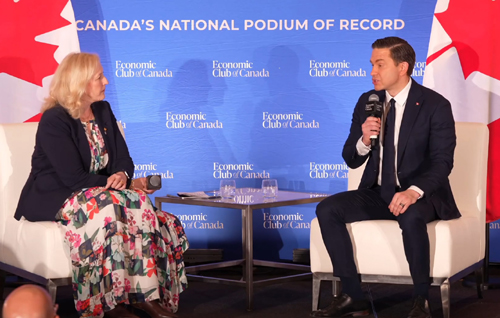
Following his formal speech, Poilievre spent about 20 minutes in a fireside chat (Q&A) led by former Conservative cabinet minister Lisa Raitt who now works for one of Canada’s major banks.
Questions came from the audience through a digital app. Replies from Poilievre included:
- Repeal Bill 69 — the ban on shipping oil off west coast of BC. He said 700 projects are waiting for federal approval (noting 10 or 15 have been forwarding to the Major Projects Office).
- Remove regulations for all those projects so we can get everything built.
- CUSMA talks: Build new leverage (against the United States) that we can use to get those tariffs knocked down. “We have to have unbreakable leverage going into these (CUSMA) talks. Canada must build unbreakable leverage… It’s all about leverage.” The goal for the CUSMA talks should be “tarfff-free access to the most lucrative market in the world”.
- A strategy around the auto sector, is to say to the Americans: “We will keep Chinese automobiles out (of Canada) if you let American autos in (to Canada).” [Recently Canada made a deal with China to allow up to 49,000 Chinese-made electric vehicles into Canada.]
- The younger generation can have hope if there is the opportunity for them to have homes and jobs, and raise families.
- Reduce taxes, delays and red tape. Have DCCs (development cost charges) just enough for pipes, parks and other infrastructure. [DCCs contribute to the finalcost of housing.]
- Get rid of the Temporary Foreign Worker (TPW) program other than for agriculture. That will provide more job opportunities for young working Canadians, says Poilievre, though it would be fair to say that many young Canadians may at first find those jobs not in their first line of desired opportunity.
- “Canada’s relationship with the United States is centuries old. It will survive centuries later. Canada must maintain focus on this country’s interests for the long term.” He would like to see all three levels of government (federal, provincial and municipal) work at Canada being “the fastest place in the world to get a permit”.

===== RELATED:
- Dropping EV mandate & funding more charging stations to boost EV sales (February 5, 2026)
- Carney supports Alberta’s interest for a pipeline through northern BC (November 23, 2025)
- Eby pleased with more national major projects in BC (November 14, 2025)
- Carney’s second set of nation-building major projects (November 14, 2025)
- Carney announces five major projects to fast-track Canada’s economic transition (September 11, 2025)
- NEWS SECTIONS: CONSERVATIVE PARTY OF CANADA | 45th PARLIAMENT of CANADA | CANADA-USA | BUSINESS & ECONOMY