


Sunday August 30, 2026 | WASHINGTON, DC [Posted at 11:43 am PT]
by Mary P Brooke | Island Social Trends
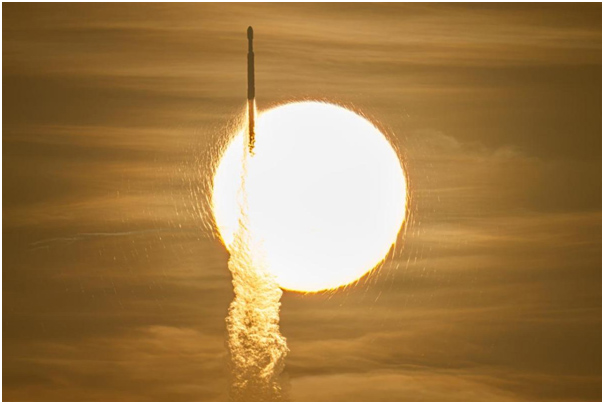
The Nancy Grace Roman Space Telescope launched today, as scheduled, from the agency’s Kennedy Space Center in Florida this Sunday August 30.
The overall mission is launching nine months ahead of schedule. “Delivered ahead of schedule and on budget, this mission reflects more than a decade of dedication from the NASA workforce and our industry partners. Now, Roman will give us a new atlas of the universe, push the boundaries of discovery, and demonstrate what is possible when America’s space program pairs bold ambition with disciplined execution,” said NASA Administrator Jared Isaacman.
The mission launched at 7:26 a.m. EDT Sunday aboard a SpaceX Falcon Heavy rocket from Launch Complex 39A at the agency’s Kennedy Space Center in Florida.
The Falcon Heavy rocket performed as expected, says NASA — separating from the observatory 31 minutes into the flight. After separating from the center core, the rocket’s boosters safely returned to the launch site for refurbishment.
The Roman Space Telescope will offer a field of view at least 100 times larger than the Hubble Space Telescope’s, resulting in deep, sweeping explorations of the cosmos.

Three months to final orbit:
Now on a three-month, million-mile journey to its final orbit, NASA’s Nancy Grace Roman Space Telescope will soon reveal further information about the universe in greater detail than has been possible so far.
The ground control team at NASA’s Goddard Space Flight Center in Greenbelt, Maryland began receiving telemetry data from Roman seven minutes after launch, says NASA in their news release today.
The Roman team also confirmed successful deployment of the observatory’s solar panels and lower instrument sun shade an hour and 23 minutes after launch.
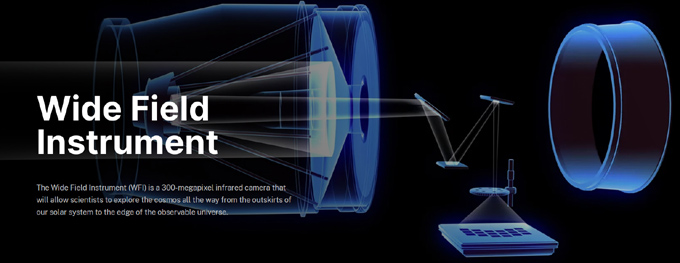
A few weeks into Roman’s voyage, its primary instrument — the Wide Field Instrument — will activate. This 300-megapixel infrared camera has 18 4K detectors, each about the size of a saltine cracker. These detectors collect photons of light that will be decoded into crisp cosmic panoramas.
Images to come:
Throughout Roman’s three-month commissioning period, scientists will run the instruments through a series of calibrations and tests. NASA anticipates releasing Roman’s first images by early 2027.
Roman will send back 1.4 terabytes of data every day, the highest data rate of any NASA astrophysics mission, so far. Machine learning, artificial intelligence, and citizen scientists will help sift through it and flag significant findings, which astronomers can then study.

Technology:
Roman pairs a large field of view with crisp infrared vision to explore vast swaths of the sky and probe deeply into cosmic history.
This flagship mission will help astronomers explore dark matter, dark energy, and worlds outside of our solar system, known as exoplanets. Its surveys will support a broad range of research extending far beyond the mission’s main science goals.

Panoramic view:
Named after NASA’s first chief astronomer, the Nancy Grace Roman Space Telescope will have a deep, panoramic view of the cosmos, generating never-before-seen pictures that will revolutionize our understanding of the universe, said NASA in a statement today.
“The observatory will usher in a new era of cosmic surveys, unveiling troves of celestial objects and shedding light on some of the universe’s most profound mysteries, including phenomena we can’t see,” says NASA.
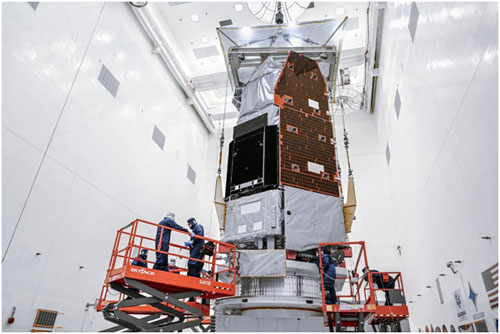
“Roman also will showcase cutting-edge technology, including a test of the most advanced technology ever flown in space to directly image planets around nearby stars, a key step in NASA’s search for life on other worlds,” says NASA.
Managed in southern California:
The Roman telescope is managed at NASA Goddard with participation by the agency’s Jet Propulsion Laboratory in Southern California; Caltech/IPAC in Pasadena, California; the Space Telescope Science Institute in Baltimore; and a team of scientists from various research institutions. The primary industrial partners are BAE Systems Inc., L3Harris Technologies, and Teledyne Scientific & Imaging.

International contributions:
Contributions to Roman also are made by ESA (European Space Agency), JAXA (Japan Aerospace Exploration Agency), the French space agency CNES (Centre National d’Études Spatiales), and the Max Planck Institute for Astronomy in Germany.
===== RELATED:
- NASA to launch Nancy Grace Roman Space Telescope on Aug 30 (July 21, 2026)
- NEWS SECTIONS: AEROSPACE | ARTIFICIAL INTELLIGENCE | NASA