


Wednesday March 25, 2026 | LANGFORD, BC [Posted at 12:45 pm | Updated 1:13 pm]
Local news analysis by Mary P Brooke | Island Social Trends
City of Langford council is a good along with their annual process of developing the City’s 2026 budget (and five-year financial plan) for operations and growth of the municipality.
Budget deliberations are never easy. They are arguably one of the most complex and consequential aspects of what elected officials deal with on behalf of their residents and as the leaders who are responsible for City management.
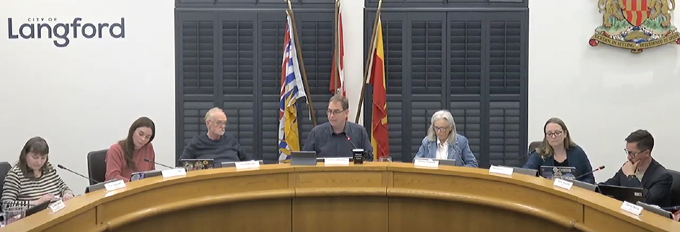
Additionally, 2026 is an election year in the four-year municipal election cycle. That makes the budget development challenge even more complex with the interplay of political nuance as most if not all members of council prepare for re-election and hope to continue developing the longer-term projects that they’ve started.
Budgets for all municipalities across the Greater Victoria region will be dealing with some form of property tax increase this year — even if a tax level increase is kept at zero that usually means defacto limits or even reductions to some areas of expense and operation (given the impact of inflation). Generally speaking, some level of annual tax increase should be expected by residents and businesses just to keep things on an even keel.
Any municipality’s council through their budget decisions will be impacting the pocketbooks and livability aspects of residents and households (including renters whose landlords pass on tax increases perhaps even with an additional cushion), businesses small and large, and the overall sense of livability in a community (depending on what services are maintained, boosted or cut).
Budgets are not just for one year, but take a five-year outlook for maintenance, growth and development.

Budget deliberation process:
There are many ways to deliberate a budget and much of it starts with politics. A council could, for example, decide not to increase taxes at all. That sounds good on the surface but for operations and livability as well as planning and growth that would essentially translate into cuts to services and possibly also staffing.
There are ongoing debt considerations to consider and the interest compiling on that (as well as what else doesn’t get funded while debt is being serviced).
There is the regional comparison of what one municipality is doing with tax increases versus another. As tax increases are usually expressed as percentages — and as each municipality has varying population sizes and budgetary obligations — a percentage comparison among municipalities results in an apples-and-oranges (asymmetrical if not skewed) comparison which is superficial at best.
Meanwhile, the complexity of moving a City forward continues. Actions are taken to continue boosting municipal livability and revenues through various tourism and economic development strategies and engagements.

Langford’s process:
Budget process might sound like dry accounting stuff but it matters. In Langford a surprising interruption to process came up at Monday night’s Committee of the Whole (CoW) meeting.
Each year council’s baseline starting point is to hear a report from the Director of Finance on where things currently stand and what level of tax increase (percentage) is needed to maintain the stated current goals of Council and all programs and services currently in place.
Then deliberations by council begin, taking several months to produce a final decision after hearing as much input as possible from staff and their departments, the public (through various levels and type of input), and relevant consultants or their reports.
Four levels to consider:
For their Budget 2026 deliberations, back in December Langford Council came up with a new framework to identify four possible percentage-levels by which they would deliberate on areas of tax level or cuts.
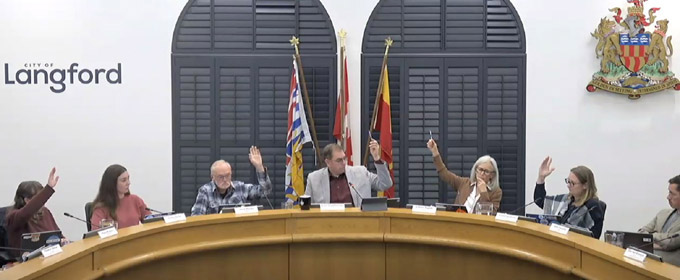
Council at their December 8, 2025 meeting chose 3%, 6%, 9% and 11% as their Langford Budget 2026 benchmarks. That seemed to make it simpler if not more sterile to just pick a lane and deal with the consequences.
An increase of 1% in property tax increases equates to $622,061.
City of Langford property tax increases over the last five years have been:
- 2.95% (2021) / previous council
- 2.95% (2022) / previous council
- 12.41% (2023) / current council
- 15.63% (2024) / current council
- 9.77% (2025) / current council

Monday night blip:
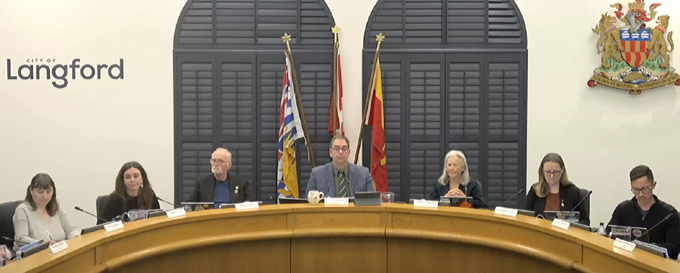
However, at their Committee of the Whole (CoW) meeting on Monday March 23, mayor and council were asked by one of their own — Councillor Keith Yacucha — to change the process mid-stream. A motion was put on the floor to work with one proposed tax percentage increase for some budget items and other percentage tax increases for others. In a notable pushback, none of the other council members supported that mid-process shift in process.
Councillor Mary Wagner in particular pointed out how a sudden change in process would throw off all of her pre-considered points for discussion at the March 23 meeting; she would not have been alone in that fact as council had been following a process decided back in December.
Changing process seems to be an approach that Councillor Yacucha has taken before. For the last two years of chairing the Community Advisory Committee he introduced an entirely different process each year. Overall that led to disruption of expectation by many community groups that sought grants-in-aid and perhaps some unfortunate funding results for some.

Questioned by Island Social Trends in recent years on the process used by Yacucha for the CAC process changes, his reply was essentially to try something to different but also to streamline the process for the committee and reduce their hours of work.
Questioned by fellow councillors at Monday’s CoW meeting, Yacucha’s reasoning was to apparently uphold some items by the treatment of one level of tax increase (giving them a form of sanctity) while shifting further focus of deliberation to others. A form of predetermination was how that was perceived by the rest of council, who did not support his recommendation for a mid-process change.
Yacucha teaches economics at the post-secondary level and is generally well-regarded on council for his opinion on current economic scenarios. However at the March 23 meeting one other councillor said that economic times are always tough, as a way to somehow bring the pervasive panic mode about the current economy down to ground.
The council already has a sober realization about how any tax increase will affect residents and possibly the political futures of some or all of council. A serious process was already underway and on Monday night council chose not to disrupt that.
Island Social Trends has asked Councillor Yacucha for a comment to include in this editorial analysis.

Cost of policing:
At their next council meeting (a Special Meeting on Monday March 30) Langford council will face consideration of how the policing portion of the Langford budget will be addressed in 2026.
As the community grows, so too must the RCMP staffing contingent — or so Council has been hearing along with arguments that population growth does not necessarily require proportional police staffing growth (other approaches to community management can be utilized and applied).
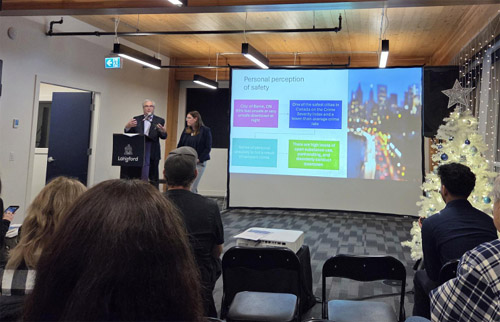
But community safety is not a light-handed issue. So Langford undertook a third-party survey in recent months on top of hiring a policing analysis consulting team to help them fortify the decisions they will soon make about the West Shore RCMP staffing budget (a cost that is somewhat proportionally shared with four other municipalities that are served by the detachment, i.e. Colwood, Metchosin, View Royal, and Highlands).
Keeping the cost of policing in balance with financial needs of many other areas of City operations is the hottest potato of budget deliberations for Langford Council in 2026.

Tough times require superior communication:
Indeed these are tough economic times.The price of nearly everything is already on the rise again due to the input costs of oil, diesel and transportation resulting from shipping interruptions of the now month-long war in Iran.
Interest rates may increase again in 2026 due to the uncertainties and supply chain impacts of the war in Iran.
But a community expects their Council to guide the process of getting through a tough time to the other side, keeping all things in balance.
If the Council and City do an effective job of communicating to residents and property owners about the complexity of this year’s budget and the surrounding economic circumstances, they will be doing their best and most people will understand.

Housing growth within a balanced budget:
All municipalities are required by the Province to produce a balanced budget.
Of particular recent interest, Langford has pointed out that without affordable housing funding from the Province (cuts to BC Budget 2026) they cannot be expected to deliver on affordable housing target levels that the Province expects.
The road ahead:
The pressures of local political opposition are not to be disregarded. But the new track that Langford has found itself on since the 2022 election would be best to continue relatively uninterrupted.
Several new (first-time) strategies on a wide range of urban development issues have been undertaken in the past three-and-a-half years by the council led by Mayor Scott Goodmanson and the nearly-new set of councillors that were elected back in October 2022 (only Councillor Lillian Szpak was re-elected from days of olde).
With the welcomed population growth that the previous Langford council brought to bear in the city through robust housing development over about 20 years, that was not holistic development — some key aspects of urban livability were overlooked (notably on maintaining greenspace and attending to a broader range of community amenities).
This Goodmanson council of 2022-2026 has attended to embarking on those longer more salient journeys like updating the OCP, producing more active transportation routes, and developing strategies for parks, arts, and economic development (and more specific livability things like construction impact management and parking guidelines).
As well, Langford council has grappled with cleaning up some difficult financial messes that the previous council brought to bear (e.g. using contingency funds to artificially suppress property tax increases and getting into the purchase of the Y building at a significant cost imbalance for overall city finances).
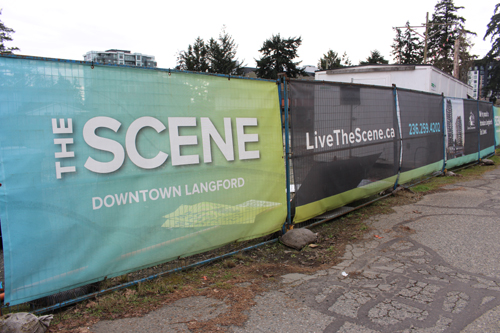
The current council has had to chase down arrears from Pacific FC for use of Starlight Stadium, and has begun to uncover why at least four major apartment/condo tower projects are still only holes in the ground.

Ballot pencils ready:
While Council is still putting a fine pencil to budget deliberations for 2026, it would be helpful to the future of the City if as many taxpayers (all residents) started putting a fine point on deciding what sort of Langford they want going forward.
If politics is of limited interest, voters might consider local municipal elections the most important to follow. People who lead our cities impact most of the basic areas of our daily lives and overall livability of our communities.
Election season has already begun. Langford will have four voting places this year (up from three in 2022) to help accommodate long voter lineups.
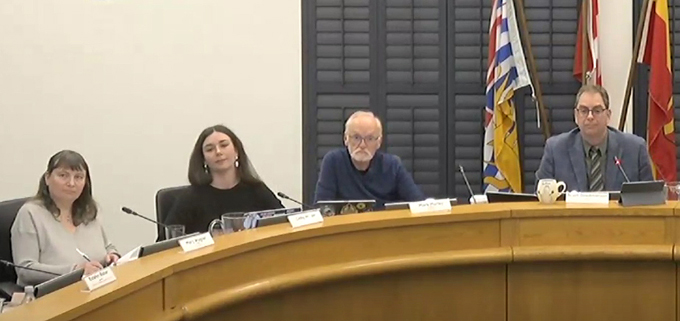
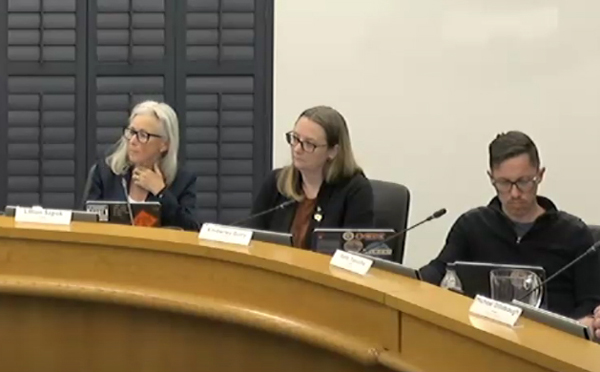
Mayor Scott Goodmanson (now also Acting Chair of the Capital Regional Hospital District Board) is seeking re-election, as are most of the current council, which is current comprised of Kimberley Guiry (currently also the Westshore Parks and Recreation Board Chair), Colby Harder, Mark Morley, Lillian Szpak, Mary Wagner (Chair of Langford’s Sustainable Development Committee) and Keith Yacucha (Chair of Langford’s Community Advisory Committee).
After the October 2026 election remuneration to Langford mayor and council will increase.
Election timeline:
The 2026 BC municipal election timeline is underway. Campaigns officially started at January 1, 2026.
| Nomination period begins | September 1, 2026 |
| Close of nominations | September 11, 2026 |
| Campaign period begins | September 19, 2026 |
| National Day for Truth and Reconciliation (Elections BC closed) | September 30, 2026 |
| Thanksgiving Day (Elections BC closed) | October 12, 2026 |
| General Voting Day | October 17, 2026 |
===== RELATED:
- MLA Parmar responds to City of Langford housing concerns (March 20, 2026)
- Bank of Canada holds interest rate at 2.25% amidst Iran conflict uncertainty (March 18, 2026)
- How much will 2026 property tax go up in Langford? (February 19, 2026)
- The Scene isn’t much to look at, City of Langford wants action (February 12, 2026)
- Strategic start on Langford Budget 2026 with four tax increase options (December 13, 2025)
- Langford hosts consultant-led info session on policing & public safety (December 12, 2026)
- City of Langford breaks silence on Pacific FC arrears (September 19, 2025)
- NEWS SECTIONS: LANGFORD | BUSINESS & ECONOMY | BUDGET 2026 | WEST SHORE LOCAL | MUNICIPAL ELECTION 2026