


Tuesday September 9, 2025 | VICTORIA, BC
by Mary P Brooke | Island Social Trends
FortisBC takes the long-term view to customer service, infrastructure development and innovation in delivering natural gas and electricity services. Key goals are reliability, sustainability and innovation.
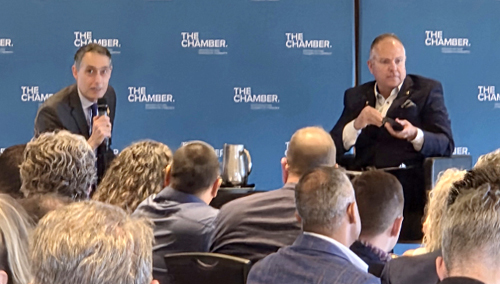
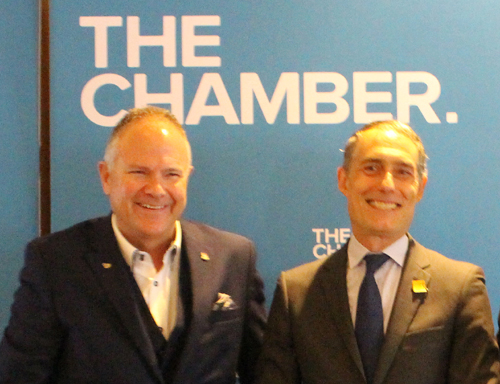
That was the overall message delivered by FortisBC President and CEO Roger Dall’Antonia, in a lunch hour address to members of the Greater Victoria Chamber of Commerce in downtown Victoria today.
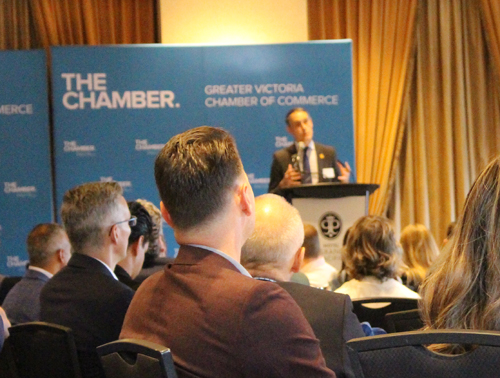
About 95 business and community leaders attended today’s luncheon at The Hotel Grand Pacific.
Greater Victoria Chamber of Commerce CEO John Wilson moderated some questions from the audience.
Serving 80% of British Columbians:
Dall’Antonia opened his speech by saying that the energy sector is crucial.
FortisBC has 1.3 million customers – residential, businesses and institutional. Of those, 30,000 are on Vancouver Island.
One way or another, every day FortisBC serves 80% of British Columbians – with gas or electricity. In some cases, natural gas is a backup when electrical systems go down — either for generators or as a pre-established operational alternative.

Economic challenges:
With a focus on his business audience, Dall’Antonia got into the details of current economic challenges which he outlined as including shipping, trade, tariffs, and broader economic frameworks.
Dall’Antonia identified six areas of critical infrastructure that are relied upon in today’s economy, with energy being the one upon which the other five rely, those being health care, transportation, food systems, water and wastewater treatment, and communications.

Government interface:
But he several times he eluded to the challenges of government policies and decisions, and that a utility service like FortisBC should not be impacted by politics as they continue to try serving households, businesses and industry. He talked about “driving economic resiliency” in the province.
FortisBC will be making an investment of $4.8 billion in infrastructure investments over the next five years (some pending regulatory approval) in both natural gas and electricity. He says that supports investment, high paying jobs, innovation and technology and “provides resiliency and reliability in a critical system”.

Getting the balance right:
“We are taking the view that as critical infrastructure you’re trying to solve a number of different challenges,” said FortisBC’s president and CEO. “Our purpose is affordable, reliable, sustainable energy for all British Columbians that we serve,” said Dall’Antonia.
“Trying to get that balance right is what we call the energy trilemma,” he said. “You can’t choose to focus on just sustainability, or affordability, you really have to think about those three key elements (with reliability being the third). Energy assets are intended to be long-lived – some may last for decades or even a century. Striking a balance between reliability and affordability is key, Dall’Anotnia said.
“It always comes back to the household or the business and the decisions we are making for customers,” said Dall’Anotnia. He says that customers still want more carbon options. “Sustainability is still critical…. you have to have reliability in extreme weather.” That’s the challenge for utilities across North America, he added.

Extreme weather impacts:
He noted the weather extremes of the heat dome 2021 and heat of the last few years, the atmospheric river and flooding that impacted transportation, successive cold snaps in the last two years and unseasonably cold weather in Victoria and Vancouver.
“It’s clear that neither the natural gas nor the electricity system as it’s currently configured can’t meet all of BC’s energy needs. Those systems must work together,” said Dall’Anotnia.

Energy conservation:
FortisBC encourages its customers to conserve energy. That is good for the environment but it also means less immediate pressure to expand technical infrastructure.

===== RELATED:
Island Social Trends is a business member of the Greater Victoria Chamber of Commerce.
NEWS SECTIONS: BUSINESS & ECONOMY | ENERGY SECTOR | EMERGENCY PREPAREDNESS