


Wednesday February 4, 2025 | VICTORIA, BC [Posted at 1:50 pm PT]
by Mary P Brooke | Island Social Trends | Reader Comments Welcome
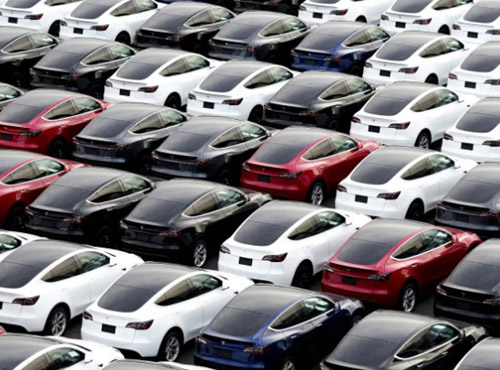
The federal government has dropped the electric vehicle (EV) mandate in favour of a new fuel efficiency system. And they have restored point-of-purchase incentives to buy EVs and hybrids, along with a supporting announcement of more funding for charging stations.
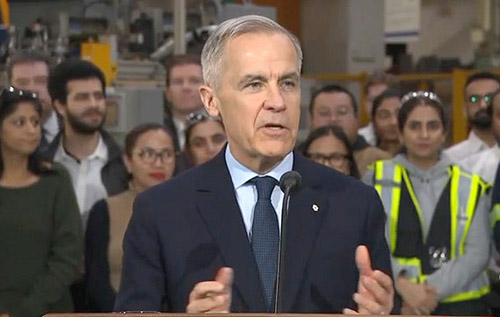
Prime Minister Mark Carney made the announcement today at an EV manufacturing plant in Vaughan, Ontario.
“In a strong domestic market we can afford to buy what we build,” said Carney, outlining the $2.3 billion investment in buyer incentives for EVs.
It will also be easier to charge EV. $1.5 billion through the Canadian Infrastructure Bank to expand out the EV-charging network across Canada.
Carney said that Canada is now going to be the best place to “invest, build and build-clean”.
Carney was introduced today at the automobile manfuracturing plant by Minister of Industry Mélanie Joly who said that Canada is “an auto nation”.

“We will not miss this opportunity,” said Carney. Strategic decisions and generational investments will results in affordable, enjoyable and low-emission automobiles of the future, he said.
Core component of the economy:
The automobile industry is the key core pillar of the Canadian economy, said Carney today. He added that entire communities have been built around car plants.
He says the auto sector is Canada’s largest employer, saying 60% of automobiles and/or auto parts are exported to the United States.
“Protecting this unique Canadian advantage,” is Carney’s goal for Canada, with the objective is to remove all tariffs in the auto sector so that there is a North American auto sector.
“That is not the current objective of the US administration. We have to prepare for all possibilities, we must take care of ourselves,” said Carney today with automobile plant employees standing behind him. He emphasized that all these changes and new directions will continue regardless of what happens with the trade relationship with the United States.

Electric and connected:
“The future of the auto industry is increasingly electric and connected, said Carney. That does earmark one stated concern by critics of data security in the use of auto-technologies. Carney also highlighted his government’s intention to double the electricity-producing capacity of this country.
These changes are expected to generate a favourable response from consumers who may then find EVs to be more affordable, and also reduce the range anxiety that happens when drivers feel there isn’t enough EV-charging availability.
How is the impact of this on Ontario automakers who are dealing with the recently agreed-upon arrangement by the federal government to allow 49,000 EVs into Canada from China? Canada’s auto manufacturers (mostly in Ontario) are still dealing with tariffs imposed by the United States on Canadian-manufactured vehicles exported to the US.
The federal government today introduced what they call a new auto strategy that rewards the production of made-in-Canada vehicles and harnesses Canada’s world-class capabilities in artificial intelligence and technology expertise to build the cars of the future.
The federal government’s strategy is intended to positions Canada to become a global leader in electric vehicle (EV) production.

Government announcement:
As stated by Prime Minister Carney today, investment is being accelerated investment across the auto-manufacturing chain including steel and aluminum.
On the consumer-facing side:
To rationalise emissions reduction policies to focus on outcomes that matter to Canadians, Canada’s new government will:
- Introduce stronger greenhouse gas emission standards that put Canada on a path to achieve a goal of 75% EV sales by 2035 and 90% EV sales by 2040 – reducing our carbon footprint and securing Canada’s global leadership in clean energy.
- These more stringent emissions standards will enable the Government of Canada to repeal the Electric Vehicle Accessibility Standard. This approach will allow manufacturers to use a wide array of technologies to meet the standards and respond to consumer preferences in the near-term, while driving EV adoption over time.
To strengthen domestic demand by making EVs more affordable and reliable for Canadians, Canada’s new government will:
- Launch a five-year EV Affordability Program to lower the cost of EVs for Canadians and create a stronger domestic consumer market.
- The new $2.3 billion program will offer individuals and businesses purchase or lease incentives of up to $5,000 for battery electric and fuel EVs, and up to $2,500 for plug-in hybrids (PHEVs) with a final transaction value of up to $50,000 on cars made by countries Canada has free trade agreements with. To support the Canadian automotive industry, this $50,000 cap will not apply to Canadian-made EVs and PHEVs.
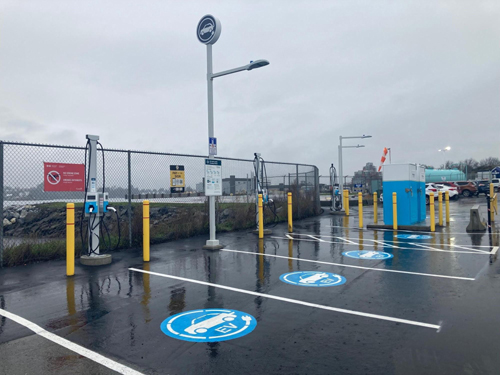
- Enhance our national EV charging network through investments of $1.5 billion through the Canada Infrastructure Bank’s Charging and Hydrogen Refueling Infrastructure Initiative, making it easier and more convenient for drivers to charge their EVs across the country.

Impact for manufacturers:
Dropping the EV mandate has been a call from the Canadian Vehicle Manufacturers Association (CVMA).
The industry is under enormous pressure due to tariffs, as outlined by CVMA President Brian Kingston on CBC Power and Politics yesterday. The mandate created “unnecessary, redundant costs” for manufacturers. Therefore, dropping the mandate is good news.
The government already has existing emission standards that should take care of the climate action goal aspect of the mandates, as Kingston outlined today. In fact, those standards could be even more stringent. “That has always been the better approach,” said Kingston today. “It’s technology agnostic, it gives consumers choice, and it reduces the cost on manufacturers.”
Emission standards require companies to reduce the emissions from their full vehicle fleet. That can be achieved with a mix of vehicles, such as EVs, plus-in hybrids, hybrids, and efficient gas-powered vehicles. Getting to the target using a range of technologies is the goal. That makes room for flexibility in business purchasing and application of vehicles in the service delivery of a business.

Clean Energy Canada:
The new auto strategy could be a serious solution to Canada’s stalled EV market and auto future, says Clean Energy Canada (CEC).
CEC is encouraged by the return of federal EV rebates via the new EV Affordability Program, saying it “brings clarity to Canadians, many of whom waited on the sidelines last year for a government update on the program, causing Canada to become potentially the only country to see EV sales decline in 2025″.
CEC says the upfront cost still remains a barrier for many consumers. As well as incentives, the organization suggests having more model options, though the Canadian Vehicle Manufacturers Association says market supply of EVs is covered with about 115 EV models on the market. “Now the demand side is the focus,” said CVMA’s President Kingston yesterday.
Competition from Chinese EVs should be controlled, says CEC, which they feel would shift the market in favour of consumers.
“Today the federal government announced a thoughtful EV policy package with the potential to achieve what Clean Energy Canada has long called for: a plan that prioritizes consumer affordability alongside long-term auto industry competitiveness,” said Joanna Kyriazis, Director of Policy and Strategy, Clean Energy Canada in a statement today.
Consumers have been missing out:
“Last year, EVs constituted one in four new cars sold globally. Canada has clearly fallen behind, consumers are missing out, and the future of our auto sector has remained fuzzy,” says Clean Energy Canada.
“And while the EV Availability Standard was a smartly designed policy solution to these challenges, what ultimately matters most is outcome. Namely, ensuring Canadians get access to a variety of well-priced EV models, that the EV market has a predictable trajectory—which is critical for enabling private sector charging investments—and that emissions from transportation decline on their way to complete decarbonization,” says Kyriazis.
Clean Energy Canada also feels it would be better for the federal government to explore a broader Canada-EU auto pact, signaling alignment on emission standards as well as vehicle safety standards—opening Canada to more European EVs—along with a commitment to collaborate on critical minerals and EV manufacturing.
Canadians want EVs, but upfront cost remains a barrier, at least for now, says CEC. The incentives announced today are intended to help reduce that barrier.

Increasing EV sales:
There is no way to reach the targets without more people driving EVs, says Canadian Vehicle Manufacturers Association (CVMA) President Brian Kingston, who said yesterday that Section 232 tariffs and the uncertainty of CUSMA renewal are problems for manufacturers and the expectation of increased EV sales.
Dropping the mandate and increasing charging station availability will help, says Kingston. Otherwise, 95% of vehicles manufactured in Canada were going to be unsalable in nine years, if the requirement for 100% of vehicles sold in Canada were to be EVs by 2035. That wasn’t helping to incentivize EV manufacturers to stay in Canada, says Kingston.
Dropping the mandate protects current production and removes a regulatory burden.

Higher efficiency standards for gas engines:
Prime Minister Mark Carney is scheduled to announce new measures intended to transform Canada’s auto manufacturing sector for a more stable and successful future.
That reportedly includes higher efficiency standards for gasoline-powered vehicle engines.
Vehicle manufacturers have introduced more EVs and gas-powered engines are far more efficient than they used to be: since 2011 efficiency has increased by 505% for cars and 30% for trucks.
Appealing to middle-income consumers:
People who could afford to be early adopters of EVs have already done that over the last 10 years. The new scenario aims to incentivize middle-income households to buy one vehicle and that it be an EV.
Getting more EV chargers in place will help boost consumer sales of EVs by reducing range anxiety. Kingston says this country falls short by about 60,000 chargers.
Quick facts:
- Canada’s auto sector supports over 500,000 workers, contributes over $16 billion annually to Canada’s GDP, and is one of the country’s largest export industries. In 2025, Canada produced over 1.2 million passenger vehicles.
- With over 90% of Canadian-made vehicles and 60% of Canadian-made parts exported to the United States, U.S. automotive tariffs are threatening Canada’s automotive manufacturing industry and the 125,000 direct jobs it supports.
- Since April 2025, Canadian-made vehicles have faced a 25% U.S. tariff on non-U.S. content (the value of U.S. content in CUSMA-compliant autos is exempt).
- Within five years, EV sales are projected to reach nearly 40% of global car sales.

===== RELATED:
- BC Hydro highlights 14 EV charging stations in downtown Victoria (January 24, 2026)
- Try an electric vehicle or E-bike August 13 at Camosun (August 9, 2022)
- Electric vehicles necessary to hit climate targets (April 12, 2022)
- Trudeau promises national network of EV charging stations (April 11, 2022)
- Saanich celebrates 20 new EV charging stations (January 12, 2022)
- Rebates for switching to specialized electric vehicles (August 6, 2020)
- NEWS SECTIONS: TRAVEL & TRANSPORTATION | CARS & TRUCKS | CANADA-NATIONAL | TARIFFS & TRADE