


Wednesday January 21, 2026 | DAVOS, SWITZERLAND [Posted in VICTORIA, BC – 7:47 am PT | Updated January 21 & 27, 2026]
by Mary P Brooke | Island Social Trends
See comments from BC Premier & federal NDP Leader (January 21, 2026)
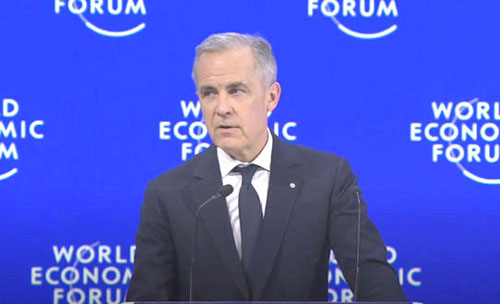
Prime Minister Mark Carney’s commentary on macroeconomic shifts in the global economy made world headlines yesterday.
He was addressing am elite audience of economic global leaders at the World Economic Forum (WEF). His remarks made media headlines around the world and was the topic of political pundit debate on Canadian TV news shows.
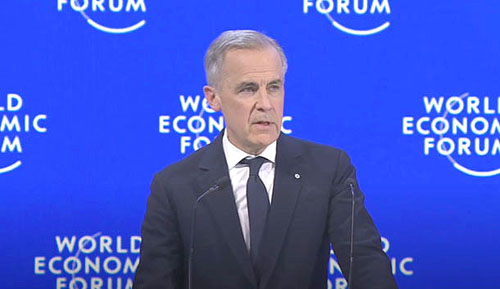
Carney seemed to feel very much at home in this financial-world scenario, given his previous career roles as governor of two G7 banks, those being Canada and then Britain.
Strategic thinking:
Reportedly having written the speech himself, there was clearly the mindset of a strategic economic thinker while using his political platform as the leader of a ‘middle power’ democracy to load extra weight to his words.
That Canada is geographically next-door to the United States — the world’s largest economic and political force that within President Donald Trump’s mission is now turning the world order on its ear — lent gravitas and grit to his comments that at another time might have seemed disruptive if not outright radical beyond reason.
Carney was essentially asking economies of the world to misbehave with respect to the post-World War II “rules based order”, by colluding with each other as “middle powers” as a way to show their own strength and build resilience in a world that appears to be quickly reorganizing as one with three major hemispheres of influence based on sheer might of significant military force and financial magnitude: the United States of America, China and Russia.

Don’t be meek:
The key message to countries and economies outside the mega-powers is that compliance with the bullies won’t buy safety.
Feigning alliance with the big powers may seem to avoid trouble but rather is actually just signalling compliance in order to presumably avoid difficulty.
Carney spoke of “participation of ordinary ritual by private individuals that they know to be false”, in other words, living a lie as if it were true. But that leans to fragility. When one person stops performing (in that way), the illusion begins to crack, said Carney.
Countries and companies to ‘take their signs down’, said Carney after outlining a metaphor of vendors in the marketplace putting up their signs of compliance with the big boss.
His macroeconomic metaphor was a message to European countries and others who last year very quickly acquiesced to Trump’s demand for a flat tariff or other forms of economic obedience.
Canada’s unique position:
Canada, in fact, stands alone in a unique situation of geographical proximity to the United States, but more significantly in that currently about 85% of this country’s trade with the United States is tariff-free (under the current CUSMA/USMCA agreement that could expire later this year).
Trump has mused has CUSMA is not important to him and that he might just not renogitate that deal which has been credited with generating increased prosperity to Canada and Canadians over the past 40 years (though it has also left many underfinanced households and small businesses behind).
“We are in the midst of a rupture, not a transition,” said Carney — familiar words to the Canadian audience but perhaps new to the world economic movers and shakers.
He got a standing ovation after outlining to the WEF audience that the world’s great powers are now using economic integration as a weapon and using supply chain interruptions as a vulnerability to be exploited.
Integration becomes subordination:
“Integration becomes the source of your subordination,” said Carney to other countries about their compliance wit the new world order that the US is trying to quickly establish — which so far has been relatively successful through the element of surprise if nothing else.
“We are no longer relying on the strength of our value but also the value of our strength,” said Carney, repeating another theme from many speeches delivered at home in Canada.
He argued for creating “a dense web of connections” — partners who share enough that they can act together through a dense web of connection, something “on which we can draw for future challenges and opportunities”.

Middle powers:
“The middle powers must act together because if we’re not at the table we’re on the menu,” said Carney to nervous laughter and applause from the audience.
Greater power have the market size to debate terns. Middle powers do not.
Carney pointed out that the US strategy is to see other countries compete with each other to be the most accommodatiing. But he warned that “that’s the performance of sovereignty while accepting submission”.
Countries can compete with each other for favour or combine to create a third path with impact, Carney outlined.
“We shouldn’t allow the rise of hard power to blind us”, rather that middle powers hold a power that emerges from working together, aka collaboration..
Middle powers need to live the truth and name reality for what it is, said Carney. HGepoints out that economic integratoin with the US is a form of coercion by the larger power. The power of real sovereignty is to act consistently, applying one’s stance equally to both allies and rivals.
“Build what we claim to believe in” rather than wait for the old order to be restored, said Carney, noting the importance of reducing the leverage that enables conversion.
Material foundation for honest foreign policy reduces vulnerability. In everyday terms one could state the obvious, i.e. that having financial resilience is key to standing up to adversity.

Canada’s resources:
“Canada has what the world wants,” Carney told the WEF audience — another phrase that the Canadian audience is familiar with by now.
He painted Canada as an energy superpower with vast reserves of critical minerals and “the most educated population in the world, an economy with sophisticated investors, capital, talent, and a government with immense fiscal capacity to act decisively”.
“We have the values to which many others aspire. A pluralist society that works, a public square that works,” said Carney with pride about Canada. He said that Canada is a reliable partner “in a world that is anything but”.
“We have a recognition of what’s happening and a willingness to act accordingly,” said Carney in his speech yesterday.
“We are taking the sign out of the window. We know the old order is not coming back. Nostalgia is not a strategy. This is the task of the middle powers,” said Carney.

A pitch for cooperation:
He purports that middle powers have the most to gain from genuine cooperation.
“The powerful have their power. We have the capiticy to stop pretending, to name reality, to build our strength at home,” said Carney.
“That is Canada’s path. We choose it openly and confidently,” he said, ending his speech by saying that path will be shared with “any country willing to take it with us”. For that he got a standing ovation, which apparently is rare at WEF events.

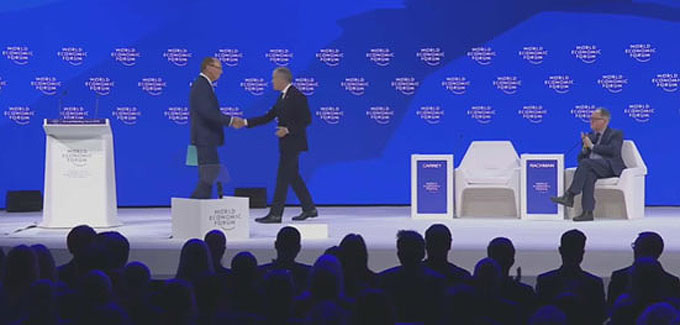
Chatting with the moderator:
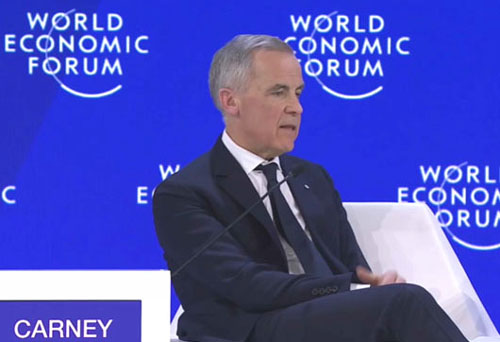
During his chat with the moderator of a Q&A after his speech, Carney made a few additional points:
- NATO is experiencing a test of the ability to withstand pressure as to cohesive sovereignty.
- China is on the offence — building outward for something as opposed to being against.
- The Nordic countries plus Canada have 20% of the world’s GDP.
- Carney got applause for remarking about standing on principle on how the US is pressuring Greenland. He said the solutions “starts with security” for Greenland and more broadly of the Arctic. “We’re at the start of the major ramp up of Above and Beyond (submarine and airfighter fleet, and over the horizon radar to protect against Russian threats),’ said Carney, who is reportedly considering sending some Canadian ground troops to Greenland.
- “Russia is without question a threat in the Arctic. Russian does horrible things,” said Carney, noting that Russia’s invasion of Ukraine is not in almost its fourth year. “The threat is more projected than actual … and we intend to keep it that way,” said Carney.
- As to participating in the proposed Peace Board that President Trump has announced: “This is a positive vehicle. We need to work on the actual structure of the vehicle. Is it for Gaza? …better to be designed in that way. Work of the Peace Board needs to coincide with the immediate full flow of humanitarian aid, said Carney. He explained there are aspects of the governance and decision-making process that could be improved, and that Canada “will work with others (including the US)”, “we will do anything we can” to improve the situation for people in Gaza. “We want support to be direct to Gaza.”

Cabinet planning:
Tomorrow Carney will be back in Canada, ready to host a two-day cabinet planning meeting January 22 and 23 in Quebec City.
The focus on that meeting with be the economy, affordability and security.
Meeting with premiers:
Carney will be meeting with Premiers in Ottawa next week on Thursday January 29.
===== RELATED:
- Comments on Carney’s speech – by BC Premier and federal NDP Leader (January 21, 2026)
- Federal cabinet Winter 2026 planning on economy, affordability, security (January 21, 2026)
- NEWS SECTIONS: CANADA-NATIONAL | GLOBAL ECONOMY | BUSINESS & ECONOMY | 45th PARLIAMENT of CANADA | CANADA-USA