


Thursday November 20, 2025 | VICTORIA, BC [Posted at 12:51 pm PT]
Editorial News Analysis by Mary P Brooke | Island Social Trends
Canada Post is still in transition between being in significant debt and finding a way through to being a modernized delivery service.
They are taking small steps forward by seemingly coming to terms with their financial losses — as in recognzing the reasons for those losses and what might be done to restore financial solvency.
At the crown corporation’s Annual General Meeting (AGM) on Tuesday there were two key messages:
- Operating loss and debt continue
- Job cuts will begin with attrition.
Overview:
The debt situation is not new. Canada Post has not posted a profit since 2018. Given the continued labour strikes by Canada Post employees (unionized under Canada Union of Postal Workers/ CUPE), that CUPW employees are guaranteed pay even if there is no work, and the lagtime of Canada Post in keeping up with its parcel delivery competitors, the losses are in no way a surprise.
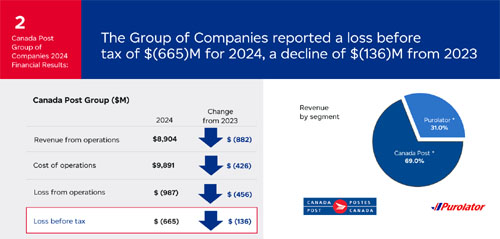
Things are going in the wrong direction — in Canada Post’s AGM presentation on Tuesday they showed a loss of $665 million in 2024 — that’s a $529 million greater loss in 2024 than in 2023.
The job cuts are part of a restructuring instructed by the federal government back in September. This is the tip of the spear to a new direction for the crown corporation for which there is no rationale for having been delayed over the past many years.

Political promises such as not closing rural post offices and not ending home delivery got in the way of good business management of Canada Post as a service to Canadians; those conditions were reversed by Minister of Government Transformation, Public Works and Procurement Joel Lightbound on September 25, 2025 with the intention of stabiliziing Canada Post finances with the hope of heading toward financial survival.
Some short term transitional changes will include extending delivery standards to 3-7 business days to help allow for ground transport instead of air.

Numbers in the red:
“Canada Post is effectively insolvent,” said the Crown corporation’s chief financial officer, Rindala El-Hage.
The federal government has bailed them out once with a loan ($1.034 billion in January 2025) but the government has said that is unsustainable.
She announced that Canada Post’s operating loss so far for 2025 totals $1.042 billion, and that its latest quarterly loss — $541 million before tax — was unprecedented.
“Unfortunately, the reality today is that when Canada Post loses money, taxpayers are footing the bill” was stated during the AGM. That has been clear for years. Canada Post could have acted sooner and so could the government have taken action far sooner than this year.
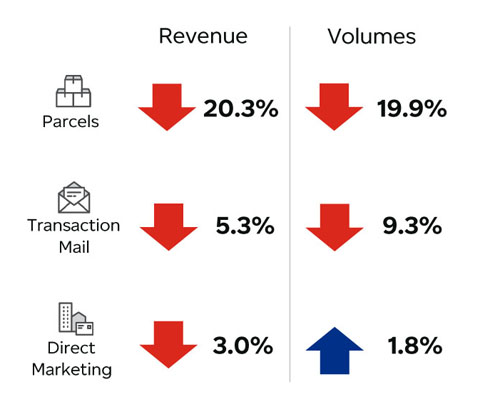
From the information presented at the AGM it appears that the greatest loss in revenue is from parcel delivery (even though parcel delivery volumes are down). There was a loss in revenue for letter delivery (with volumes down). There was a revenue decline for sending out flyers (aka Transactional Mail) even though volumes were up.
“It was the largest quarterly loss in the company’s history,” said El-Hage. She added that the “continued labour uncertainty and disruption” caused by an ongoing labour dispute with its workers contributed to the losses.
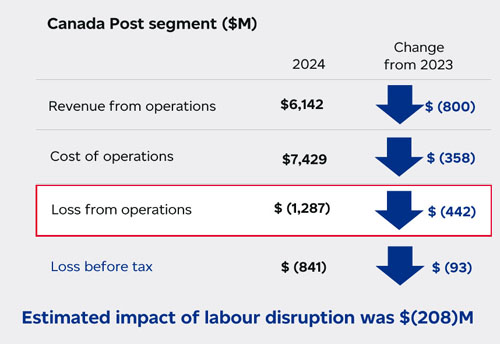
The impact of the labour disruption was a loss of $208 million, says Canada Post.

Job cuts by attrition:
At the AGM it was stated by CEO Doug Ettinger that the Canada Post workforce would need to be downsized by about 62,000 employees.
The first step toward that is by attrition, i.e. the departure of employees through retirement (on schedule or taken early).
Canada Post expects more than 16,000 employees to retire or leave their employment with Canada Post by 2030, with another 14,000 taking similar actions by 2035.

“Going forward, we will need to be a leaner organization,” said Ettinger. “Between retirements and other approaches such as voluntary departures, we can navigate this change with respect for our employees.”

CUPW response:
CUPW issued a statement after the AGM.
As would be expected, they are looking out for their employees first. But as usual CUPW seems slow to recognize that the health of the corporation translates to the ability to retain and pay employees.
“The CEO of Canada Post, Doug Ettinger, doubled down on plans to axe our jobs and our public services. These plans will have devastating impacts on the communities we serve,” said CUPW in a statement.
Canada Post had said they are happy to see the possibility of deregulating the setting of postage rates, but the union seems out of their lane to say that “Canada Post should not be allowed to set rates arbitrarily”.

Customer base is changing:
This comment on Reddit (Nov 18) highlights the way that many Canadians are experiencing Canada Post: “We are publicly funding and subsidizing junkmail delivery!!! It is pretty much the only thing that is delivered.”
Indeed, a large part of the Canada Post service model is to support the delivery of flyers for small business customers. The small businesses who rely on this form of marketing may themselves be falling behind the times.
And clearly for many years, Canadian households have not relied on sending or receiving letter mail (which had been the core of the Canada Post service since its inception).

Deeper transitional analysis:
Canada Post employees have had a life-long job guarantee. It’s unclear why a crown corporation (or any business) would agree to operating with that condition. But now that is changing.
While the transition may be uncomfortable, employees who leave Canada Post are part of a transition in the Canadian economy that has to do with shifting workers to new areas of the economy where there is growth and expansion to viable operations and the future needs of society and economy.
The government seems to feel that it’s Employment Insurance (EI) has the structure and capacity to handle this transition.That may work for people who are employed by corporations. But 60% of working adults in Canada are not employed in jobs where they get a standard paycheque or are eligible for EI (as was pointed out by the NDP during the last federal election).
As part of Prime Minister Carney’s economic revision of the Canadian economy there seems to be a strident effort to not just save jobs or support workers as they transition to other jobs (which is a relief those who have standard sector jobs). But there is also a blind eye being turned to the reality that more than half of Canadian working adults do not have the mainstream employment – they are part-time, consultants, self-employed, gig workers or have other form of inconsistent or non-traditional employment.

===== RELATED:
- Jobs Minister Hajdu on Canada Post, Air Canada, youth employment, retraining supports (November 2, 2025)
- Federal government ends door-to-door Canada Post delivery, workers go on strike (September 26, 2025)
- Quietly stabilizing Canada Post with a $1.034 billion loan (January 24, 2025)
- NEWS SECTIONS: CANADA POST | JOBS & EMPLOYMENT