



Wednesday January 28, 2026 | OTTAWA, ON [Reporting from VICTORIA, BC | Latest update January 29, 2026 at 1:12 pm PT]
Political news analysis by Mary P Brooke | Island Social Trends | SEND COMMENTS
British Columbia is on a roll to fulfilling a chunk of the world’s needs around metals, minerals, and energy.
It’s part of the Look West plan which wasn’t mentioned by name in Ottawa today but leaked through all aspects of BC Premier David Eby’s remarks to media about his meetings in Ottawa today.
The meetings that media and Canadians heard about today from Eby were his trilateral meeting with Prime Minister Mark Carney and Alberta Premier Danielle Smith, and the outcomes of various other meetings with federal ministers and representatives.

Eby’s big Wednesday in the capital city got traction for BC on three key things: dealing with public safety in Surrey (aka the extortion file); finding a path to deal with the proposed pipeline from Alberta through the north of BC to the coast; and overall the many facets of what is impacting BC’s capacity to fuel the economic engine of Canada including mining and more strategic management of population growth and related immigration factors.

Tomorrow, the prime minister and all the premiers will meet for a closed-door series of discussions on a wide range of discussions and potential decision-making or deals around economy, trade, security and sovereignty.
All the premiers seem to be on board to working with the Carney Liberal government. These are challenging times, and Carney not only seems to be on top of a master plan but so far the Canadian public and businesses are generally widely supporting the prime minister and the direction of his ‘new’ Liberal government.
Carney’s speech as delivered to the World Economic Forum last week (aka the Davos speech) is still resonating for how it has inspired all the premiers.
Grab a coffee, here’s the long version…

Safety in Surrey:
In the fast-growing community of Surrey, the policing issue currently centers around extortion and gangs and how people can be safe in the community.
Eby discussed this with the public safety minister and “at significant length with the prime minister”.
“The conversation was on making sure the police have all the resources they need to be able to address this issue,” Eby told media today.

“In particular we discussed the call from mayors for an escalation and a declaration of a state of emergency. Our consensus was to make sure that police are communicating adequately with the community that they understand the seriousness, how profound this is for the community,” Eby said today.
“The prime minister, our ministers and I have agreed that within the next two weeks we will have a meeting of police leadership from Ontario, British Columbia, Alberta, Manitoba, and national police at Green Timbers (an RCMP depot) in Surrey. So that all police can be together, we can assure that there are no gaps in sharing information, that all resources that are needed have been delivered. And they can get a handle on this as the national issue that it is,” said BC’s premier.

“To that end as well, the prime minister committed additional RCMP resources to British Columbia to allow us to free up our resources from the CFSEU (Combined Forces Special Enforcement Unit) that is already participating in the task force. But this will allow additional resources for this gang enforcement team to join the front lines of the fight against extortion in our province,” said Eby.
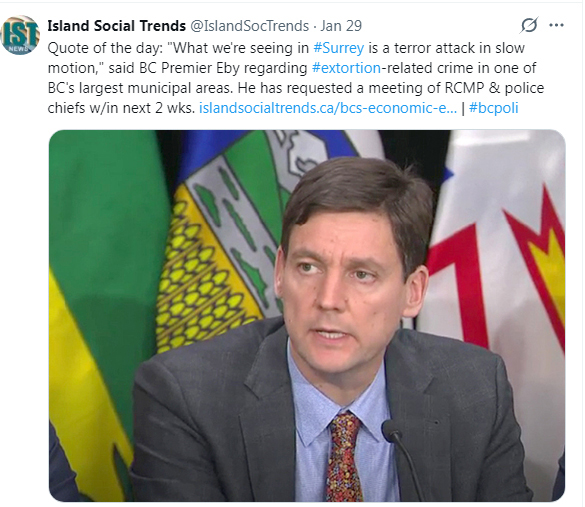
Eby said that two agreements were reached with the federal government on Wednesday:
- the meeting in Surrey — to be held within the next two weeks — that will be coordinated to bring together the chiefs of police from four provinces (Manitoba, Ontario, Alberta and BC) as well as national police to ensure there are no gaps in information sharing; and
- that all resources required have been delivered to ensure these investigations are concluded with the rest of the prosecutions.
“There was also a commitment by the Prime Minister and his minister that there would be an increase in RCMP resources for British Columbia on this file to see that gang task force members can participate in the overall effort in Surrey and south of the Fraser,” Eby told media today.

Trilateral meeting:
Eby’s trilateral meeting with Carney and Smith was a highlight of the news stream today, given how contentious things became when it became evident that BC had been entirely left out of the loop of discussing and planning a Memorandum of Understanding between the federal government and the Alberta government — for a potential pipeline that would run through BC.
“The tone was very civil in the meeting and borderline friendly,” said Eby in response to a media question on that aspect of the meeting of putting two opposing forces in the same room. That comapres to some frostier encounters at previous meetings.
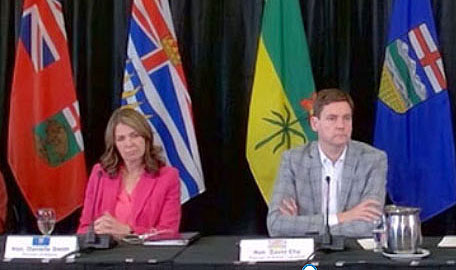
There is a lot of overlap and shared interests between BC and Alberta in terms of electricity and energy, noted Eby, who said Alberta is BC’s largest trading partner among the provinces.
“The goal here is to respect each other’s differences and move forward as best as possible,” said Eby about dealing with Alberta.
Smith will still try to gain advantage. Eby did seem to flinch a bit today when Smith casually revealed that Alberta is aiming to develop ski resort towns similar to Whistler which is one of BC’s tourism hot spots.
They discussed issues of “shared concern between British Columbia, Alberta and Canada”. They talked about being important trading partners with each other, said Eby.

Resources, energy and economy – and dealing with the proposed northern pipeline:
“That the western Canadian economies will be driving a path forward for Canada, and how we can do that better,” said BC’s premier as to figuratively wrapping a bow around the entire package that this trip to Ottawa is hoped to produce — i.e. BC getting in place as the economic driver of the Canadian economy.
Carney, Eby and Smith today talked about hydrogen, an electrical intertie (high-voltage transmission connections between different regional power grids), and pipelines.
The Alberta-British Columbia electricity grids are currently connected by a critical 1,200-megawatt (MW) capacity intertie, primarily used to exchange BC’s hydroelectric power with Alberta’s wind, solar, and natural gas resources as supply and demand require.
BC Hydro can already quickly ramp up its large hydro generation to assist Alberta during high demand.

Issues for further inter-tie development likely include limits on power exports that would affect grid reliability, energy sharing, climate goals, smart grids and storage investments. But that would not involve any of the political risks of the proposed northern pipeline.
For Eby the pipeline opportunity includes optimization of the Trans Mountain Pipeline (something this is already government-owned and operating though not at capacity). “As well as Premier Smith’s proposed pipeline across the north of British Columbia”, he said in his press conference in Ottawa today.
As to not having been consulted at the beginning of the pipeline MOU process between the federal government and Alberta, Eby said he said he made it clear to the prime minister and to Premier Smith that “the process was backwards”.
“We should have all been at the table at the beginning. British Columbia was not. I think that was very unfortunate. But we have to move on,” said Eby, really on a roll today with taking leadership at seemingly every turn.
“Alberta has an important relationship with British Columbia our relationship with the federal government is crucial. And so we’re going to respect our differences on this file and try to find ways to work forward together,” said BC’s premier during his remarks to media.
Eby notes that spill protection and response will need serious consideration of a pipeline proposal or plan goes ahead.
“The need for the tanker ban and why it’s there (is) a significant risk to our economy. And finally and most crucially, the need for Indigenous consent if this is to go ahead because they are our key partners on literally tens of billions of dollars on projects that are going to employ thousands of Canadians and generate billions in federal revenue.”
“Alberta has committed to keep British Columbia up to date on their progress on this project,” said Eby about the pipeline that might end up crossing the north of BC. That is, “if they are successful in finding a proponent and as they identify potential sites along the coast that they wish to propose to the federal government for this project.”
Eby articulated in response to a media question that “Alberta is not yet at phase where they have even identified a site where the pipeline is going to exit to. They haven’t identified a proponent that will be paying for it. The MOU requires a private proponent. They haven’t engaged with First Nations along the coast or received consent related to that. So they’re at a very early stage in this project,” said Eby in a skillful way of being somewhat open to the project (as Carney has the federal authority to push it through) while at the same time downplaying the northern pipeline.
“I underlined the crucial importance for engaging with First Nations for this process. These are the same First Nations that are supporting in excess of $50 billion in energy projects already in British Columbia, and we need their continued support to be able to deliver those projects,” said Eby while itemizing LNG Canada Phase 2, Ksi Lisims LNG, Cedar LNG in that regard.
“The involvement of First Nations was key, to underline that,” said Eby.
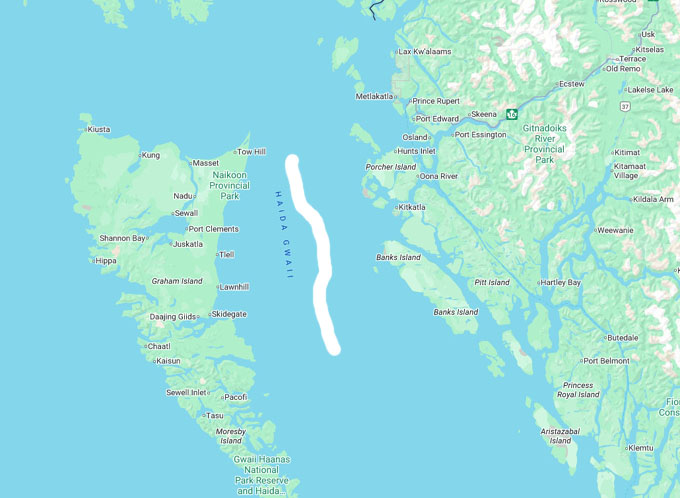
“I’ve been very clear with Premier Smith and with the prime minister that I believe that the tanker ban off the coast of British Columbia is there for a reason. It’s been there across multiple governments for a very clear reason,” said Eby. “It’s an incredibly treacherous stretch of water,” he said, referring to the Hecate Strait. “A spill of bitumen will decimate the north coast economy causing billions of dollars in damage.”
“There are alternatives to this project that are far more realistic and timely, the least of which is the optimization of the publicly-owned Trans Mountain Pipeline project — a project that the government already owns. It’s not operating at capacity and could take significant additional capacity within a short period of time,”
Eby says he “understands” that the Prime Minister and the Premier of Alberta are “committed to a new pipeline through British Columbia”, and that he understands the prime minister’s constitutional authority with respect to that project, i.e. that a project in the national interest supersedes the authority of a province or territory.
“Alberta committed to keep us updated going forward. It was a good conversation, and I look forward to hearing more from them,” said Eby about the Alberta government.
“In the meantime, I believe there are opportunities for us to work together on issues related to the shipment of ammonia to the coast, as well as electrical intertie and ensuring that both of our provinces have affordable and accessible electricity at peak times in the market,” said Premier Eby, again in an effort to steer attention away from the pet piipeline project of the Alberta Premier.

Provinces working together:
“For me, for British Columbians, there’s really only one path forward for Canadians and that through a unified country — all of use working together, respecting each other’s differences, and committing to respond to the very real threat that we’re facing as a result of the President’s policy south of the border,” said Eby today.
“I have encouraged all Premiers to strongly discourage separatist sentiment in provinces. Now is a time for us all to pull together. That’s the case whether it’s Alberta, Quebec or anywhere else. Proposals of Cascadia – of British Columbia joining the west coast states are always a smile for people but the true path forward for us is within Canada,” said Eby who landed many of today’s comments to media with a bit of a dry-wit quip.

The LNG & Indigenous factor:
Eby doubled down on another key reason as to why he is “so challenged by this conversation” about a pipeline from Alberta to the north BC coast.
“British Columbia has five LNG projects that are either under construction or reaching final investment decision within the next year. The focus, I believe, of the federal government — if they wish to grow the federal GDP, creating opportunities for all Canadians, British Columbians — but not exclusively British Columbians — to create federal tax revenues that pay for services across the country. The focus has to be on real projects that are getting delivered, that are going to be reaching final investment decision, privately funded, worth tens of billions of dollars.”
“LNG Canada Phase 2 is the largest private sector investment in Canadian history that reaches final investment decision this year. We should be all hands on deck delivering those projects but also responding to reality that these are projects affecting very small communities that need infrastructure and other supports to be able to respond to the massive number of people that are going to be working on these projects across the country,” said Eby.
BC’s premier again pointed out that “we still don’t know the route of this proposed pipeline, that there is no proponent, that there’s no money for it”. Repetition of that message could be working to BC’s advantage, as Eby repeats it whenever and wherever he can. Afterall, his political fortunes and those of the NDP could be weighed upon heavily by any loss of LNG or mining project investments as a result of Alberta going after their own political prize.
“Premier Smith is going to work on it, I respect that, but I am encouraging all of us to stay focused on what we’re trying to do here, and advance conversations of mutual interest,” said Eby.
“They’re at a very early stage at best,” said Eby as to Alberta’s work on developing a proposal about a proposed pipeline to the BC north coast, following a media question about aspects of the tanker ban.

Eby’s meeting with Carney:
Eby said he “very much appreciated the prime minister’s time” to cover a range of issues today.
“We discussed an array of topics with the prime minister We discussed the issue of extortion in Surrey. And we have a shared commitment through our ministers to ensure a meeting of police chiefs, from key provinces affected by this issue – four different provinces — as well as national police at Green Timbers in Surrey within in the next two weeks.”
As for softwood lumber, Eby says he identified an opportunity for the federal government to work with the government of India by lifting the 10% tariff that India has on softwood lumber. That could be part of the trade negotiations that the federal government is having with India. Eby also underlined the harm to BC’s softwood sector as a result of US President Trump’s policies for that country’s softwood.
It’s unlikely that Carney is unaware of these things, but discussing them in formal meetings gets them effectively and strategically on the record.
As for the FIFA World Cup 2026 games coming to Canada this summer, Eby noted the economic opportunities. He also noted how the federal government will need to have “a key role in security” around the games that will be held in this country in two large urban centres (Vancouver and Toronto).
When Carney was in Qatar one of the things achieved there was Qatar being on board to contribute to the delivery of security services during the FIFA World Cup games in Canada this summer.

Economic development around major projects:
Eby discussed with Carney the economic opportunities of national major projects in BC (e.g. mines, energy projects, ports) but that infrastructure support will also be needed for smaller and northern communities that will be impacted.
Iranians in Canada:
Eby asked Carney for any updates as to the conflict in Iran, as BC has a large Iranian population that is feeling anxiety.
Carney reportedly assured Eby that he had discussed this issue with US President Trump and that that “they are working on providing the best support possible to Iranian Canadians to be able to find out what’s happening to their relatives over there”.
CUSMA:
An update on the federal government’s Canada-United States-Mexico Agreement (CUSMA) review will be provided to Canada’s premiers tomorrow, said Eby.
CUSMA is likely one of the biggest items on the agenda, for without a free-trade agreement like CUSMA (which allows about 85% of goods to be traded tariff-free across the Canada-US border) things in Canada could get a lot more expensive or even not be available to businesses and consumers.
In recent days, Dominic LeBlanc said that meetings with his US counterpart about proceeding with the CUSMA discussions that are scheduled for 2026 would continue in the near future.
LeBlanc is currently juggling three significant roles: Minister responsible for Canada-US Trade, Intergovernmental Affairs and One Canadian Economy; Minister of Internal Trade; and President of the King’s Privy Council for Canada.

Population in BC:
The population in British Columbia grew by about 300,000 people over about three years following the pandemic. That made population growth a “significant issue” for British Columbia, said Eby today.
“We’re grappling with that in terms of schools, hospitals, infrastructure,” he said — something that he has told British Columbians about for well over a year.
However, now BC has a different sort of population challenge — there aren’t enough people coming into the province to help keep the economy growing. Eby feels that has to do with federal immigration policy that has “dramatically reduced” the number of people who can migrate to Canada from other countries.
The serious consequences that Eby identifies include that the BC provincial nominee program can’t recruit the level of health workers, entrepreneurs and technical specialists that would help grow the economy “to the level that we’d like to”, said Eby.
It’s a key issue that Eby says he will be raising with Carney around the Council of the Federation table with the other premiers tomorrow.

===== RELATED:
- Premiers of Canada’s territories outline what the north needs (January 28, 2026)
- Canada’s premiers in Ottawa to discuss economy, projects & trade (January 28, 2026)
- Canada Groceries and Essentials Benefit replaces GST rebate to help Canadians with affordability (January 26, 2026)
- Premiers to meet Jan 28 ahead of meeting with Carney: affordability, trade diversification (January 26, 2026)
- AI legislation & investment are key to a safe sovereign country, says AI Minister (January 23, 2026)
- Federal cabinet Winter 2026 planning on economy, affordability, security (January 21, 2026)
- Carney’s speech to economic elite makes global headlines (January 21, 2026)
- NEWS SECTIONS: COUNCIL of the FEDERATION | BC & NATIONAL | CANADA-NATIONAL | CANADA-USA | 45th PARLIAMENT of CANADA
===== REPORT TYPO