


Monday November 3, 2025 | VANCOUVER, BC [Posted at 1:49 pm PT | Updated 3:26 pm PT]
by Mary P Brooke | Island Social Trends
Nov 3, 2025: Premier Eby says BC’s previously announced anti-American ads will *not* be running; instead there will be cooperation with the federal government on all strategies dealing with the US trade situation.
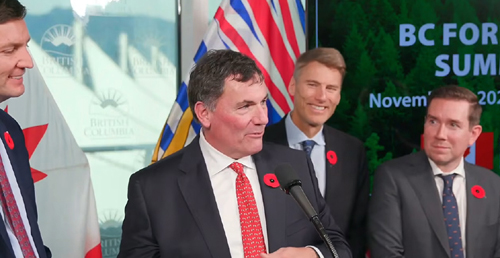
In Vancouver today, BC hosted a BC Forestry Summit about the softwood lumber sector.
Premier David Eby hosted Dominic LeBlanc, federal Minister responsible for Canada-U.S. Trade, Intergovernmental Affairs, Internal Trade and One Canadian Economy, who has been the lead negotiator for Canada in trade talks with the United States over the past many months.
Also on-camera for the press conference this morning were Gregor Robertson, federal Minister of Housing and Infrastructure and Minister responsible for Pacific Economic Development Canada; Tim Hodgson, federal Minister of Energy and Natural Resources; and Parliamentary Secretary to the Minister of Energy and Natural Resources, Corey Hogan (MP for Calgary Confederation).

Attending as well from the BC cabinet were B.C.’s Minister of Jobs and Economic Growth Ravi Kahlon and Forests Minister Ravi Parmar.
Acknowledging the federal lead:
Eby opened his remarks at this morning’s presser in Vancouver by thanking the federal ministers and MPs “who showed up this morning to discuss this crucially important issue for British Columbia”.

Foundational sector:
“Our softwood sector is foundational to British Columbia. It is one the largest employers, one of the biggest contributors to our provincial GDP, and when you look across the country it’s larger than the automotive sector, it’s larger than aluminum and steel combined, and has an impact right across the country,” said Eby.

Sizable forestry sector:
Of course, the BC forestry sector impact right across the country has to do with supplying lumber to a number of key sectors including housing. Perhaps the longstanding presence of softwood lumber in the Canadian lifestyle and economy has been so fundamental that it has been taken for granted.
“It deserves to be treated with the seriousness and respect that a sector of that size should command,” said Eby today.

“I’m confident saying — coming out of this meeting — that the federal government understands that. We spent a lot of the meeting talking about the importance of this sector to communities large and small, across the province,” said Premier Eby.
“We have a shared commitment to work together to address the crisis that the sector faces – the unfair and unjustified tariffs imposed by the White House on this sector directly threatens (BC and Canada / inaudible). “And without imminent action that things will get significantly worse for families and for communities across the country and particularly in British Columbia.

Agreement for federal and provincial progress:
Coming out of the meeting, Eby said there is agreement to a table of deputy ministers (federal and provincial) and senior representatives from a political level — task force or working group — over a period of weeks, not months, on supports for the sector.
“BC has put forward a number of specific proposals to the federal government. We discussed those proposals in detail this morning. We heard from the senior representatives of the labour movement as well. We have a commitment from the federal government — a very positive response to that — to work with us to ensure we’re delivering that,” said Eby.

One voice:
“We are going to remain unified and together on communications, on strategy — so that British Columbians and Canadians know that the federal government and the provincial government are in their corner — standing up for them and speaking with one voice on this,” said Eby today.
Eby thanked LeBlanc in particular “for the leadership he has shown on this file” as well as Taleeb Noormohamed, MP (Vancouver Granville) for facilitating the meeting and all the representatives “for taking this as seriously as it deserves and working with British Columbia”.

Weaving BC into the Canadian fold:
Minsiter LeBlanc told media today that “it was a privilege for me and four of my cabinet colleagues, two parliamentary colleagues to be here with you premier, and your cabinet colleagues, to talk about the importance of the softwood lumber sector obviously in British Colubmia”.
Softwood lumber is “massively important to the GDP of this province but it is to the country as well,” said LeBlanc today.
“So I was able to update the premier on the negotiations with the United States, on the conversations we had had previously with the Americans,” said LeBlanc who has led the trade negotiations for Canada over most of this year.

Acknowledging the obvious important of softwood lumber to the Canadian economy, LeBlanc committed to Eby that the federal government would “work with him and colleagues when and if those negotiations resume in the short term, to ensure that we’re buckled up”.
“But as the premier said, we’re not going to wait. Because the hour is grave, the moment is serious for us, to continue to work together and to adjust and increase the supports that the province and the government of Canada can put in place together to support the sector and the women and men who work in British Columbia and every part of the country,” said LeBlanc in Vancouver today.
“This is a critical industry to the fabric of the whole country. We see British Columbia as a dominant player in Canada in this industry, that’s why we thought it was important for us to hear directly from the premier, from his government, and from representatives of the workers in the industry,” said LeBlanc.
“But we will as a national government of course be having conversations with other partners across the country as we quickly put together measures that will support this sector in British Colubmia and across the country as we face these unjustified American tariffs,” said LeBlanc today.
“We took stock of the work that the BC sector is doing in this province,” said LeBlanc about BC’s position on things. “We recognize the urgency of the moment.”
“We’re very quickly ensuring that the government of Canada is the most effective and reliable partner to the province of BC in getting those federal supports that the prime minister announced a few months ago — out the door in the most efficient and effective way. But are obviously open to working with the sector and provinces that in every region of the country we’re hitting the target,” said Minister LeBlanc.

Funding:
Eby said that BC’s forestry sector should have access to the federal funding that has already been announced to support workers and sectors impacted by the US tariffs. Some funds have been not accessed or applied for yet, the premier said.
Some of the those resources will be ‘fast tracked so we can access those resources immediately for the forest sector,” said Eby today.
The forest sector is “incredibly diverse” says Eby, from very small shops to big internationally traded companies. Eby wants to make sure there are supports in place to support the diversity of workers in the sector.
Eby noted that pivoting to new markets for softwood lumber “is crucially important”. He is hopeful all this will be implemented as quickly as possible.
The Business Development Bank of Canada was at the table today. They’re responsible for allocating the lending measures that were set out by the prime minister, Eby explained. “We got an update from them that the money is rolling out,” said Eby.
The message is always the same for Eby: “That we see a fair representatives of BC companies and individuals benefiting from these federal programs on a per capita basis.”
For weeks, Eby has been making the case that forestry is as important to the Canadian economy as energy, steel and aluminum which have been getting the lion’s share of mention and attention in political debate about the trade war (and possibly also actual Canada-US trade negotiations).

COFI response:
“We are pleased to see the federal and provincial governments working together with urgency to ensure predictable access to logs, streamline regulations, and create conditions for companies to invest, innovate, and keep people working — even when markets are challenging,” said Kim Haakstad, President & CEO of the BC Council of Forest Industries (COFI) in response to the outcomes of the BC Forestry Summit today.

“Combined with uncertain wood supply and prolonged trade disputes, many forest products companies are now on the brink of closure. To give companies a fighting chance to stay open, we need a coordinated federal–provincial work plan that strengthens competitiveness and sustains jobs in forest-dependent communities,” said Haakstad in COFI’s statement today.
Forestry tariff social media ads will not be posted:
A set of social media ads about forestry sector tariffs that were set to be released this week will not be released. The impact could have been disruptive to the solidarity that is clearly needed by Canada when dealing with the United States over trade issues.
A TV commercial released by Ontario in a similar antagonistic tone toward the US ended up seeing Prime Minister Carney on the spot and having to apologize to Trump last week after Trump suspended trade negotiations.
Carney and Canada-U.S. Trade, Intergovernmental Affairs and One Canadian Economy Minister Dominic LeBlanc still have a big job on their hands to steer Canada’s economy and sovereignty through rough waters.
It was made abundantly clear today that BC will fall in line with what Carney is trying to do with regard to Canada-US trade negotiations.

===== RELATED:
- BC won’t run anti-US ads about forestry tariffs, will cooperate with federal strategy (November 3, 2025)
- New BC forest trade office opening in England (October 27, 2025)
- BC may launch Canada-Russia-US forestry tariffs social media campaign (October 26, 2025)
- Op-Ed: BC government must act decisively to stabilize the forestry sector (October 23, 2025)
- Premier’s statement on softwood lumber (BC Government news release – April 5, 2025)
- NEWS SECTIONS: TARIFFS & TRADE | USA-CANADA | CANADA-NATIONAL | FORESTRY