


Tuesday August 12, 2025 | VICTORIA, BC
by Mary P Brooke | Island Social Trends
On Friday August 8, it was announced by the United States that their Department of Commerce’s final determination is to more than double countervailing duties on Canadian softwood lumber imports—from 6.74% to 14.63%.
British Columbia accounts for about one-third of Canada’s softwood lumber production, and about 40 percent of Canada’s softwood exports to the United States.
BC Forests Minister Ravi Parmar on July 25 released a statement in response to the softwood lumber anti-dumping duties announced by the United States. And over the last two weeks has appeared in national TV media to explain the challenge to the softwood lumber sector under the current scenario of increasing export pressure on the BC softwood lumber sector. but also responding to Prime Minister Carney’s support for the softwood lumber sector (over $1 billion in loans and grants).
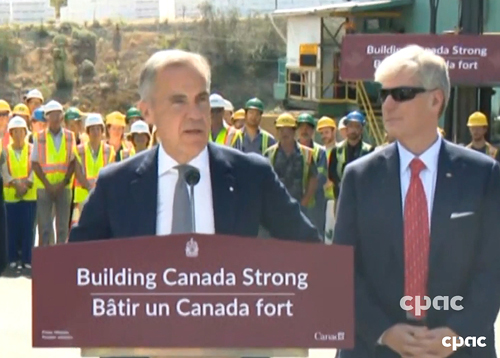
“The forest industry is a pillar of the Canadian economy,” said Carney on August 5 in West Kelowna. “It supports 200,000 jobs across the country, contributes more than $20 billion directly to our GDP. It’s the economic backbone of nearly 300 rural, Indigenous and northern communities, many of them right here in British Columbia,” the Prime Minister said at his announcement that day in BC.
On Friday August 5, on CBC Power and Politics, Parmar told host Katie Simpson regarding the federal announcement: “This is really good news. We have been calling on the federal government for the number of months to ensure that it is stranding strong with British Columbians and forestry workers from coast to coast to coast as they deal with these unjustified softwood lumber duties.”
At that point in the time, the countervaling duties were set to go up “very soon”, and that indeed happened on August 8.
Parmar described the Section 232 so-called justification from the US (i.e. that there is a security threat from Canada by selling lumber into the United States) as “ludicrous”.

August 8 increase:
With duties and tariffs combined, the overhead for softwood lumber exports to the United States is over 30 percent.
The U.S. Department of Commerce’s final determination was to more than double countervailing duties on Canadian softwood lumber imports—from 6.74% to 14.63%. This comes on top of the previously announced increase to anti-dumping duties, now set at 20.56%, bringing the combined total to a crippling 35.19%.
On August 8, further statements were released by the BC Council of Forest Industries (COFI) and the BC Lumber Trade Council, both outlining the damage that will result for the forestry sector, softwood lumber businesses and workers in the sector.

A shift to long-term support:
“We hope that there’s a long-term softwood lumber deal but in the interim, the support is widely needed,” said Parmar about Carney’s promise for softwood lumber sector support.
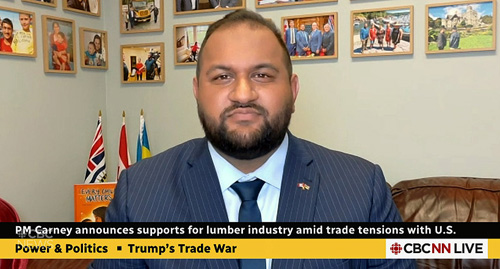
As for anything else that the BC Forests minister would have hoped to hear from the federal government on softwood lumber: “I’m looking forward to getting into the details. British Columbia is the forestry capital of the world. We are the second largest exporter of softwood lumber into the entire world, except into Russia,” said Parmar on August 8.
So Carney’s announcement “is a big deal for us, just like the auto sector is a big deal for Ontario, forestry is a big deal for British Columbia”. The announcement shows “liquidity supports and diversification supports”, says Parmar.
Parmar looks forward to working with Federal Minister of Energy and Natural Resources Tim Hodgson on ensuring that British Columbia “gets its fair share of those dollars, particularly capital funding that I hope will be able to transform this sector as the prime minister talked about”, said Parmar on CBC last week.
That would be “not only for providing more lumber domestically but also looking at those international partnerships that we need to develop further,” said BC’s Forest Minister who added that BC forestry had not been a priority with the federal government until now. There is now a federal parliamentary secretary dedicated to this file and BC Premier David Eby is having direct conversations with Carney on this file. “It’s a night and day comparison,” said Parmar, regarding the way softwood lumber was handled under the previous Liberal government compared to the ‘new’ Liberal government.

Agencies like Canada Wood are being reinstated.
Can the BC softwood lumber industry survive if it doesn’t have access to the United States?
“We’re always going to be trading partners with the United States,” said Parmar in his CBC interview. “Americans are going to finding out very shortly the impact these duties are going to be having on them,” in that building new homes will become more expensive in the USA as a result of the export-related increases.

All three statements (Forests Minister, COFI and BC Lumber Trade Council) are posted below.
===== RELATED:
- New measures to transform Canada’s softwood lumber sector (August 5, 2025)
- Forests Minister Parmar: combating US-imposed tariffs on BC forest sector should be federal priority (July 26, 2025)
- NEWS SECTIONS: FORESTRY | CANADA-NATIONAL | CANADA-USA | BUSINESS & ECONOMY
Forest Minister’s Statement on US Antidumping Duties
BC Forests Minister Ravi Parmar
VICTORIA, BC (July 25, 2025): “U.S. President Donald Trump has made it his mission to destroy Canada’s economy, and the forestry sector is feeling the full weight of this.

“It is no secret, the sector — one that employs tens of thousands of workers in our province — has faced years of uncertainty, driven by ongoing trade disputes, global market pressures, and the compounding effects of climate change. Now, we face further challenges, with rising unfair and unjust duties imposed by the United States.
“These duties are nothing more than a tax on middle-class Americans trying to build or rebuild a home. They are hurting people on both sides of the border, with the forestry sector being unfairly targeted.
“Let me be clear: we will not stand by while Donald Trump tries to rip paycheques out of the hands of hard-working people in B.C.
“We’re going to fight for our workers, our communities and the future of this sector. Not just to protect jobs, but to build a future where forestry workers and their families thrive for generations to come.
“Premier David Eby is at the table with other premiers federally discussing our Team Canada approach and response. In B.C., I will be convening my Softwood Lumber Advisory Council to advise and support our government’s response and strategy.
“I have appointed former deputy minister to the premier, Don Wright, as a strategic advisor on softwood lumber, to ensure B.C.’s interests are well represented, and to help us align with federal and cross-provincial efforts.
“We will continue to take action to address the challenges the forestry sector is facing because this is about more than lumber; it’s about people and place. By working together with industry, First Nations and communities, we can build a resilient and sustainable forest economy that works for people, protects our resources, and ensures long-term prosperity for everyone in B.C.”

BC Council of Forest Industries (COFI)
The BC Council of Forest Industries (COFI) represents forest tenure holders and manufacturers of wood products, pulp and paper, biofuels, and bioenergy in British Columbia.

Vancouver, BC (August 8, 2025) – The BC Council of Forest Industries (COFI) condemns the U.S. Department of Commerce’s final determination to more than double countervailing duties on Canadian softwood lumber imports—from 6.74% to 14.63%. This comes on top of the previously announced increase to anti-dumping duties, now set at 20.56%, bringing the combined total to a crippling 35.19%.
“These unjustified actions continue to harm workers, families, and communities on both sides of the border,” said Kim Haakstad, President & CEO of COFI. “To mitigate these harms, we must focus on what we can control, which is the competitiveness of the B.C. forestry industry within Canada.”
Haakstad emphasized that B.C. is Canada’s largest producer of softwood lumber, yet the sector faces mounting challenges, including rising costs, declining harvest levels, regulatory delays, and policy uncertainty. “If we don’t take urgent action to improve our business climate, we risk losing more mills, jobs, and economic opportunities,” she said.
COFI is urging the provincial government to take immediate action to improve the business environment for forestry in B.C. This includes streamlining permitting processes, activating provincial timber sales, removing cross-ministry bottlenecks, and enhancing partnerships and revenue sharing with First Nations to ensure a sustainable and reliable wood supply for mills.
“With the right policy tools, B.C. can send a strong message that it is committed to creating a climate where primary and secondary forest manufacturers want to invest, ensuring a steady supply of wood products for B.C., Canada, and beyond,” Haakstad added.

BC Lumber Trade Council
The BC Lumber Trade Council (BCLTC) represents the majority of British Columbian lumber producers on trade matters

Vancouver, BC (August 8, 2025) – The BC Lumber Trade Council (BCLTC) is expressing strong concern following the U.S. Department of Commerce’s final decision to more than double countervailing duties on Canadian softwood lumber imports—from 6.74% to 14.63%. Combined with the recently increased anti-dumping duty of 20.56%, the total duty level now stands at 35.19%.
“This decision will harm communities on both sides of the border,” said Kurt Niquidet, President of the BC Lumber Trade Council. “It places unnecessary strain on forestry-dependent regions in Canada while driving up construction costs for American builders and families. What is needed now is a stable, negotiated agreement that supports jobs, trade, and housing affordability.”
BCLTC is calling on both the Government of Canada and the U.S. Administration to make resolving the longstanding softwood lumber dispute a top economic priority.
“We believe the best way forward is through meaningful negotiation—not litigation,” Niquidet added. “A durable agreement would bring certainty to a critical cross-border supply chain and support the long-term interests of both countries.”
In the absence of a negotiated settlement, BCLTC will continue working closely with the Government of Canada and industry partners to defend Canadian interests through all available legal channels, including proceedings under the United States–Mexico–Canada Agreement (USMCA).
“Lumber producers in British Columbia compete in an open, market-based system and receive no unfair subsidies,” Niquidet emphasized. “We will continue to stand up for Canadian producers—and for the thousands of workers and communities whose livelihoods rely on a stable, rules-based trading relationship with the United States.”