



Thursday April 2, 2026 | WEST VANCOUVER, BC [1:36 pm PT]
by Mary P Brooke | Island Social Trends | BC FERRIES UPDATES
With the busy travel period of Easter weekend coming up, BC Ferries addressed media today regarding a few recent issues with services of the fleet.
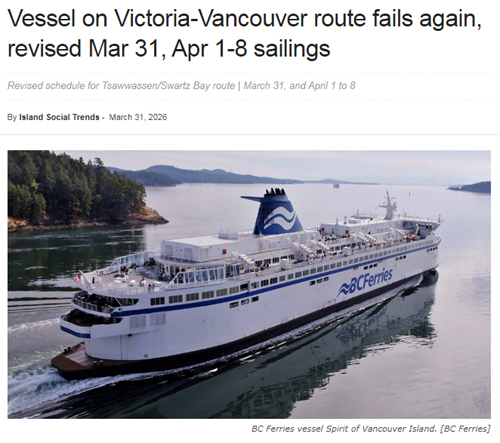
- Problems with the Spirit of Vancouver Island major vessel on the Tsawassen-Swartz Bay route (Vancouver/Victoria) has produced a revised schedule for this week and over the Easter long weekend. It will take at least another 24 hours for engineering teams to complete analysis and work to address the issues. BC Ferries will “flood the communication channels” to communicate with customers who have travel plans already.
- The Queen of Surrey vessel serving Nanaimo has been interrupted, with service expected back online toward the end of this weekend. BC Ferries is “working furiously to get that ship ready to go”.
“Safety is the foundation of everything we do inside this company,” said BC Ferries Nicolas Jiminez today, as an overarching concept for all that the service undertakes to get people where they need to go.
“Our teams want to provide the service that we’re committed to providing,” the CEO said as to the enthusiasm and intent of BC Ferries to deliver for travellers.
Living on an island involves dependence on ferry travel. This impacts people who live and work on Vancouver Island, the Gulf Islands and other smaller islands in northern coastal regions. All goods shipped into and out of island economies include the cost of transport (whether by trucks on ferries, or by air).
Adverse weather or mechanical issues are dealt with as they come up. There is an “investment of time and money” to make sure the fleet “remains technically available”, said Jiminez today.
“The system generally speaking keeps the promises it makes to customers.” He repeated several times that “reliability numbers” are above 99%, also mentioning 99.8%.
Investments are designed to ensure the ability to standup the sailings, said Jiminez.

Annual maintenance:
Many ships in the fleet are aging. Between September and May (which used to be September to June), 21 ships go through maintenance and refit.
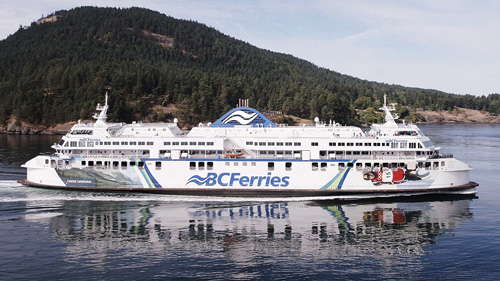
“We do this in a very compressed time frame because we want to be ready for our peak season,” said Jiminez, adding that increasing use of ferries for travel is compressing the traditional maintenance period.
Peak travel, peak seasons:
In last couple of years the BC population has increased in and of itself, and people are relying more on ferries overall, said Jiminez. Service levels have surpassed pre-COVID levels in order to keep up.
Travel on ferries is part of vacations and ‘life’ (e.g. needs for medical appointments, family visits, and employment obligations).
Peak usage on BC Ferries vessels is seen in the travel seasons around Family Day weekend, March break, Easter long weekend, Thanksgiving weekend and Christmas.

FIFA travel surge:
This year an additional peak period will be when many more people are in BC to take part in FIFA World Cup Games and related activities. The first game at Vancouver’s BC Place will be in mid-June.
“We tried to organize our refit periods to make sure we can stand up the system a little bit earlier,” the CEO said, with regarding to the upcoming FIFA load.

“We are working extra hard to be ready for the surge in people — earlier than normal,” the CEO explained, who said his confidence level is high.
No resilience in the system:
“We don’t have relief inside our fleet. We need investments – not just replacing the ships that we’ve got – but there is no resilience in the system,” said Jiminez in defending the need for a fifth major vessel in the system to support user demand on the major Vancouver-Victoria route.
The BC Ferries system is “running at peak and every ship is operating”, says Jiminez. “The ships are old but they work very well,” he said today.
Interruptions cause challenges for travel. “If one ship is operating at mechanical failure we have nothing in the system,” the CEO told media today.
He says that BC Ferries “has made the argument to the regulator that the system needs more relief and resilience”.
BC Ferries regulated by the BC Ferry Authority — a corporation which is essentially owned by the Province of BC (the province holds all the shares).
We can make the case for change but it’s up to others to agree and allow those investments to occur.

New ships coming:
Four island class vessels will be delivered this year and early next year, said Jiminez today. Just a few weeks ago the tenth Island Class Vessel was launched from a shipyard in Romania.
BC Ferries is spending “hundreds of millions in building four new major vessels”. Those ships are nearing completion of design, with cutting of steel in the fall and the building process coming in 2027 and 2028 — to be ready for service in 2029.
BC Ferries got significant public and political heat last year when the new major vessels contract was announced in June 2025, for all being contracted with a shipyard in in China.
“You can’t buy and build ships overnight. It does take time,” Jiminez stated today as the obvious, adding that the goal is to make ships be as reliable as possible. They are spending millions to rebuild the fleet, he reminds.

Fares up, budget shortfall:
Fares for vehicles and passengers on BC Ferries sailing go up nearly every year. Fares are set to go up on April 8, 2026 for walk-on, drive-on and making standard vehicle bookings.
“Rather than applying a flat increase to all fares, BC Ferries is making targeted adjustments that average to the 3.2 per cent overall increase approved by the BC Ferry Commissioner,” states BC Ferries.
- Both drive-up and prepaid fares for a standard vehicle and adult will increase to $110.
- Foot passenger fares will increase by $1 to $21 for an adult and by $0.50 to $10.50 for a child.
- Foot passenger saver fares will remain at $15 for adults and $7.50 for children.
- On minor and northern routes, fares will increase between $0.95 to $2.05 for a standard vehicle and between $0.40 to $0.60 for adult passengers, depending on the route.

Infrastrcuture upgrades:
“Huge investments” are required to modernize the fleet and its infrastructure.
Jiminez notes the Horseshoe Bay Terminal at West Vancouver (where today’s media conference was delivered from) as being old (constructed 60 to 70 years ago) and is currently a construction zone.
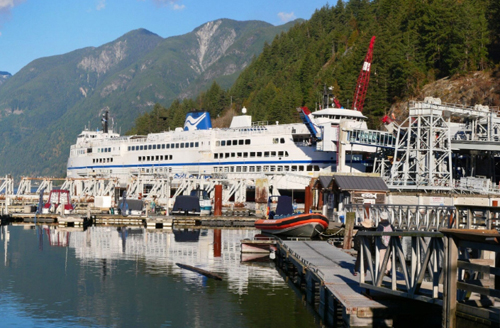
“It requires a lot of work to maintain in a safe way,” the CEO said.
The shipyard investment in Richmond is being upgraded to perform more effectively with modern infrastructure, Jiminez outlined as case in point.
They continue to hire engineers and trades to maintain new and old ships. The infrastructure at 47 terminals needs constant maintenance — half of them need substantial work to operate safely, the CEO said today, citing the need for “hundreds of millions to sure that work is happening”.

Revenue gap:
There is a gap in terms of revenues and costs to run this system, being a capital intensive service. That will be additionally noticeable in 2027-2028 as new ships come on stream. There will be “a gap to run system versus fleet online”.
“Systems like this cost a lot of money to run,” says Jiminez. This fall, BC Ferries will “lay bare the realities of the system”.
Among other things, there needs to be a fifth vessel, something the BC Ferries Commissioner has turned down.
Last year, BC Ferries said there needs to be a 5th vessel in order to ensure service levels (when other vessels need downtime for repairs).
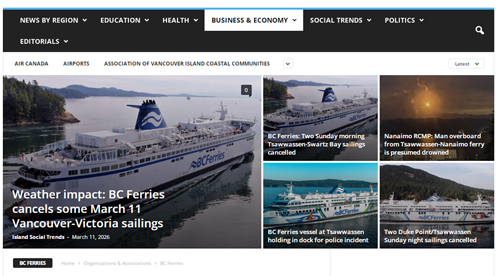
===== RELATED:
- BC Ferries: some cancelled Nanaimo-Vancouver sailings April 2 & 3 (March 31, 2026)
- Vessel on Victoria-Vancouver route fails again, revised Mar 31, Apr 1-8 sailings (March 31, 2026)
- BC Ferries returns repaired vessel to Victoria-Vancouver route on March 29 (March 29, 2026)
- BC Ferries March 24 Vancouver-Victoria cancellations (March 24, 2026)
- BC Ferries launches 10th Island Class vessel (March 19, 2026)
- Four new major BC Ferries vessels to service major routes (March 31, 2025)
- NEWS SECTIONS: BC FERRIES | TRAFFIC | TRAVEL & TRANSPORTATION | COASTAL BC