


Monday December 15, 2025 | VICTORIA, BC [Posted at 6:23 pm | Updated 6:42 pm]
Editorial analysis by Mary P Brooke | Island Social Trends
What’s in the future for BC’s economy?
Each year, BC’s finance minister meets with economists from across the country to glean some insights on that very question.
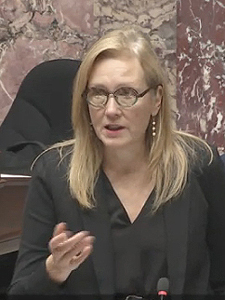
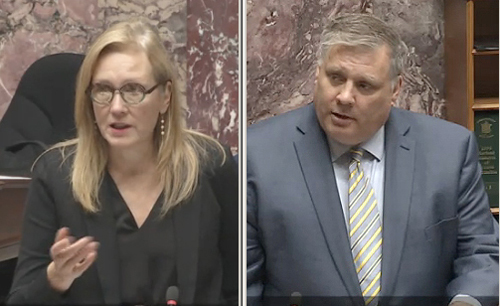
BC Finance Minister Brenda Bailey held the province’s annual Economic Forecast Council meeting last week with eight economists.
Each delivered their assessment of where the economy is at and where it might head in 2026 and beyond — both federally and with a focus on BC (these prepared statements can be updated up to January 6, 2026).
And then in a round table format they addressed particular issues of interest to Minister Bailey in her work ahead of preparing Budget 2026 including the federal budget, immigration and skilled labour, growth of the tech sector, tariff war and trade impacts, retail and housing.
The annual get-together was done remotely this year (and last); in prior years the exercise usually brought economists in from across Canada to attend in person. This might be one example of how travel costs in government are being trimmed, as Bailey has pointed to in various media availabilities.

Productivity is weak:
Most of the economists had similar views of the current status of the overall Canadian economy, including about productivity being weak. Nothing new there — it’s been the case for about 25 years now, highlighted by economists (including now Prime Minister Mark Carney when he was in the private economic sector).
Now the stark and grinding impact of tariffs and the ongoing uncertainty as to trade with the United States put additional pressures on attracting or encouraging investment that would lead to productivity (i.e. more money generated from business activity and more jobs producing tax revenues).
There was concurrence among the economists on December 8 about a ‘K-shaped’ economic scenario at this time of economic transition. That’s a post-recession recovery scenario where different parts of the economy bounce back unevenly (when seen on a graph the lines go in separate directions as do the two lines in the letter ‘K’).

Improving productivity and resilience:
Improving productivity requires having more skilled workers and companies that produce more economic activity and profit. Nationally this is the broad approach of the Carney Liberal government and is well understood in BC where a significant investment in trades and health-care worker training has been undertaken. BC is also developing now four of the major projects (e.g. mines and LNG facilities, supported by an expanding electricity grid in the northwest) that have backing from the federal Major Projects Office.
Those are all long-term strategies that will be helpful and therefore impactful. But an economic boost is also needed in the short term said some economists to the BC Finance Minister last week. They suggested some supercharging of the housing sector — perhaps by allowing in foreign investment in new-housing development (which seemed like a throwback to a real estate sector problem that the BC NDP had fixed).
Bailey pointed out that trades training is already indeed a BC NDP government focus so that workers are available to build new housing and infrastructure. She heard from one or two economists what BC already knows (and has led the way in) that wood frame housing construction is cheaper; mass timber construction has been a thing in BC for many years now.
However, to put it bluntly — some of the economists (most of them with Canada’s major banks but also the Bank of Canada, a credit card company, a credit union, and a real estate association) feel that BC should be more aggressive in terms of assigning investment to economic growth more than putting a protective ring around societal economic supports.

Finance Minister Bailey seemed to rankle upon hearing that, as ‘putting people first’ is the cornerstone of the BC NDP raison d’être for being the governing party. As well, she seemed struck by the comment from one of the economists that the trust level in the BC budget needs to be improved (implying there was camouflage by accounting, as it might be put).
One economist went so far as to say that the Canadian economy is in significant trouble if not bordering on sinking into a Depression. To BC in particular, one economist advised being as thoughtful and as aggressive as possible.
Population growth through in-migration to BC was robust in post-recession years (but not so much this year) which put a burden on BC’s functionality in terms of housing availability and the capacity to fulfill on social supports such as education and health-care. However, overall, BC’s birthrate has hovered at net zero for years (births only barely compensating for deaths). It almost went without saying at the EFC that well-financed skilled immigration is essential to help boost BC’s workforce until job retaining of current BC workers catches up.
One economist said that political leadership is always important in economic matters for a country and for the provinces, especially now. That could include talking more directly to businesses and households about the need to be aggressive with BC’s economic strategy (a flavour of the ‘sacrifice speech’ that Carney delivered to university students in October). That might include a restructuring of income tax levels to incentivize investors to relocate into Canada.

BC Conservative critique:
On most of the key points presented by economists last week, BC Conservative Finance Critic Peter Milobar agrees. He says he would want to see more productivity in BC, bringing in more investment and adjusting the tax rate to be more attractive to investors.
In this regard, it indicates how the economic stance of BC’s official opposition party aligns with the bankers and investment pundits. The emphasis is on wooing investment to BC with the hope of a productivity boost but there is no guarantee in that for producing a trickle-down boost for the rest of the population.
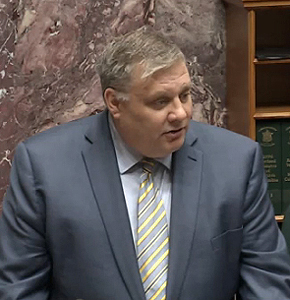
Milobar attended last week’s EFC and tells Island Social Trends that there was he heard “nothing of a shocking nature”, that much of the financial profile sounded like the second quarterly report (released on November 27 by Finance Minister Bailey). The second quarterly report included indicators of a soft job market and that consumer spending (relied upon for provincial sales tax revenues) will head downward.
Milobar supports job growth so as to increase the tax base. He says the BC Conservatives support removing interprovincial trade barriers to boost competition. The NDP government is working on both those things.
Milobar points to education and health as things “that we all rely on” and need to be protected. Though he worries about federal health care funding transfers being frozen or even diminished if the federal government finds themselves in a fiscal squeeze; that would see the provinces having to do the same or more with less.
The BC Conservative finance critic is also worried about the province possibly spiraling into operating debt and notes “continual downgrades” to BC’s credit rating. BC has the highest marginal tax rates which produces a competitive disadvantage, says Milobar.
He echoes what some of the economists said last week that the BC government’s budget appears to possibly be ‘fudging’ the true picture. The Finance Minister has repeatedly said that generally accepted government account practices are used in preparing the quarterly reports and the budget. Milobar says there are ‘questionable projections’ in both.
Milobar points to removing the carbon tax (which in BC politically followed the federal government’s cancellation of that consumer-level tax) which added to BC’s debt load overnight. He mentions the cigarette settlement money was applied to general revenues instead of the health care budget (though a few months ago Minister Bailey pointed out that over the past several years the province has proceeded with cancer care related to lung disease from smoking, regardless).
In the legislative assembly on December 2 Milobar presented a bill that would overturn a low-carbon fuel tax on airline fares (which comes into effect January 1, 2026) saying there will be a knock-on impact on the tourism sector. The NDP response was that it wouldn’t make a lot of difference to people’s travel plans.

On December 2 in the House, Green MP Rob Botterell pointed out that maintaining the consumer carbon tax would have reduced the provincial deficit by 25%.
Then-leader of the BC Conservatives John Rustad said during the December 2 legislative session that debt sends money to banks instead of to British Columbians and the local economy.
Bailey defended the debt with this example: “When we began our work in 2017 we inherited a deficit of hospitals and schools. We have built infrastructure that was very much flattended,” said Finance Minister Brenda Bailey on December 2 in the legislature. “When you build hospitals you’ve got to put people in them to run them. When you build schools you put teachers in them to teach. It’s important that we continue to do the work to make things more affordable for British Columbians.”
Milobar pointed to frequent hospital closures mostly in rural BC (resulting from insufficient staffing).
Tech sector:
With the fast uptick in use of artificial intelligence (AI) across all economic sectors and daily life for businesses and households in the not too distant future, there is room for effective investment in technology.
Milobar recognizes the investments being made by the NDP government in the Vancouver-based tech support (such as in the gaming industry and bio life sciences) but insists that BC’s productivity could be boosted by investment in technological innovation in the resource sector, the forest sector, clean technologies and heavy equipment. That would be a boon to the rural interior and northern regions of the province, he says.

- The BC Government issued a forestry clean-tech innovation strategy in 2017, for the years 2016-2024. The BC Forest Innovation webpage was last updated in April 2024.
- A forest innovation program was launched federally in 2012, a program that was updated in 2023.
- There is forestry tech innovation research being done at the University of British Columbia including in computing, imaging, communications technology, and DNA sequencing.
Aging population:
It’s not new at all to recognize that BC’s population count is lopsided to the older-person side. Many older people retire here and/or live longer in part due to the more temperature climate than in other parts of Canada.
As people age their reliance on the health-care system usually increases. This is impactful on the acute care system (hospitals, clinics, doctor’s offices) as well as for long-term care.

The BC NDP government knows that helping people age in place at home is far more cost effective (and healthier) than having them live in communal settings like long-term care. Opposition finance critic Milobar challenges the BC government to achieve better results in this area including maintaining or increasing long-term care spaces as well as further boosting supports for programs and organizations that deliver various aspects of home-care.
Federal budget:
The economists advising BC Finance Minister Bailey on December 8 highlighted that the Carney Liberal federal budget focuses on defence spending. One economist said it equates to $3,500 per year per household, calling that a ‘big number’. That might be achieved by paring back the overall growth rate and also health-care transfers to the provinces. People would feel that.
One of the economists went so far as to say that the federal budget’s framework to achieve the defence spending target is “sound’, adding there should be some spending on growth enhancements in the short term but not if it impacts long-term productivity. That economist sees a three- to five-year timeline for this impact to dig into how the country experiences economic wellness.
Defence spending is linked with protecting Canada’s sovereignty, which seems more necessary in the face of aggression from countries that might hold non-democratic views and goals being achieved through aggression (whether economic, military, cyber or biological).
Another big chunk of the federal budget — if well applied — can support an explosion in creating more housing supply as well as enhancing the country’s electricity generation and distribution grid.
Another of the eight economists on the EFC call last week said that borrowing in he federal budget offers the illusion of being a fiscal anchor. Though arguably, how does a nation respond to the intense challenges of urgent trade diversification and various industrial sectors crumbling under the impact of tariffs without borrowing to keep things afloat at least in the short term.
If those who are supported use the funding and gift of time for the necessary work of restructuring, that is really the only way out and forward. Just as a small business would do when faced with pivoting. The COVID pandemic years oddly enough in some ways prepared the Canadian psyche for this.
===== RELATED:
- More on the Economic Forecast Council meeting of December 8 (article to come – week of December 15)
- Why the BC Conservatives would lead a better economic direction (article to come – week of December 15)
- BC Jobs & Economic Growth Minister Ravi Kahlon takes Look West to Ottawa (December 10, 2025)
- NEWS SECTIONS: BUSINESS & ECONOMY | ECONOMY | BUDGET 2026