


Wednesday April 29, 2026 | TORONTO, ON [Posted 6:54 am PT]
by Mary P Brooke | Island Social Trends
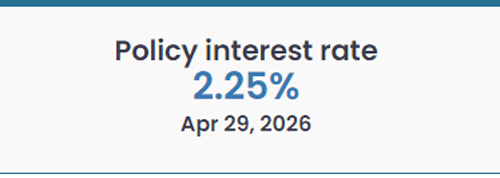
The Bank of Canada has maintained their policy interest rate at 2.25% with the Bank Rate at 2.5% and the deposit rate at 2.20%.
The announcement came at 9:45 am ET this morning (6:45 am PT). More statements to come after the press briefing.
Uncertainty is seen as resulting from the Middle East conflict as well as continued US trade policy developments. Supply chain interruptions have happened due to the interrupted shipping channels in the Iran region and by choice Canada is undertaken trade diversification in response to the US trade challenge.
Here is the Bank’s full April 29, 2026 statement:
The evolving conflict in the Middle East is causing heightened volatility and US trade policy continues to reshape global trade patterns. Both are ongoing sources of uncertainty. The Bank’s April outlook assumes tariffs remain unchanged and the global benchmark price of oil declines to US$75 per barrel by mid 2027.
The Iran war has led to sharply higher energy prices and transportation disruptions, diminishing growth prospects in oil-importing countries and boosting inflation worldwide. In the United States, growth is still expected to be solid over the projection horizon, boosted by AI-related investment and consumption growth. China’s economy is being supported by robust exports. In the euro area, higher prices for oil and natural gas will weigh on economic activity.
Financial conditions have been volatile, reflecting daily developments in the Middle East and shifting market expectations for inflation and interest rates. Bond yields are modestly higher since January while equity markets, which weakened sharply at the outset of the war, have recovered. Since the start of the war, the US dollar has appreciated against most major currencies. The Canada-US exchange rate has been relatively stable.
Overall, the global economy is expected to grow by about 3% in 2026, 2027 and 2028. Projections for inflation over the next year are revised up because of the jump in energy prices.
The outlook for economic growth in Canada is little changed from the January Monetary Policy Report (MPR) projection. After a contraction in the fourth quarter of 2025, growth is forecast to have resumed in early 2026. Consumer and government spending are supporting economic activity, while tariffs and trade uncertainty are weighing on exports and business investment. Housing activity declined in the fourth quarter and is being held back by slow population growth, economic uncertainty and ongoing affordability issues. The labour market is soft, with subdued employment growth over the past year and job losses in sectors targeted by US tariffs. The unemployment rate remains in the 6½%‑7% range, reflecting both weak hiring and fewer job seekers.
The Bank’s April forecast projects GDP growth of 1.2% in 2026, rising to 1.6% in 2027 and 1.7% in 2028 as growth in exports and business investment resumes along a lower trajectory. With GDP growing slightly above potential, the current excess supply in the economy is gradually absorbed. While the war in Iran may alter its composition, overall GDP growth is little changed in the updated forecast: Since Canada is a large net exporter of oil, higher oil prices increase national income even as consumers are squeezed by higher gasoline prices.
CPI inflation climbed to 2.4% in March because of sharply higher gasoline prices. The March increase follows several months of slowing inflation data. Core inflation has been easing and held steady at just above 2% in the most recent inflation report. The proportion of components of the CPI basket rising above 3% has also declined in recent months. As expected, so far there is little evidence that oil prices have fed through more broadly to goods and services prices, but this warrants close attention in the months ahead. Near-term inflation expectations have moved up with higher gasoline prices and still-elevated food price inflation, but longer-term inflation expectations have remained anchored.
CPI inflation will likely rise further in April to about 3%. Based on the assumption that oil prices will ease, inflation is forecast to come down to the 2% target early next year and remain around 2% over the projection horizon.
Against this backdrop and taking into account the current projection, Governing Council decided to maintain the policy rate at 2.25%. We are closely monitoring the impact of the conflict in the Middle East and how the economy is responding to US tariffs and trade policy uncertainty. Governing Council is looking through the war’s immediate impact on inflation but will not let higher energy prices become persistent inflation. As the outlook evolves, we stand ready to respond as needed. The Bank is committed to maintaining Canadians’ confidence in price stability through this period of global upheaval.
===== RELATED:
- Bank of Canada holds interest rate at 2.25% amidst Iran conflict uncertainty (March 18, 2026)
- Bank of Canada holds interest rate at 2.25% (January 28, 2026)
- Bank of Canada interest rate expected to remain at 2.25% on Jan 28 (January 26, 2026)
- NEWS SECTIONS: BANK OF CANADA | AFFORDABILTY | BANKING & FINANCE| TRADE DIVERSIFICATION | POVERTY REDUCTION