



Tuesday September 23, 2025 | VICTORIA, BC [Updated September 24, 2025]
EDITORIAL ANALYSIS by Mary P Brooke, Editor | Island Social Trends
UPDATE SEPT 24, 2025. The resolution to request $30 million in annual funding from the BC provincial government was approved by UBCM today. Also there was approval.of a motion to set up an advisory body to review the funding model.
——–‐—— Original.post:
Many British Columbians might be shocked to hear about the struggles of public libraries in their towns and cities.
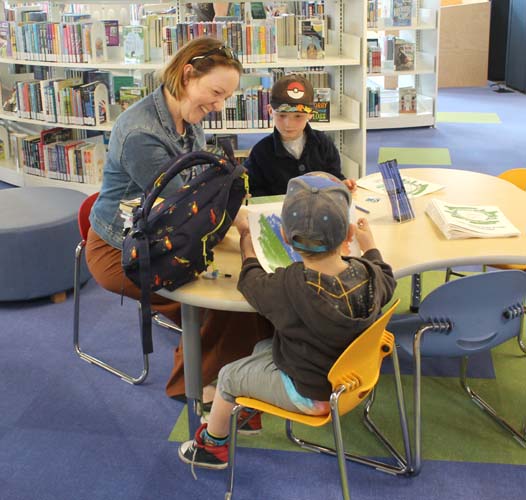
What used to be places for research in the book stacks or quiet family time or quick use of public computers, libraries have become just as much the front line of our communities as some streets.
In the two-hour session on libraries at the Union of BC Municipalities (UCBM) Convention in Victoria on Monday, there was a bit of ‘shock and awe’ by a few speakers to try and convey the urgency of library funding shortfalls but also how public distress is worn on the library’s sleeve for all to see.
The changing face of libraries:
People who study to be librarians are essentially not prepared for what they will face on the front lines. One of the speakers outlined rather graphically yesterday how one of their regular patrons died of a drug overdose in the library washroom and how the other patrons reacted and how one librarian had to keep a child busy in the stacks so as not to see the body taken out on a guerney.

In addressing the room of about 140 municipal leaders and library staffers there was commentary as to how hiring is different than it used to be. Library managers are no longer looking for ‘quiet well-read people’ but for people will social situation management skills who realize that administering Naloxone will be part of the job. Two different skill sets and a shift of realities for communities. Anyone who reveres the role of learned information specialists — a characterization that librarians used to hang their hat on — likely feels a sense of loss over what libraries have become.
But at the same time there can be a sense of community pride in what libraries have become — the place that people go to or turn to in their communities when it’s unclear where else to go. Helpful people with helpful information, that seems to be the expectation.

Indeed, in social media this week, two of the Greater Victoria Public Library branches posted with the colours and drama of a major emergency that their digital system would be offline for two hours,
One leading edge for libraries is their digitization, seeing themselves as a bridge to the digital world and providing opportunities for critical thinking and expression.

Appealing for more provincial funding:
Apparently library funding has been frozen at $14 million per year since the BC Liberal government cut the libraries budget line item in 2009 (with inflation, in today’s dollars that clearly doesn’t go as far it is used to). There was a one-time infusion of $45 million from the province to the library system over three years in 2023 when the province had a surplus.
The Ministry of Housing and Municipal Affairs says that Budget 2025 commits annual funding for public libraries of up to $14 million in 2025, 2026 and 2027. Funding has already been distributed for 2025.
It was illustrated by one or more speakers on Monday that librarians are real ‘troopers’ — doing more and more with no additional support, or in fact with eroding financial support. Much of the funding for libraries comes from municipal budgets.
But there is only one taxpayer. Perhaps one of the reasons that library funding has not been publicly heard at this level of crisis until now is because municipalities — like the librarians — have kept doing their best with what they have.
But it sounds like a breaking point has been reached, and librarians are seeking more at the provincial trough.

Perhaps it is good news about the distress that has finally led to the motion at UBCM this week that seeks increased capital funding for libraries, put forward by at least 10 municipalities: Hudson’s Hope, Prince George, Creston, Grand Forks, Nelson, Smithers, North Vancouver City, Squamish, Surrey, Powell River (motions RR25 through RR 29).
The request is for core funding to be increased to $30 million as put forth by the BC Public Library Partners and recommended by the province’s Select Standing Committee on Finance and Government Services. Libraries feel they are part of delivering the province’s important goals of enhancing economic growth, reducing costs for families, and making communities safer and want more substantive provincial funding in order to be part of delivering those goals.

Can-do, but can no longer do:
Librarians openly painted themselves yesterday as a culture of committed can-do enthusiasts for the role of public libraries for their regular patrons and the broader community. But the ability to do continually more with less is showing some threadbare distress. Staff go on stress leave, programs get cut back, and so on.

But one delegate from the audience suggested that there has been a marketing shortfall, i.e. not presenting the needs of libraries in a more cohesive and engaging way.
Perhaps that is now happening, with the concerted effort that — if successful — the UBCM motions on public libraries will achieve in the way of informing the province of the needed direction in funding.
Cutbacks by the libraries themselves can only go so far… will it be books/collections, programming, staff hours, operational hours.
The point was made that people may not miss their community library until it’s no longer there.

Ministry statement:
Currently the Public Libraries Branch falls under the Ministry of Housing and Municipal Affairs which is indicative of how the province sees the role of libraries as public spaces.
“We recognize the pressures facing libraries as community hubs and understand that local decisions about service levels in a community are challenging to navigate,” says Christine Boyle, Minister of Housing and Municipal Affairs in a statement to Island Social Trends today.
“Libraries are critical to our communities and we remain committed to working with library leaders and local governments to ensure public libraries can continue to meet the evolving needs of Brisih Columbians,” said Boyle.
The Ministry notes that public libraries are primarily supported by local governments and that as such the level of local funding varies widely among communities. I saying that, it sounds as though the funding of libraries sits locally by policy choice of the Province. The Ministry says that “provincial funding is meant to complement local funding”. But most municipal budgets are already strained to capacity.
The Province’s complementary funding is itemized as helping public libraries participate in province-wide programs and services such as inter-library loan, BC Summer Reading Club, Library2go and shared digital collections.

Since 2020:
Since 2020, the Province has invested an additional $56 million in direct support to communities and oubrary boards in addressing rising service costs and ensuring continued access to vital resources.
That includes $3 million in 2020, $8 million in 2022 and the “historic” one-time $45 million investment in March 2023 through Enhancement Grants to 71 public libraries.
While these grants were not intended to replace core funding, they were designed to provide flexibility and address immediate service demands. This is in addition to the $14 million the Province contributes annually to public libraries; funding has already been distributed for 2025.
Government says that Provincial support, including library grants, has helped libraries better serve their communities through more inclusive, accessible spaces and services — both in-person and online.
The support focuses on ensuring access to shared services across the public library system, particularly as demand for online resources and digital services continue to grow. Libraries have used provincial funding to increase access to digital resources such as e-books and audiobooks, lifelong learning opportunities (technology workshops), and other critical services (internet access) that help people build skills, access opportunities and stay connected.

Growing Communities Fund:
The Province also provided the $1-billion Growing Communities Fund to communities for infrastructure projects, which some communities have allocated towards capital projects like libraries.
In Vancouver, $4.5 million was invested into renovating Central Library’s children’s section, its first major renovation since Central Library opened 30 years ago.

Steady as she goes, with crises:
Overall, there is a sense that the library administrative ecosystem is comfortable, despite that it faces pressures.
Mari Martin, Director, Public Libraries Branch within Housing and Municipal Affairs was part of the libraries panel yesterday. While of course the government says it wants to do the best it can, all of what was heard yesterday sounded oddly as a combination of ‘business as usual’ and ‘we will do the best with what we have’.

One speaker suggested that perhaps there is ‘too much governance’ in the system, that the number of library boards (many of which are comprised of elected leaders who get additional pay for attending library board meetings) could be trimmed.

===== RELATED:
- BC municipal leaders gather for 2025 UBCM convention Sept 22 to 26 in Victoria (September 21, 2025)
- Greater Victoria Public Library drops late fines while pitching for donations (January 7, 2024)
- Library now fine free on all physical items at Vancouver Island Regional Libraries (January 5, 2023)
- Big crowd for long-awaited Sooke Library opening (June 12, 2022)
- More than books at new Esquimalt Library (March 30, 2022)
- Waiving overdue fines on kids’ books is a plus (January 27, 2019)