



Wednesday April 29, 2026 | NATIONAL [Posted 6:35 am PT in VICTORIA, BC]
Economic political analysis | by Mary P Brooke | Island Social Trends
The federal government’s spring economic statement (SES) was unveiled in Ottawa yesterday.
In addition to mention of already-announced programs and initiatives (such as the boosted grocery rebate), there is some new funding (such as for wide-sweeping trades training), new areas of expenditures (including a multi-faceted investment in sports) and a lower-than-expected deficit (though it is historically still quite large).
As hinted by Carney in his full-lnsght interview with CBC one day before the SES, the big push to support Canada’s economic growth is to boost an army of workers in the skilled trades. The goal is to recruit as many as 80,000 to 100,000 new skilled trade workers by the 2030-31 fiscal year.
The reduction of CPP base contribution from 9.9% to 9.5% of an employee’s pay cheque is presented as helping employees but it also quietly helps businesses across the country who are required to match employee CPP contributions.
The process of air passenger complaint resolutions will be taken off the shoulders of the Canadian Transportation Agency (CTA) — a quasi-judicial tribunal and regulator and outsourced to “a neutral, third-party dispute resolution organisation”. This not only helps Canadians with travel woes but frees up government resources.

Update overview:
“Budget 2025 is translating our vision into real action through major projects, less red tape, and generational infrastructure
investments that move goods to market,” says the federal government.
“The Spring Economic Update 2026 builds on this momentum with strategic investments that support productivity, growth, and competitiveness.”
The SES is clearly about advancing Canada’s economic strength for the economy overall as well as for improved economic potential for individual Canadians and households.
Prime Minister Carney took the political and promotional lead on this budget on Monday, with Finance Minister François-Philippe Champagne taking a more perfunctory role on announcement day. But overall it was a low-key affair for the general public who are primarily seized with concerns about daily to day affordability.
The update has likely foreshadowed today’s upcoming Bank of Canada interest rate announcement — the interest rate component of the ecnomy somehow now seemed dwarfed by much larger and broader economic and poltical dynamics.

Reshaping Canada:
Overall, there is an intention for this economic overview to feel robust and filled with intention, but it also reveals an economy in distress and indicates a long recovery timeline.
Canadians have been gently primed by Carney over the past year to be ready for big changes. When big change comes slowly or strategically it can seem less severe, but there is nothing gentle or insignificant about this economic phase for Canadians and Canada.
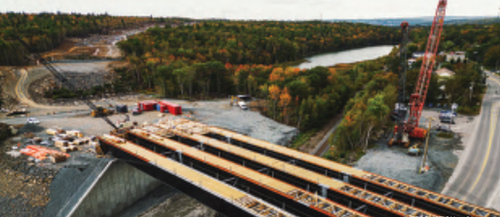
Canada is being reshaped, piece by piece. Not just with physical infrastructure but by way of changes to employment (and education systems in support of that) and how Canadians are supported at the household levels.
Changes for households and communities might seem slow but it seems like things are heading in a direction that will have the potential of success. At least to survive as a country let alone thrive.
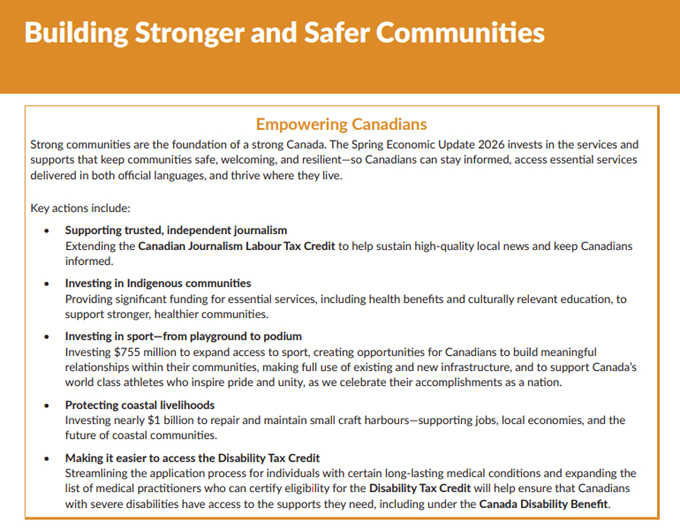
Some new components in the Spring Economic Statement:
Canada Strong Bonds:
A quasi-retail investment product called Canada Strong Bonds was pre-announced by Carney earlier this week. The process will allow ‘everyday Canadians’ to invest in Canada’s economy. Similar to Canada Savings Bonds of past decades, the funds are intended for a focus on building new infrastructure (including the labour requirements for that) — not just through the Major National Projects but across regions and communities.
While fashioned after a certain type of surplus-fund investment model of countries like Norway and Singapore, the fund has not been started with surplus but with borrowed funds. But that is Canada’s reality and Carney seems okay with building from there.
Disability tax credit process:
Changes aimed at streamlining the disability tax credit (DTC) application process were in Tuesday’s economic update. A reduced amount of paperwork is promised for individuals with one of more of 40 long-term conditions (including Alzheimer’s, dementia, Down syndrome and a range of other conditions).
The government will also change the criteria to allow an expanded range of practitioners to authorize the applications to certify “severe and prolonged impairment” including podiatrists, physiotherapists, speech pathologists and occupational therapists.
Such a high profile handling of the disability tax credit process in the SES indicates that government has heeded the demand-level for the DTC. It sadly also indicates the level of disability in people across this country, whereas last century there was an assumption that most people were generally fully able-bodied.

Sports economy:
A big push to support sports “from playground to podium” as Prime Minister Carney put it one day ahead of the SES, shows not only his love of sport but the economic might of that sector.
Yes, there was a lower number of medals at recent Olympics, but it’s not all about the awards. Sport can have impact across entire communities and local economies.
- The government has announced new funding for sports facilities and programs across the country; $755 million is being allocated over the next five years (with about $188 million on an annual basis thereafter).
- Within that rollout will be $660 million geared toward sports organizations to boost youth participation.
- A further $50 million is being set aside to upgrade facilities to host “world-class sporting events,” with the aim of ensuring those facilities can continue to be used after those events.
- Another $45 million is being earmarked toward high-performance athletes. This part of the funding will also address some of the findings in the Future of Sport in Canada Commission’s final report.
Banking affordability:
- Canadians are paying less in banking fees, with new rules capping non-sufficient funds fees at $10 and strengthening consumer protections.
- Enhanced low-cost and no-cost bank accounts provide all Canadians the opportunity to access to up to 50 per cent more debit transactions at a cost of no more than $4 per month.
Addressing fraud and financial crime:
The government aims to address fraud and financial crimes, Several previously announced measures were highlighted in yesterday’s economic update. There will also be a ban cryptocurrency ATMs.
Commentary:
The Conservatives as Official Opposition are calling the spring economic statement “a credit card budget”. referring to the enormous deficit which is much larger than under the previous prime minister. The key difference to this deficit (in addition to be much larger) is that it focuses on spending that will build infrastructure, economic resilience, and new economic systems in communities and across the country.
Clean Energy Canada says the SES “puts a welcome focus on energy and affordability”, adding: “If we want solutions that will last—industries we can build on and savings that won’t evaporate in a few months’ time—clean energy must remain central to both endeavours.”

===== Direct links:
Spring Economic Statement – all components (Government of Canada, April 28, 2026)
===== RELATED:
NEWS SECTIONS: 45th PARLIAMENT of CANADA | BANK OF CANADA | TARIFFS & TRADE