


Tuesday April 21, 2026 | OTTAWA, ON [Posted at 10:41 am PT]
by Mary P Brooke | Island Social Trends
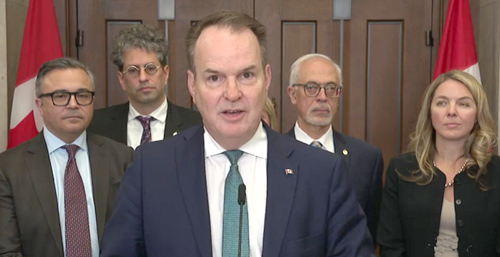
The Canadian Space Launch Act introduced today woud bring in changes to aeronautics legislation, allowing Canada to do its own space launches and contribute Canadian nuance and values to exploration beyond this planet.
Part of the goal is to keep supply chains here in Canada, said Transport Minister Steven MacKinnon today in Ottawa during the announcement of this new direction.

Currently Canada is the only G7 country without its own launch capabilities (other than for sub-orbit satellites, which Canada can already do).
The legislative updates would establish the necessary authorities to provide regulatory certainty to industry, support investment and infrastructure development, and strengthen Canada’s ability to meet its international obligations related to space.
“The Canadian Space Launch Act‘s regulatory framework is key to securing our place in the rapidly growing global space economy while building on Canada’s historic contributions to humanity’s space innovations. This positions Canada to meet strategic needs, enhance resilience of critical infrastructure and other systems that rely on space assets, while fueling domestic innovation and industry growth and positioning Canada for renewed economic and security partnerships with allies,” as stated in today’s government release.

Aiming for 2029, to not fall behind:
A fairly tight timeline of 2029 is part of the strategy to get Canada fully up to speed with current launch and re-entry capabilities (ensuring these are dedicated to Canadian requirements and availabiity) as well as many components of space-related technology that can serve a range of functions for livability on Earth such as telecommunications, mapping and intelligence requirements.
These are things that “Canada cannot permit itself to fall behind on”, said MacKinnon. New directions in this area will increase options and capabilities in protecting Canada, including making sure that the Canadian Armed Forces “stay current on pace wit the rest of the world”, he said today.
Benefits also include better support and management of ocean ecosystems including currents and temperatures. “Space capabilities are integral to that work,” said MacKinnon.

Economic benefits:
Canada wants a share of this broad expanding market, which could generate $40 billion in the domestic space market for Canada by 2040, said MacKinnon today.
Through these shifts in action and priority, Canada would be repatriating money that would have been spent elsewhere while creating more jobs here within the technology sector, MacKinnon briefly outlined in a short press conference.
- In 2022, revenues of the space sector were estimated at $5.0B, with exports reaching $2.0B, and contributed approximately $3.2B to Canada’s gross domestic product.
- In 2023, Canada’s space workforce grew by 5.9%, creating a record of 13,888 space-related jobs from coast to coast to coast.
- The global space economy is estimated to reach $1.5 trillion by 2032.
Recent Artemiss II mission:
Canadian Astronaut Col Jeremy Hansen has recently returned from the 10-day NASA Artemis II moon mission (launch on April 1 through splash-down on April 10).
“Jeremy Hansen has renewed our enthusiasm and possibilities for space,” said MacKinnon today, adding that Hansen is currently “a pretty busy guy”.
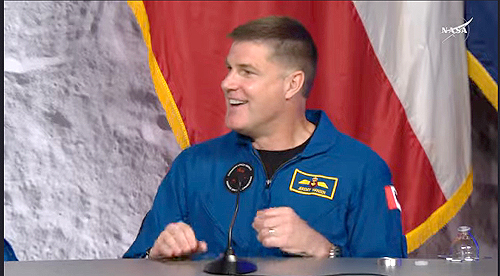
Hansen and his three fellow Artemis II crew members (Reid Wiseman, Victor Glover, and Christina Koch) will be making a visit to Canada soon, as organized by the Canadian Space Agency. They have also been invited to visit US President Donald Trump at the White House.
===== RELATED:
- Astronaut Jeremy Hansen enthusiastic about space flight impact on humanity (April 16, 2026)
- NEWS SECTIONS: AEROSPACE | 45th PARLIAMENT of CANADA | OFF-PLANET | TECHNOLOGY | NASA | CANADIAN SPACE AGENCY