


Saturday April 4, 2026 | OFF-PLANET [11:44 am PT | Updated 12:14 pm & 3:29 & 4:48 pm PT]
by Mary P Brooke | Island Social Trends
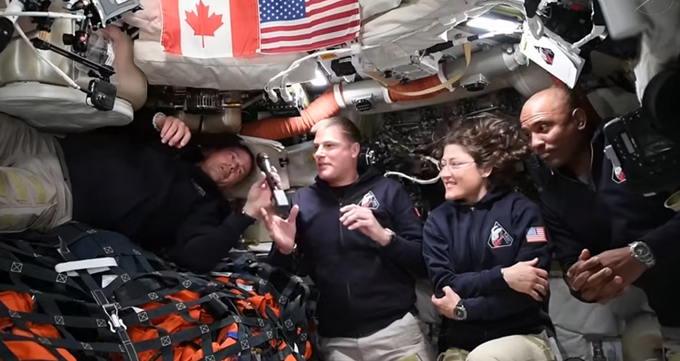
This is Day 4 of the Artemis II space mission from Earth to the moon and back. This is the first ever crewed flight test of the Orion space craft.
The full trip is expected to take 10 days, from launch to splashdown.
On Day 7 (April 7) the Orion capsule — called Integrity — that is carrying the four Artemis II crew members is expected to be looping around the back (dark) side of the moon before heading back to Earth.
Crew members are Reid Wiseman (commander), Victor Glover (pilot), Christina Koch (mission specialist), and Canadian astronaut Jeremy Hansen (mission specialist).
When the Orion craft is behind the moon there will be a 30 to 50 minute blackout in communications between the on-board crew and mission control on Earth.

Today’s press conference:
The daily press conference by NASA from Houston will be held around 2:15 pm PT. Journalists asked a range of questions of four panelists: John Honeycutt, manager for the NASA space launch system (SLS) program; Judd Frieling, ascent flight director; Debbie Kouth, Orion deputy program manager; and Dr Kelsey Young, science flight lead for NASA Mission science directorate.
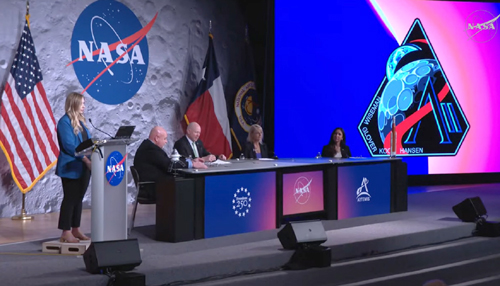
Four NASA reps took questions on technical and cultural aspects of the mission, including the far-side flyby coming up on Monday — all the crew members will be heard from several times per hour. Most of the lights will be out on the cabin to enable the best possible camera images. Real-time information will be available during the flyby.
A few glitches so far include getting enough urine expelled from the waste water system, a complete crash of one of the astronaut’s laptops (Christina Koch’s laptop) which means three laptops will now need to be shared among four astronauts.
Crew training was described. That included learning lunar geography so that main features of the moon’s surface can be readily identified (and why why features are important).
Tapes and other materials are likely off-gassing, as to what the burning smell might be as reported earlier today. That investigation is ongoing.
The astronauts will be relied upon to notice any subtle nuances in colour in imagery that they see outside the capsule windows.
These four astronauts were chosen for the Artemis II mission because they are test pilots who ‘speak the language’ of flying the spacecraft, media were told today.

Comments from the SLS program manager:
“Integrity remains on a proved return trajectory,” said SLS Program Manager John Honeycutt as ‘first things first’. He is excited about Day 6 coming up (when the spacecraft will be behind the moon out of Earth’s view and without contact). The craft is now closer to the moon than to Earth, Honeycutt summarized, adding that the crew has been “incredibly busy” and that “it looks like they’re really enjoying their work”.
He said that imagery being captured and returned to Earth is “pretty incredible”. Some of the image angles of the moon captured yesterday have never been seen by human eyes before (only by robotic imagers). Status updates include assessment of mission risk, said Honneycutt. Anomalies and any necessary actions are discussed, he outlined.
“A few items are being worked on today. None of those were any increase in mission risk,” said Honeycutt. “The team has not asked MMT to take on any additional risk, so far.”
Entry interface is “the big one that gets us home,” said Honeycutt, referring to the splashdown currently timed for April 10. “It gets the crew’s boots back on Earth,” he stated. “The first step in that is getting the rocket ready,” he explained, adding that “the next step is having the SLS deliver the space craft to the point in space where it needs to be”…. and “it did that with 99.92% accuracy — that was a big bulls eye and I’m very happy about that”.
Comments from the ascent flight director:
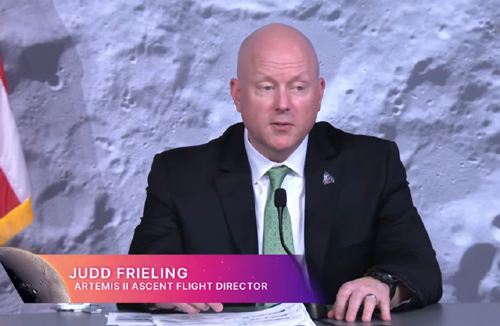
The crew did a CPR demo yesterday, said Judd Frieling, Artemis II Ascent Flight Director, in his opening remarks. The point of that was to figure out a good spot in Integrity if they needed to do that. The crew also checked out their med kits and tried out an angio event. A DSN emergency comm test was done again.
The astronauts did a public affairs out-brief and Jeremy Hansen did a Canadian Space Agency (CSA) conference, Frieling next noted.
In his remarks during the CSA conference, Canada’s astronaut Jeremy Hansen said “humanity needs those contributions so just get after it”, with regard to any doubts people may have about what it asked of them. It’s part of motivating the next generation of astronauts and aerospace progress.
The crew also had private family conferences and the planned psychological conferences on their schedule for today.
Then he mentioned a test of the “search, acquire and track mode” just in case the vessel loses its pointing knowledge and would then be able to acquire communication with Earth on its own, Frieling explained.
“Overnight there was an attempt to vent the waste water tank that’s attached to the toilet. We had problems with that due a suspected blockage (thought to be ice),” said Frieling. The crew was advised to use their collapsible contingency urine devices — just like they did on flight Day One.
The planned trajectory correction for today was cancelled “because Orion is doing such a great job”, said Frieling. Accuracy of the TMI burn was impressive. The cancellation of today’s correction allowed Orion to be put in an attitude that will put sun on the vent of that wastewater tank to see if that can be heated up to get the wastewater vented. So far, about half of the urine was able to be released from the tanks; trouble-shooting will continue on that.
Later today the crew will videotape the exercise device to get more engineering data on how it is functioning and another CSA event will be done. Some more photos will be taken. And then the crew will have their planned medical conferences.
Comments from the Orion deputy program manager:
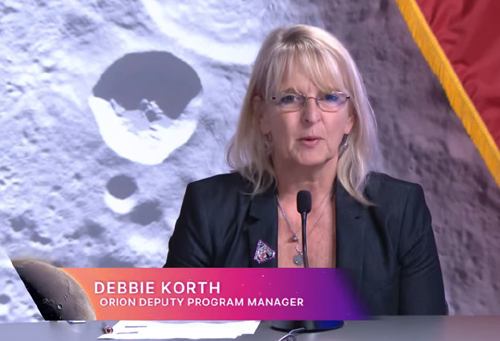
Debbie Korth, Orion deputy program manager, reported the Orion spacecraft as “in very good health”.
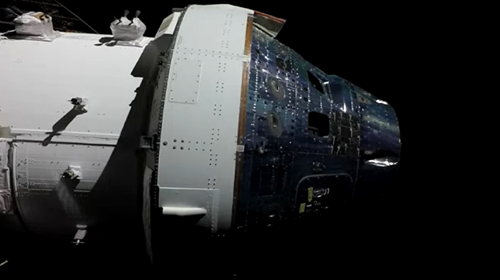
“There are no major anomalies at this time,” she stated. She showed a “beautiful view of the Orion with the sun shining off all of (the tape that covers backshell tiles)”. There was no damage and no major tape removals, said Korth, adding that it “looks quite a bit better” than Artemis I at this stage of the mission.
Yesterday a routine external inspection of the entire spacecraft was done to “ensure it’s healthy for that return trip when it needs to come back home,” said Korth.
The optical communications system has been downloading gigabytes of information through the mission, making high resolution images possible.
The urine venting continues to undergo troubleshooting. The location of that technology on the spacecraft “has been seeing more shadow” than sunlight. Giving it sunlight helped progress the venting (as outlined previously by Frieling). “But that didn’t solve the whole problem,” she pointed out.
But the toilet “is operable and we have redundancy to get us through the mission”.
Korth’s team continues to test all the systems and they continue “to work all the minor things” they have on their list, she said.

Comments from the Artemis Science Flight Operations Lead:
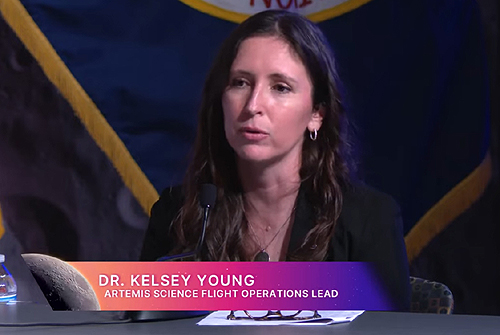
“We’re now two days away from the lunar flyby,” said Artenis Science Flight Operation Leader Dr Kelsey Young as her opening remark in today’s press conference.
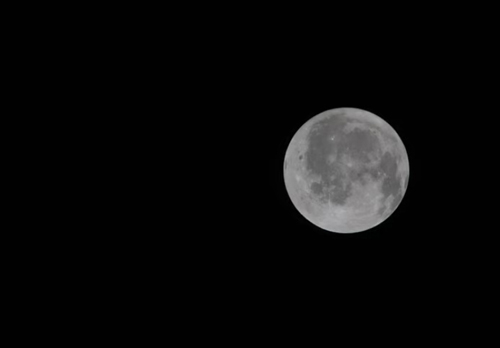
During the flyby “big chunks of the near side” will be viewable. As the crew gets closer, they will focus on the near side-far side transition, Young explained.
“They will be able to see features that human eyes have never before seen,” said Young. An earthrise will be seen for the first time.
The sun will pass behind the moon from the perspective of the astronauts on Integrity. That will create a solar eclipse. “That is very unique to this mission,” said Young. The eclipse will last approximately 53 minutes, then a sunrise “where the sun pops out the other side of the moon”.
A set of 10 lunar science objectives to be achieved during the flyby were developed by the Artemis Science Flight Operations team. The objectives were based on “driving questions”, which produced ‘targeting plan” for the crew to follow on Monday. They have an hour booked in their cabin time to review the objectives before Monday, said Young.
The crew will be expected to take photos that help the NASA team back home do analysis of the dark side of the moon.
This mission will make possible all next things for work and exploration on the moon.
More broadly, as an example, years ago the Apollo missions helped us understand the Earth and well as the moon. Next generations will be inspired by Artemis II for involvement n future space missions.

===== RELATED:
- Artemis II crew: burning smell so far not of concern (April 4, 2026)
- Artemis II: Day 3 meals & tech work (April 3, 2026)
- Artemis II: Col Jeremy Hansen says “It was a great burn!” (April 2, 2026)
- Day 2 technology details for Artemis II crew (April 2, 2026)
- Artemis II: troubleshooting some technical things (April 2, 2026)
- Canadian astronaut Jeremy Hansen heads to the moon (April 1, 2026)
- Artemis Mission Updates (NASA)
- NEWS SECTIONS: AEROSPACE | OFF-PLANET | TECHNOLOGY | NASA