


Thursday March 26, 2026 | HALIFAX, NS [11:40 am PT]
by Mary P Brooke | Island Social Trends
Defence in this decade seems to be more focussed new and emerging areas of warfare including drones and cyber attack.
The federal Liberal government continues a messaging of “in an increasingly dangerous and divided world, Canada must be prepared” and “The world has changed, and Canada must change with it”.
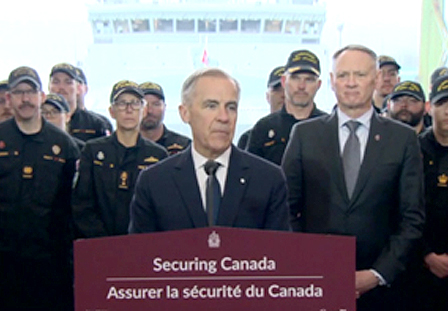
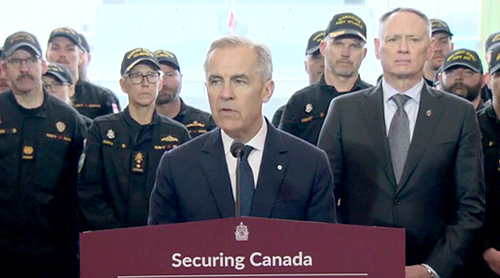
Canada’s preparation is “to defend ourselves and our values, to secure our sovereignty, and to stand with our Allies”, as stated in today’s federal government news release after Prime Minister Mark Carney and Defence Minister David McGuinty made an announcement in Nova Scotia after touring a Royal Canadian Navy vessel.
“For too long, Canada did not sufficiently build that strength. By 2014, Canada’s defence spending had fallen to just 1% of our GDP, half of our obligations as a NATO member,” it is stated in a news release from the Prime Minister’s Office (PMO) today.
Meeting the 2% NATO target:
“That is why, six weeks after the election, Canada’s new government released an ambitious plan to rebuild, rearm, and reinvest in the Canadian Armed Forces. A core objective is to achieve the NATO 2% defence spending target this year. For the past 10 months, we have moved at unprecedented speed and scale – working across over a dozen federal departments and agencies to spend more than $63 billion, the largest year-over-year increase to Canada’s defence spending in generations,” the PMO news release states.
“As a result of that work, Canada has achieved the 2% defence expenditure target – half a decade ahead of the previous government’s schedule. The 2% target is a foundation for an even stronger, more independent, more secure country,” says Carney’s news release today.
Achieving the 2% NATO target is politically part of appeasing concerns expressed by US President Trump about some countries not pulling their weight with NATO commitments. The CUSMA negotiations are getting underway which would be assisted by eliminating at least this one objection that the US might pinpoint.
Achieving the 2% target was a Liberal government promise to be met within the current fiscal year (which ends in just a few days, on March 31, 2026).

$3 billion investment:
Today Prime Minister Carney announced today that more than $3 billion in infrastructure and defence-related investments will be made across Atlantic Canada.
It’s part of further building on Canada’s mission to rebuild, rearm, and reinvest in the Canadian Armed Forces, the government says.
Atlantic region investments:
For Canada to accelerate a path to NATO’s new target of 3.5% on core defence spending and an additional 1.5% of GDP on defence and security-related investments by 2035,
- In Nova Scotia: major, targeted investments to modernise critical infrastructure, build new facilities to support the next generation of naval and air fleets, and expand training and operational capacity.
- $1.2 billion to modernise critical power and municipal service infrastructure at CFB Halifax Dockyard and Stadacona – upgrading essential services and facilities to ensure the base has sufficient power and utilities to support new capabilities and future naval operations.
- $648 million to construct two new aviation support facilities at 14 Wing Greenwood – supporting the Royal Canadian Air Force’s CP-8A Poseidon fleet and CQ-9B Guardian with modern hangars, maintenance, and operational infrastructure.
- Over $180 million to build the Combatant Training and Integration Centre – supporting training, operations, and integration for the Royal Canadian Navy’s future river-class destroyers.
- $82.5 million to acquire Halifax Gate –a 475-acre waterfront industrial site that will support current and future Royal Canadian Navy operations, including the movement of personnel, ships, and supplies.
- $60 million for a new, 140-unit apartment complex for Canadian Armed Forces members, near 12 Wing Shearwater – because every member of our Armed Forces deserves a safe, high-quality place to call home.
- In New Brunswick: more than $1 billion in the CFB Gagetown Range and Training Area
- introducing new ground-based air defence systems and ensuring soldiers train on infrastructure built to last the next century.
- $20.2 million to upgrade transition centres at CFB Gagetown, improving support for Canadian Armed Forces members as they transition to civilian life.
Four pillar strategy:
Canada’s defence investment strategy rests on four pillars:
- investing in the foundations of defence – the women and men who serve, and the equipment and the infrastructure they use;
- expanding and enhancing our military capabilities;
- strengthening Canada’s defence industry; and
- diversifying Canada’s defence partnerships.
Agency and Strategy:
Over the next decade, Canada will unleash half a trillion dollars in defence investment – from submarines and aircraft to drones, sensors, and radar systems.
- In October 2025, Carney’s Liberal government launched the Defence Investment Agency to overhaul and streamline Canada’s defence procurement so the Canadian Armed Forces have the world-class equipment they need.
- in February 2026, the government announced Canada’s first-ever Defence Industrial Strategy – a bold plan to get our Armed Forces what they need, when they need it; scale Canadian defence companies; and put hundreds of billions of dollars to work in the strategic sectors of our economy.
Generational investments:
Continuing to refer to the federal government as :”Canada’s new government”. Carney’s news release today says the government is “delivering on its promise” which it outl – to make generational investments in the women and men of the Canadian Armed Forces and to further accelerate these investments in the years to come. In a more dangerous and divided world, Canada is taking full responsibility for defending our sovereignty and building our strength as a reliable partner and Ally.
- At the 2025 NATO Summit in The Hague, Canada and our NATO Allies agreed to a new Defence Investment Pledge of investing 5% of annual GDP by 2035 to ensure our individual and collective security. As part of this pledge, Canada will invest 3.5% of GDP in defence spending and 1.5% of GDP in critical defence and security-related investments.
- Canada officially joined the European Union’s Security Action for Europe (SAFE) initiative at the Munich Security Conference in February 2026. SAFE is a key pillar of the EU’s Readiness 2030 plan, and Canada’s participation in SAFE will enhance defence readiness on both sides of the Atlantic.
- Canada continues to work to establish the Defence, Security and Resilience Bank (DSRB) – a new, multilateral financial institution that will bring together likeminded partners to mobilise and deploy private capital and support collective security. The DSRB will provide long-term, low-cost financing for defence, security, and resilience initiatives across supply chains, helping to address critical financing gaps, with benefits for member governments and defence firms, including small and medium-sized enterprises.
- Canada’s defence sector is an important contributor to the economy with close to 600 firms directly accounting for 36,000 jobs in 2022, supporting a total of 61,200 jobs across the defence value chain. These companies generated $14.3 billion in revenues that same year and contributed $7.4 billion to GDP across the defence value chain.
- Atlantic Canada plays a critical role in advancing Canada’s economic and national security – home to nearly 10,000 direct aerospace and defence jobs, representing 20% of Canada’s defence industry employment.
- The Defence Investment Agency is modernising Canada’s defence procurement by centralising expertise, cutting red tape, and streamlining decisions – supporting the implementation of Canada’s Defence Industrial Strategy and helping accelerate defence investments.

===== RELATED:
Carney announces new directions and spending for Canadian defence (June 9, 2025)
NEWS SECTIONS: CANADA-NATIONAL | NATIONAL DEFENCE | BUDGET 2026