


Tuesday March 24, 2026 | NEW YORK, NY [Posted at 7:35 pm PT]
by Mary P Brooke | Island Social Trends [VICTORIA, BC]
Aviation experts today provided more information and analysis about the Sunday night Air Canada jet crash incident at New York’s LaGuardia airport.
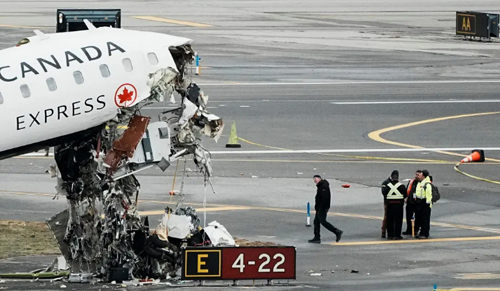
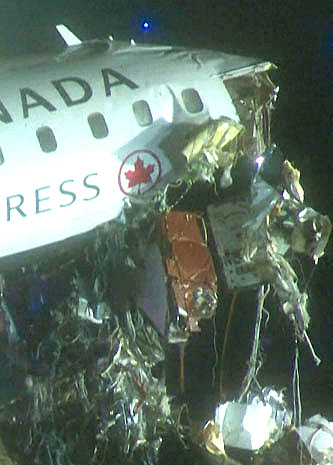
A CRJ900 jet — Air Canada Flight AC8646 — impacted an airport firetruck late Sunday night, resulting in the death of the pilot and copilot.
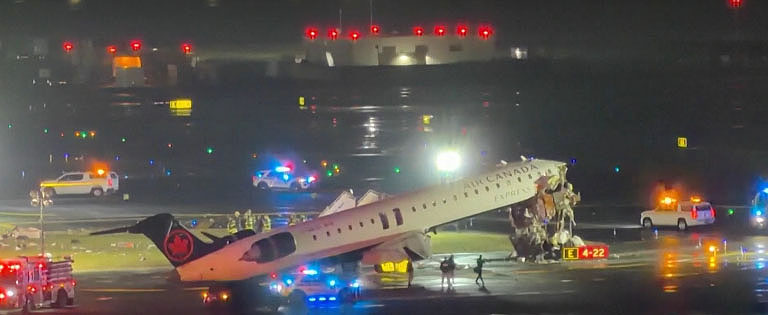
There were 72 passengers on board and four crew (two of those were the pilots).
The pilot and the copilot were killed instantly in the collision between the airport and an airport firetruck. The aircraft did not catch on fire.
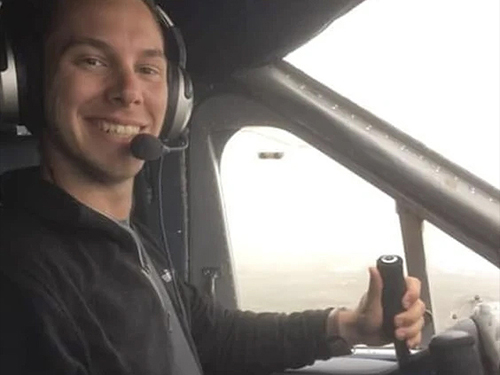
The pilot has been publicly identified as Antoine Forest and the first officer (co-pilot) was Mackenzie Gunther. Both were in just the first few years of their piloting careers.
Several passengers and at least one flight attendant as well as the two firefighters were taken to hospital with injuries; most have since been released from hospital.
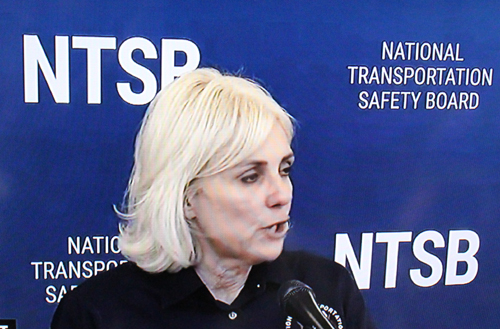
Today was the first full day on-scene for flight investigators, said Jennifer Homendy, chair of the US National Transportation Safety Board (NTSB) in a press conference this afternoon from New York.
The investigative team started this morning with a two-hour meeting just to organize the investigative groups and walk through what they needed to accomplish today, said Homendy.
Yesterday it had taken a while for investigators to arrive at LaGuardia due to delays at other airports due to backups of TSA lines. she said.
Data recorders:
“We were able to take possession of the cockpit voice recorder (CVR) and the flight data recorder (FDR). That was at 9:57 am (ET),” said Homendy as to yesterday’s recovery of those devices.
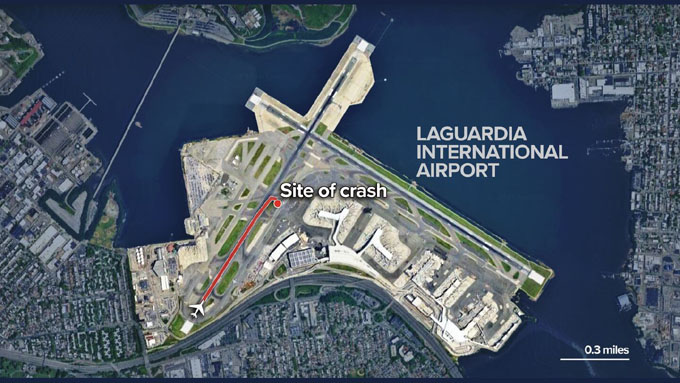
A hole had to be cut into the upper surface of the aircraft in order to receive those, due to the position of the plane on Runway 4 where it has been sitting since the crash incident around 11:45 pm ET on Sunday night.
The CVR and FDR have been taken to the NTSB labs for downloading and analysis.
The CVR contained more than 25 hours of good quality audio across four separate channels. The FDR contained approximately 80 hours of data and recorded more than 400 parameters.
A voice recorder group meeting is scheduled for tomorrow at the NTSB headquarters in Washington, DC to review the recording and produce a written transcript, said Homendy.
Preliminary information:
Some information from the final three minutes of the cockpit voice recorder was released today.
That information was methodically delivered by NTSB lead investigator Doug Brazy today during the NTSB press conference.
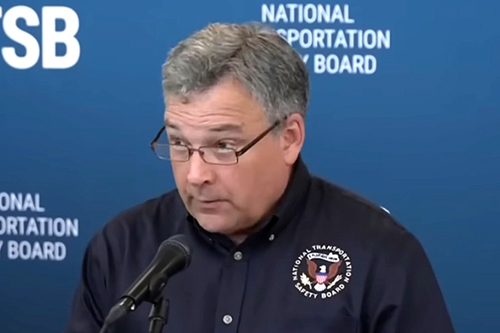
A summary from the CVR during the final three minutes of the recording was provided today, with all times referenced to the end of the CVR recording.
- 3 min 7 sec – the approach controller instructed the airplane to contact LaGuardia tower.
- 2 min 45 sec – the flight crew lowered the landing gear.
- 2 min 22 sec – the flight crew checked in with the LaGuardia tower.
- 2 min 17 sec – LaGuardia tower cleared the airplane to land on Runway 4 and advised that they were number two for landing.
- 1 min 52 sec – flight crew set the flaps to 30 degrees
- 1 min 33 sec – flight crew set the flaps to 45 degrees
- 1 min 26 sec – an electronic 1,000 callout occurred from the enhanced ground proximity warning system indicating that the airplane was 1,000 feet above the ground.
- 1 min 12 sec – flight crew confirmed that the landing checklist was complete
- 1 min 3 sec – an airport vehicle made a radio transmission to the tower but that transmission was stepped on by another radio transmission and the source of who made that transmission has yet to be identified.
- 54 sec – flight crew acknowledged that the aircraft was 500 feet above the ground and on a stable appraoch
- 40 sec – LaGuardia tower asked which vehicle needed to cross a runway
- 28 sec – Truck 1 made a radio transmission to the tower.
- 26 sec – The tower acknowledged that radio transmission
- 25 sec – TRuck 1 requested to cross Runway 4 at taxiway Delta
- 20 sec – Tower cleared Truck 1 and company to cross Runway 4 at taxiway Delta
- 19 sec – Electronic 100 enhanced ground proximity warning system callout ocurred
- 17 sec – Truck 1 read back the Runway crossing clearance
- 14 sec – Electronic 50 callout
- 12 sec – Electronic 30 callout, and at that same time the tower instructed a Frontier Airlines flight to hold position.
- 11 sec – Electronic 20 callout
- 10 sec – Election 10 callout
- 9 sec – The tower instructed Truck 1 to stop.
- 8 sec – A sound consistent with the airplane’s landing gear touching down on the runway
- 6 sec – A pilot transfer of controls from one pilot to the other (the co-pilot had been flying, so it was apparently standard procedure to transfer controls so that it’s the pilot who is actually landing the plane and bringing it to a stop)
- 4 sec – Tower again instructed Truck 1 to stop.
- 0 sec – The recording ended.
Aircraft rescue info to come:
A timeline of events regarding the aircraft rescue and firefighting operations will be developed, said Homendy.
Firefighter truck and other vehicles:
It is known that the firetruck was responding to a United Airlines Flight 2384 at the gate which had two aborted takeoffs and the firefighters had received information that there were fumes or smoke or some sort of smell in the cabin so they were en route across the airport runway areas to address that.
Truck 1 had collided with the aircraft. There were other vehicles behind Truck 1 which did not begin to cross the runway.
“Truck 1 did not have a transponder,”:” said Homendy. She then allowed for a long pause for the significance of that point to sink in — there was no direct locational information being transmitted from the truck to the tower.

Air traffic control:
There were two certified professional controllers in the tower at the time of collision — the local controller and the controller in charge, said Homendy.
- The local controller manages active runways and the immediate airspace surrounding the airport; that local controller had signed on at 10:45 pm ET and the shift would have ended at 6:45 am ET. NTSB points out that the local controller had signed in at 10:45 pm but wasn’t necessarily in position at 10:45 pm.
- The controller in charge is in charge of safety of operations. All safety of operations. He had signed in at 10:30 pm ET and that shift would have ended at 6:30 am ET. The controller in charge was also doing the duties of the clearance delivery position, and provides pilots with their departure clearance.
“It is not clear who was conducting the duties of the ground controller. We have conflicting information,” said Homendy, saying it could have been either the local controller or the controller in charge.
“Ground controller duties are to manage all aircraft and vehicle vehicle movements on the taxiways and that generally excludes active runways. The positions were combined into two positions,” said Homendy who explained that is standard procedure for the midnight shift at LaGuardia.
She explained that having two controllers in the tower cab during the midnight shift is standard practice across the national airspace.
The NTSB has several times “raised concerns about” fatigue during the night shift, said Homendy.
“We have no indication that was a factor here but it is a shift we have been focussed on in past investigations,” she said today. She mentioned about how the circadian rhythm of the brain is at its lowest point late at night.

Safety system:
LaGuardia has a runway safety system (called ASDE-X) that allows air traffic controllers to track surface movement of aircraft and vehicles.
Yesterday NTSB requested the replay of the event from the ASDE-X system — the display of information that would have been available in the tower cab. They also asked the tech center for the analysis of the ASDE.
“Analysis shows that the ASDE-X system did not alert,” said Homendy, followed by another long pause.
There was no alert “due to the close proximity of vehicles merging and unmerging near the runway resulting in the inability to create a track of high confidence”, said the TSB lead.
That property might indicates that the vehicles were essentially in the same spot or close to it.
There were two targets seen by radar on taxiway Delta. We don’t see any of them go in front of the plane on the runway.
The runway status lights were functioning, but that is still to be verified.
Don’t be quick to judge:
“I would caution pointing finger at controllers and saying distraction was involved. This is a heavy workload environment,” said Homendy today. She noted there was a United Airlines flight involved in the overall scenario and that they still need to determine what happened at shift change which was around 10:30 pm.
NTSB still needs to determine who else was in the tower and available at the time.
But Homendy says they require full verification of all information around that, including why the controller who handled the Flight AC8646 incident was still on duty for several minutes after the incident.
Normally after an incident like that the controller would be taken off duty.
“We have questions about that — was anybody available to relieve tat controller. We don’t know that yet. We also have questions about what else was occurring. What other traffic they were dealing with at the time,” said Homendy.

Interviewing the local controller:
An interview with the local controller (who handled the Flight AC8646 call) was scheduled to be interviewed at 4 pm ET today.
There are logs but also conflicting information including dates and times on the logs, said the NTSB official.
The aviation system is safe:
“There are multiple layers of defence built in to prevent an accident. So when something goes wrong, that means many many things went wrong.” said Homendy.
“That’s why we’re here… to prevent this from reoccurring, from happening again — and that’s going to take some time” she said before taking media questions.

===== RELATED:
- Two Air Canada pilots dead in LaGuardia tarmac crash (March 23, 2026)
- NEWS SECTIONS: AIRPORTS | AIR CANADA | TRAVEL & TRANSPORTATION