


Sunday March 22, 2026 | OTTAWA, ON [1:24 pm PT | Updated 2:14 pm]
News analysis by Mary P Brooke | Island Social Trends
Global Affairs Canada issued a statement yesterday which outlines support of the G7 nations for supporting Middle East partners against “unjustifiable attacks by the Islamic Republic of Iran and its proxies”.
This significant shift comes after Canada and other G7 nations initially expressed their displeasure with not having been pre-consulted by the United States or Israel as to those two countries lobbying an attack on Iran three weeks ago (to disable Iran’s nuclear development capabilities).
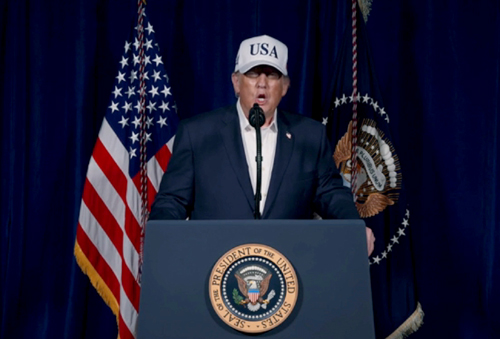
Trump was using the element of surprise. He is a deal-maker who doesn’t pre-consult. In that perspective he expects Allies to ‘deal’ as well — ask for something that they want in return for helping out in the Iran situation. He is not of the mindset to openly ask for help.
Escalation could happen in 48 hours:
At 7:44 pm ET yesterday (Saturday March 21), Trump further stated that the US will destroy the electrical generating infrastructure in Iran after 48 hours of his announcement, if Iran does not loosen its grip on the Strait of Hormuz. That evidently would involve US bombing activities targeted at electrical infrastructure but there is risk of civilian impact.
If the US goes ahead with this, Iran says it will retaliate.
This draws G7 countries ever so much closer to dangerous activity in the Middle East region.
Canada and other G7 nations already have had a range of basic military supports in the region, now likely being bolstered just in case. According to a military commentator on CBC today, Canada has skilled trained people and also a level of robotics that can be used.

Dependent on oil and shipping:
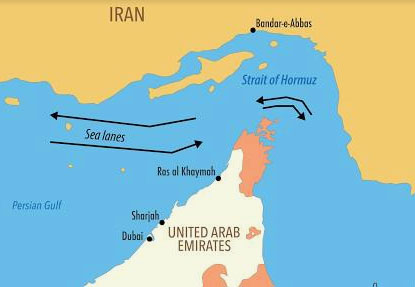
It’s clear that the entire world economy is highly dependent on one narrow body of water (the Strait of Hormuz) for a notable portion of the world’s oil and gas energy supply.
Trump recognized that this is Iran’s advantage against most of the rest of the world which relies on shipping of energy products. As well, fertilizer products and other goods that ship from China and Middle East producers reach western economies via the Strait of Hormuz.
It’s perhaps unconventional by traditional political standards, but Trump waited until countries around the world realized that their oil-dependent economies rely heavily on a shipping passage that is vulnerable to Iran’s intentions. In that way he has garnered Allied/NATO/G7 support in the region.
Big picture, and immediate considerations:
- The short-term picture is that Israel has aligned with US military power to eliminate the final proxy of Islamic-based terrorism in the Middle East (hence Israel’s attacks in Lebanon where Hezbollah is based).
- The mid-term is already happening: economies around the world are feeling economic pressure through a challenge to oil and gas supplies; the world has dipped into its oil reserve to help stabilize prices but it’s not enough for a long-term period. (Note: Canada has no oil reserve and very limited refining capacity, which makes us doubly dependent on external oil providers.)
- The big-picture long-game benefit is at least two-fold: a) worldwide economic flow of goods will be stabilized; b) democracies and humanity will benefit by the overthrow of an autocratic regime in Iran (that for 47 years has oppressed its own people) in a way that an entire population could be liberated.
Dependent on ocean-based shipping:
Canadians are now also seeing that despite so many modern technologies, a good chunk of Canada’s trading economy (and that of many other countries) is still dependent on putting things on boats and floating them to the ports all over the world.
The cost of crude oil is up 50% compared to last month.
Sending cargo by aircraft is a costly alternative for some goods, but oil and and gas still need ships (or pipelines) for transport.

Costs are up:
Buckle up, Canada. Prices for oil and gas (including as gasoline for vehicles and as a base-product for a myriad of products and processes) are up and will be for a while. The cost of living is suddenly even higher. That will increasingly include the cost of food as current inventories run low and new inventories come in at a higher wholesale price due to transportation input costs. That’s on the pocketbook side.
On the broader economic side of things, Canada’s fertilizer export industry depends on shipping and will be impacted, at least in the short term.
On the societal side of things, this country is now feeling the pressure of fighting (preventing an escalation of) war. It changes not just financial decisions but overlays a sense of uncertainty on many levels (a form of psychological weight) — especially for military families.
On the political side of things, discussion about war will now be part of the federal debate and public discourse at various levels. This is an added functional cost to the political and parliamentary system, in addition to the angst that it will need to contend with among the Canadian population.

Canada’s evolution on this issue:
When Prime Minister Mark Carney first heard of the US attack on Iran he was on a foreign trade trip but had an immediate response of support for taking out the Supreme Leader of Iran including remarks about how many Canadians had been killed by that regime.
That was heartfelt, shooting from the hip on bigger political and sovereign issues. To that he got pushback even from among his own Liberal caucus.
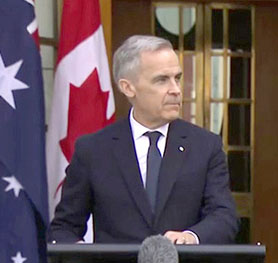
Carney quickly followed with remarks about following international law (as related to starting international conflicts).
Canada’s position at that point was no direct involvement, which for most people would mean ‘no boots on the ground’.
Then with a practical realization said that Canada would support partners in the impacted region. Carney had only recently been on a trip that included economic trade mission stops in UAE (in November) and Qatar (in January).
Now there could be Canadian ships in the water in the Middle East region for protection of safe passage of ships through the Strait of Hormuz.
G7 last week:
After the March 11 G7 Leaders’ virtual meeting, Carney and Starmer discussed the situation in the Middle East in person in London on March 16.
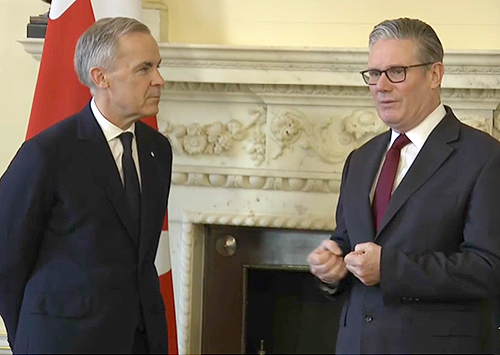
Carney and Starmer condemned the Iranian regime’s missile and drone attacks, including on civilian and energy infrastructure, and expressed deep concern over the toll on civilians, the risk of further regional escalation, and the broader global economic consequences of the conflict, including rising energy prices.
A five-nation statement about the Middle East was later released on March 16 from Canada, UK, France, Italy and Germany which included condemnation of “Hezbollah’s decision to join Iran in hostilities” (an action which led to attacks on Lebanon and then Israel fighting back).
Full statement:
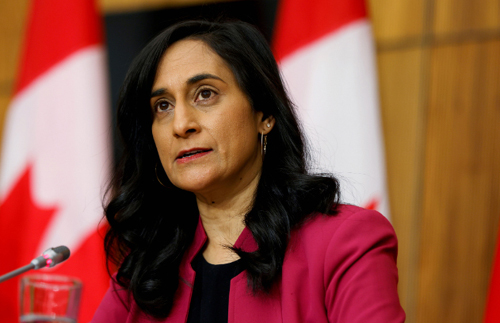
Canada’s Foreign Affairs Minister is Anita Anand.
Here is the G7 Foreign Ministers Statement as issued March 21, 2026, as posted on the Government of Canada website:
G7 Foreign Ministers’ Statement on support to partners in the Middle East
March 21, 2026
“We, the G7 Foreign Ministers of Canada, France, Germany, Italy, Japan, the United Kingdom and the United States of America, and the High Representative of the European Union, express support to our partners in the region in the face of the unjustifiable attacks by the Islamic Republic of Iran and its proxies.
We condemn in the strongest terms the regime’s reckless attacks against civilians and civilian infrastructure, including energy infrastructure, in Bahrain, Kuwait, Oman, Qatar, Saudi Arabia, the United Arab Emirates, Jordan, and Iraq, in line with UNSC Resolution 2817. The Iranian regime’s unjustifiable attacks against these states also threaten regional and global security. We call for the immediate and unconditional cessation of all attacks by the Iranian regime. We reaffirm the importance of safeguarding maritime routes, and safety of navigation, including in the Strait of Hormuz and all associated critical waterways, as well as the safety and security of supply chains and the stability of energy markets. We stand ready to take necessary measures to support global supply of energy such as the stockpile release decided by International Energy Agency members on March 11.
The G7 has repeatedly stated that Iran must never obtain a nuclear weapon and that it must halt its ballistic missile program, end its destabilizing activities in the region and around the globe, and cease the appalling violence and repression against its own people.
We support the right of the countries unjustifiably attacked by Iran or by Iranian proxies to defend their territories and protect their citizens. We reaffirm our unwavering support for their security, sovereignty, and territorial integrity.
We condemn the brazen attacks in Iraq by Iran and its militias against diplomatic facilities and energy infrastructure, particularly in the Iraqi Kurdistan Region, and against U.S. and Counter ISIS Coalition forces, and the Iraqi people.
===== RELATED:
- Poll: Most Canadians feel Canada should not be involved in Iran conflict (March 17, 2026)
- Canada & UK: Middle East & Ukraine defence, energy infrastructure, supply chains (March 16, 2026)
- USA & Israel launch bombing in Iran (February 28, 2206)
- Carney opens up wide range of economic ties with Qatar (January 18, 2026)
- Deepening bilateral engagement and economic cooperation between Canada and UAE (November 23, 2025)