

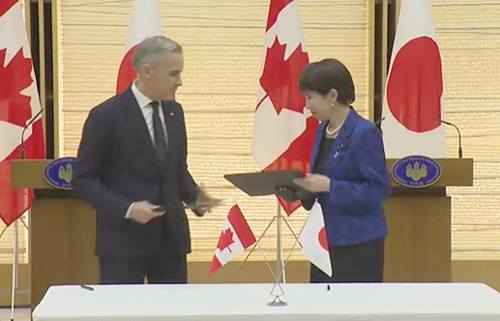

Friday March 6, 2026 | TOYKO, JAPAN
by Mary P Brooke | Island Social Trends [VICTORIA, BC]
Canada has engaged with Japan to produce a strategic partnership.
This comes during Prime Minister Mark Carney’s visit to Japan yesterday and today, meeting with Japan’s Prime Minister Takaichi Sanae. Canada’s Minister of National Defence David J. McGuinty is also in Japan for this engagement.
“Canada is focused on what we can control – strengthening our economy at home and diversifying our partnerships abroad, including in the Indo-Pacific,” it was stated in a news release from the prime minister’s office today.
“In a more dangerous and uncertain world, strengthening this relationship presents enormous opportunities for greater security, stability, and prosperity for both our peoples,” says the prime minister’s news release on March 6.
“By expanding and modernising our partnership, we are creating long-term opportunities for our workers and building a more secure and resilient future for both countries,” said Carney.
Food and energy security were emphasized by Carney in his speech as important between Canada and Japan, as well as the Arctic and climate.
Carney arrives back home in Ottawa around 4 pm (ET). His wife Diana Fox Carney has accompanied him on the now-concluding 10-day trip to India, Australia and Japan.
Japan is fourth-largest economy:
“We do much, but we’re ready to do much more,” said Carney in his remarks at a media availability podium in Tokyo.
“Japan is an over $5.5 trillion market, the world’s fourth-largest economy, and Canada’s fourth-largest source of foreign direct investment – with nearly $40 billion in bilateral trade,” says Carney’s news release.
Finance, forestry, automotive:
“Canadian businesses in Japan are leaders in financial services, forestry, and automotive sectors, and 70% of the cars manufactured in Canada are made by Japanese companies – supporting thousands of high-quality careers for Canadian workers,” it is stated in Carney’s release today while he is still overseas.
Joint statement:
Carney and Sanae released a joint statement and announced an ambitious new Comprehensive Strategic Partnership between Canada and Japan across defence, energy, critical minerals, trade, and technology.
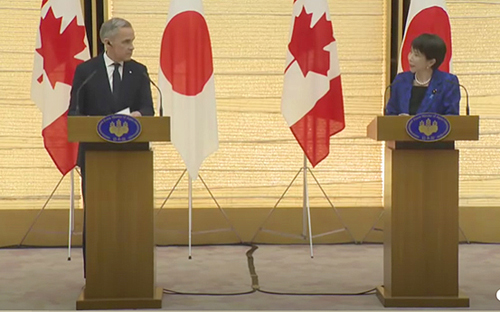
This partnership is described as being to reinforce collaboration between the two countries, attract more capital into Canada, and give greater depth and opportunities to our growing relationship.
Defence and security:
Canada and Japan share a robust defence and security partnership, spanning the Canadian Armed Forces’ Operation NEON in the Indo-Pacific, joint and multilateral exercises with the Japanese Self-Defense Forces, cooperation on cybersecurity and emerging threats, and a shared commitment to achieving a just and lasting peace for Ukraine.
To bolster our defence and security relationship and build up our defence industrial cooperation, the leaders announced:
- Three bilateral Memoradums of Cooperation (MOCs) that will strengthen collaboration on international emergency response, joint Coast Guard exercises, and action against illegal, unreported, and unregulated fishing in the North Pacific.
- Additional strategic planning, bilateral exercises, and joint operations and training exercises, including joint sails between the Royal Canadian Navy and the Japanese Navy as well as the potential for Japan’s participation in Canada’s Operation NANOOK.
- Strengthened cybersecurity and cyber defence cooperation through a new Canada-Japan Cyber Policy Dialogue, including information exchange, resilience building, and collaboration on cyber threats.
- Greater defence industrial collaboration between Canadian and Japanese companies on frontier technologies, including artificial intelligence (AI), autonomous systems, and space security, to build out our defence supply chains, increase capital flows into defence sectors, and create high-paying careers.
Trade and investment:
To build on and expand their strong trade ties, Canada and Japan will:
- Instruct their officials to identify immediate investment opportunities, including through pension funds.
- Increase efforts to support Japanese automotive manufacturers in advancing their decarbonisation efforts in Canada through multiple pathways.
- Leverage existing MOCs, including those on battery supply chains and industrial science and technology, to deepen bilateral cooperation and catalyse economic gains for both countries.
- Modernise the Canada-Japan Joint Economic Committee, building on 50 years of close economic cooperation, to capitalise on emerging opportunities such as semiconductors, batteries, AI, clean energy, critical minerals, and resilient supply chains.
- Deploy trade delegations, including a Team Canada Trade Mission to Japan in 2026 and an upcoming visit to Canada by the Japan Business Federation to unlock new commercial partnerships for Canadian businesses and investment opportunities in Canada.
To bolster energy security and leverage Canada and Japan’s complementarity in supply, Prime Minister Carney and Prime Minister Takaichi committed to:
- Expanding bilateral trade and cooperation on energy projects, including liquified natural gas and liquified petroleum gas, recognising their important roles in energy security and the energy transition. This also underscores Canada’s unique position to meet demand for low-emission energy, thanks in part to our enhanced methane regulations.
- Increasing cooperation on clean energy technologies, including nuclear technologies, hydrogen, energy-efficient industrial processes, as well as carbon capture, utilisation, and storage.
- Harnessing innovation in clean storage, grid modernisation, and clean‑energy integration.
Advanced technology, manufacturing and research:
Canada and Japan are both leaders in advanced technology and trusted partners in the responsible development of AI, manufacturing, and research and development (R&D). To reinforce this relationship, the two countries will:
- Deepen cooperation on critical minerals, including joint work to secure reliable supplies, enable value‑added processing, and support diversified manufacturing ecosystems. This includes collaboration through the G7 Critical Minerals Production Alliance.
- Increase partnership opportunities on semiconductors, AI, cybersecurity, batteries, hydrogen fuel cells, clean technologies, quantum technology, fusion energy, and other strategic sectors central to economic competitiveness.
- Advance joint R&D and innovation cooperation in new and emerging technologies, building on this year’s 40th anniversary of the Canada-Japan Agreement on Cooperation in Science and Technology.
- Intensified collaboration between our two countries’ innovation, venture, investor, and startup ecosystems, including by accelerating greater two‑way investment, strengthening links between accelerators and corporate innovation networks, and supporting joint commercialisation in emerging technology sectors.
In addition to these efforts, Canada and Japan will increase Arctic scientific and technological cooperation as well as joint efforts on climate change and environmental observation. To that end, the leaders welcomed the signing of a bilateral MOC to conduct joint scientific activities in fisheries and marine research, including stock assessment, climate and ecosystem science, advanced marine technologies, and researcher exchanges to support sustainable resource management.
Sector meetings:
In Tokyo, Prime Minister Carney will meet with the leaders of major Japanese firms across automotive, advanced manufacturing, clean and conventional energy, infrastructure, and technologies. The stated goal is to position Canada as a reliable trade partner and a competitive destination for new investments.
Follows visits to India and Australia:
Carney’s visit to Japan follows his latest engagements in India and Australia as part of a 10-day trade mission.
- In India, Canada secured over $5 billion in commercial agreements
- In Australia, Canada elevated the bilateral partnership in critical minerals, defence, and AI and secured up to $10 billion in investment commitments.
“By re-engaging with global giants and deepening our partnerships with our closest allies, Canada is creating high-paying careers at home, diversifying our trade, attracting massive investment, and building a stronger, more sovereign, and more resilient Canadian economy,” the prime minister’s release states.

Anniversaries:
Carney’s official visit to Japan coincides with important milestones in the Canada-Japan bilateral relationship, including:
- The 50th anniversary of the Canada-Japan Joint Economic Committee, which has underpinned five decades of structured economic dialogue and sustained trade and investment growth between our two countries.
- The 40th anniversary of the Canada-Japan Agreement on Cooperation in Science and Technology, which has enabled scientific partnership in frontier fields such as AI, quantum computing, clean energy, advanced materials, and next‑generation digital technologies. Canada and Japan have recently expanded the scope and ambition of this partnership, including through new MOCs on industrial R&D and battery supply chains.

===== RELATED: