


Monday February 2, 2026 | VICTORIA, BC [Posted at 12:18 pm | More reader comments added February 8, 2026]
by Mary P Brooke | Island Social Trends
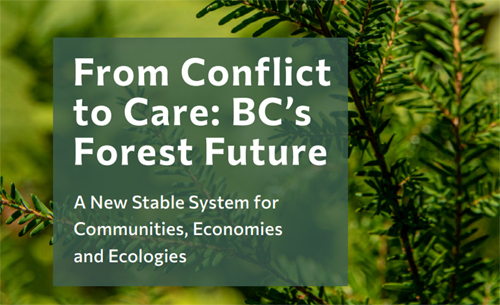
Link to the final report (PDF) – From Conflict to Care: BC’s Forest Future
A new independent report from the Provincial Forestry Advisory Council (PFAC) finds that British Columbia’s current forest management system is failing to meet a range of needs, including communities, First Nations, businesses and the environment.
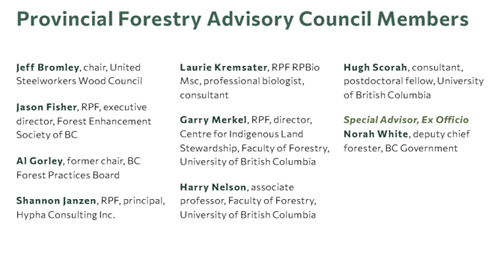
The concept, report and analysis was delivered in person this morning in Victoria, led by BC Forests Minister Ravi Parmar and BC Green MLA Rob Botterell (Saanich North and the Islands). Details were outlined by Shannon Janzen and Garry Merkel, registered professional foresters and co-chairs of Provincial Forestry Advisory Council (PFAC).
The report concludes that small, incremental reforms are not enough to address the scale of challenges facing the sector.
BC Greens support:
BC Green MLA Botterell said the report reimagines BC timber sales. He gave much credit to Minister Parmar for the way this process was put together. “We’ve got a path forward,” the BC Green MLA said.
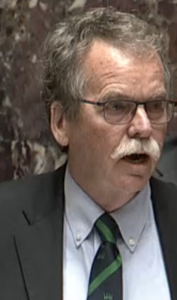
“This offers a monumental reset for British Columbia’s forests,” said Botterell in a followup statement. “Implementing the recommendations of this report would usher in modern forest management that meets the moment.”
“Mill closures, drought, climate change, tariffs, and wildfire have shaken workers and families, and devastated towns and ecosystems,” notes Botterell. “BC’s forestry industry cannot continue to function the wya it has, and we cannot risk another short-term fix.”

Co-chair comments:
“It’s been decades in the making where we are today,” said Janzen. “We have to stop doing the same things and do the things that are going to make a difference.”
“Our current reality is not okay,” said Janzen.”We ‘re going to focus on structure and system in place rather than investing time and energy in conflict.”
“The system is built on an era that no longer exists,” said Janzen. Disruption and change now demands that adaptation happen, she said.
Janzen points out that investors are “being asked to invest in a very unstable system right now”. “This needs to change,” she says.
“For whatever reason, it just hasn’t been done in BC,” said Janzen today regarding area-based land management. She told media today that BC is “one of the last jurisdictions” to take this direction. It’s a way to “manage common resources”.
Predictable fibre supply is what investors are looking for, said Merkel. The system is fractured, having been built piece by piece, said Merkel.

Minister Parmar:
Forests Minister Parmar says the new direction moves from volume-based to area-based. It’s a working forest model with a sustainable harvest, said Parmar today. He also highlighted the importance of jobs in the forestry sector.
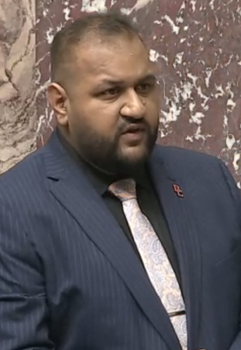
A key goal is “real certainty and stability for workers” and a sustainable sector “that looks a hundred years out”, said Parmar.
Report process:
The Provincial Forestry Advisory Council report called From Conflict to Care: BC’s Forest Future identifies outdated systems, limited access to trusted public data, and deep structural misalignment as major drivers of ongoing conflict and instability. Decades of layered rules and centralized, top-down decision-making have created a system that lacks the predictability and flexibility needed to respond to today’s ecological, economic, legal and social realities.
“This isn’t about tinkering around the edges or adding more rules,” said Shannon Janzen, co-chair, PFAC. “It’s about rethinking the system as a whole. From Conflict to Care lays out a practical path forward, one that moves beyond elusive short-term fixes toward a system capable of addressing challenges and realizing the opportunities that we actually face.”
At the heart of the report is a shift toward Land Care – moving away from managing forests primarily through timber-harvest targets and toward regionally grounded, area-based decision-making about forests. This approach is designed to improve transparency and predictability, and to better reflect local conditions and regional requirements.
The report notes that the industry is struggling to adapt to declining fibre supply, rising costs and market pressures. While past reforms have added complexity and expense, they have not delivered the long-term stability or transparency communities, First Nations, and businesses need to plan and adapt.

Provincial Forestry Advisory Council:
“We heard frustration across the spectrum that the system keeps asking people to endure more process, while delivering less certainty and little change on the ground,” said Garry Merkel, co-chair, PFAC.
“This report responds directly to that reality. It sets out a way to move decision-making closer to the land, grounded in transparent information and regional accountability. Stability will not come from preserving the status quo. It will come from changing how the system is built,” says Merkel.
The report highlights this systematic transition as an opportunity to reset relationships, with the land and with people, by supporting place-based approaches that reflect Indigenous Rights and Title, and local knowledge.

Recommendations:
Key proposals include creating a transparent, light detection and ranging (LiDAR)-based public forest and ecosystem inventory, and shifting to area-based land management with independent oversight to allow regions to develop co-ordinated plans reflecting local priorities.
The report also outlines pathways to support First Nations in co-designing land management approaches consistent with their governance and responsibilities.
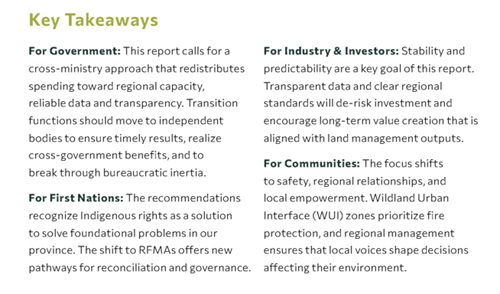
There are four strategic themes in the report, four key takeaways, and 10 recommendations.
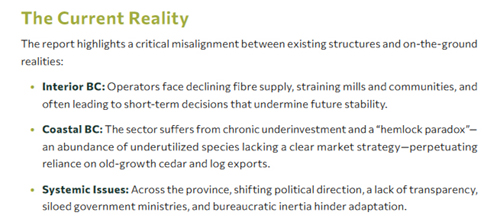
The report highlights a critical misalignment between existing structures and on-the-ground realities within Interior BC, Coastal BC and System Issues.
The Provincial Forestry Advisory Council stresses that meaningful change will require co-ordinated and focused implementation. Piecemeal action is unlikely to succeed. From Conflict to Care provides a structured transition toward a more stable, accountable, and responsive land management system, one designed for today’s realities and the long-term care of B.C.’s forests.

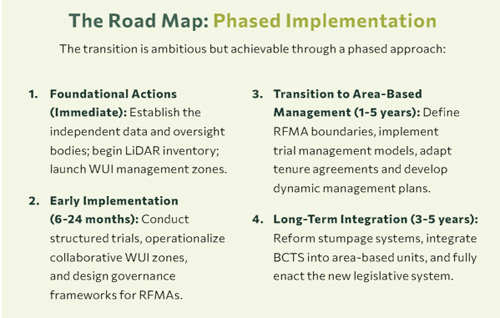
The Council’s report includes a roadmap that emphasizes a phased approach to implementation that are foundation and immediate, early implementation (6 to 24 months), transitional to area-based management (1 to 5 years), and long-term (3 to 5 years).
About the Provincial Forestry Advisory Council (PFAC):
The Provincial Forestry Advisory Council is an independent advisory body established to provide expert, non-partisan guidance on the future of forest policy in British Columbia. Its members bring experience across Indigenous governance, forest management, economics, ecology and public administration.
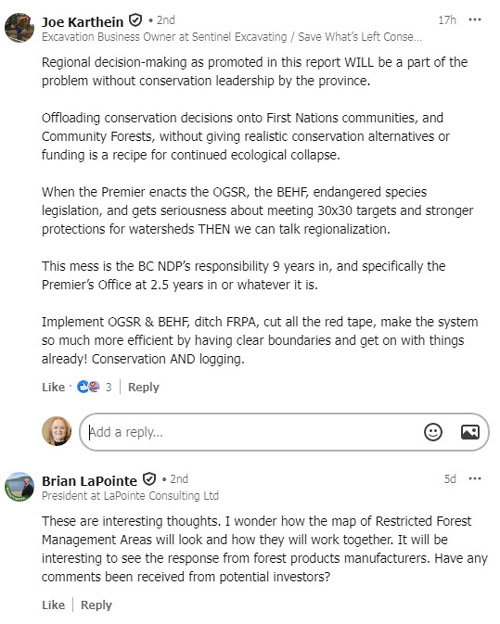
===== READER COMMENTS:

===== RELATED:
- External website: Provincial Forestry Advisory Council
- Premier Eby highlights forestry, mining & reliable electricity as key to economic resilience (January 20, 2026)
- BC Natural Resources 2026 Forum at critical economic pivot point (January 14, 2026)
- BC Forests Minister Parmar pleased with federal lumber sector supports (November 26, 2025)
- BC softwood lumber summit: provincial-federal cooperation & faster funds (November 3, 2025)
- NEWS SECTIONS: FORESTRY | 43rd BC PARLIAMENT | GOVERNMENT OF BC