


Saturday January 24, 2026 | VICTORIA, BC [Posted at 8:41 pm PT]
Political news analysis | by Mary P Brooke | Island Social Trends
ONE IN A SERIES OF ARTICLES about BC CONSERVATIVE LEADERSHIP CANDIDATES | See BC Conservative News Section
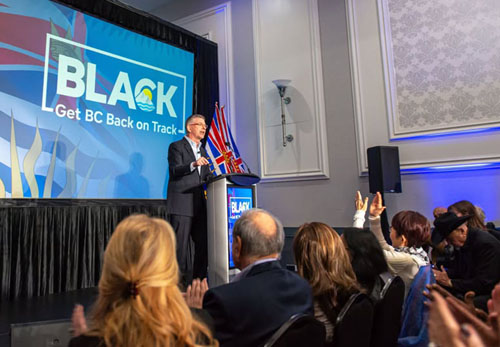
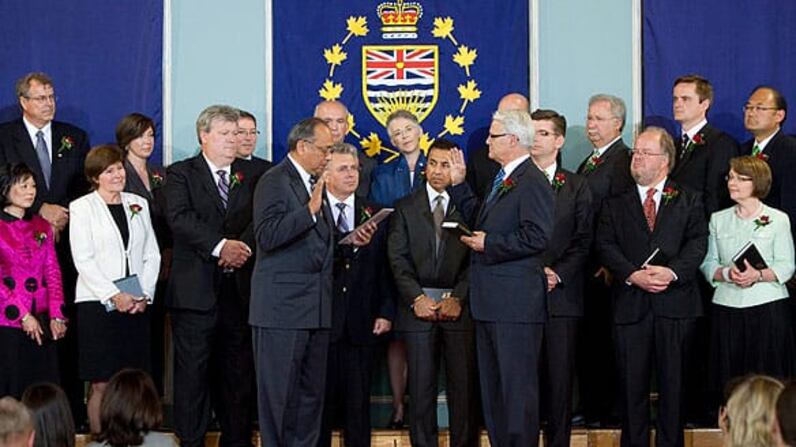
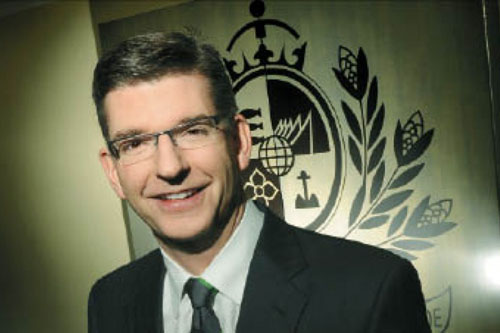
If you followed BC provincial politics back in the Gordon Campbell era, you would have known about then BC Liberal cabinet minister Iain Black. He was part of that era in BC politics during 2005 to 2011 as MLA for Port Moody–Westwood (later Port Moody-Coquitlam).
At that time he was the Minister of Small Business, Technology and Economic Development and the Minister Responsible for the Asia-Pacific Initiative. Essentially, he was the ‘minister of trade’, he tells Island Social Trends.
Now he’s back.
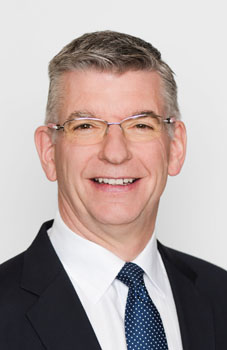
Black’s recent return to politics took the form of warm-up as a candidate in the April 2025 federal election, as the Conservative candidate for Coquitlam—Port Coquitlam, where he came somewhat close to defeating the long-time (now four-term) Liberal incumbent.
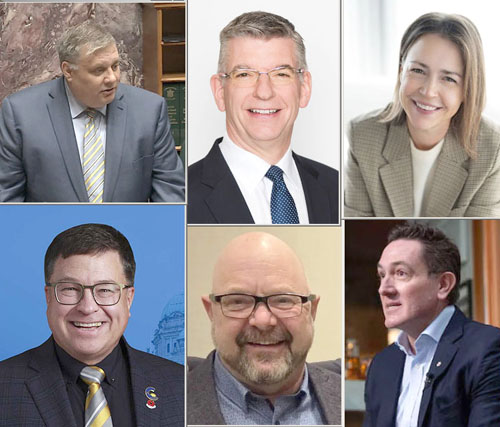
Black is now one of currently six contenders for the Conservative Party of BC (aka BC Conservatives), in a race that will see a new party leader chosen on May 30 of this year. Leadership nominations close on February 15 and voting by BC Conservative party members takes place May 9 to 30. Currently all the leadership contenders are from the BC Lower Mainland or interior, none from Vancouver Island.
In the meantime, Black is reacquainting himself with the provincial issues of the day and getting his name out there as the potential new BC Conservative leader.
Refresher on the BC Conservatives come-back:
It’s worth noting that two years ago the BC Conservatives Party as a right-of-center political party was barely a blip on the public’s radar for things provincial and political. They the party had two MLAs in 2023, after both John Rustad and then Bruce Banman left the BC Liberals to become BC Conservatives. That gave them official party status (third party in the BC Legislative Assembly).
British Columbians saw the long-time BC Liberals rename their party as BC United in April 2023. Apparently that was to distance themselves from the federal Liberal party if not the reputation of the BC Liberals themselves, but more so as a marketing exercise to attempt to bring a ‘big tent’ assembly of candidates into their party for the 2024 election.
John Rustad — one of only two BC Conservative MLAs at the time — in August 2024 executed a deal with then BC United Leader Kevin Falcon to merge the two parties. It was a strategy to succeed in finding candidates in all 93 ridings for the October 2024 election. That worked. The BC Conservatives who won 44 seats on the October 19, 2024 election night (with a few weeks to sort out final results, however). The goal of the centre-right party (ultimately with a few clearly right of centre MLAs) was to oust the BC NDP government and they almost achieved that; BC NDP Leader Premier David Eby barely hung on with a razor-thin BC NDP majority by winning 47 seats (shaved down from the previous 55).

Rustad’s success with restoring the party of the centre-right with a wide range of MLA backgrounds and skill levels (not a lot of them previously in politics) was also ironically partly the source of his demise. After just two sessions in the BC Legislative Assembly in 2025, by December last year he was no longer the party leader after a tumultuous year of seeing a few MLAs leave to be independents or to start their own party (OneBC became the 4th Party in the BC Legislative Assembly).
Through a strategy for the right to win at any cost, the hen-house door was open to pretty much anyone who wanted to run as a BC Conservative (as was evident even during the election when a few candidates needed to be dropped).
Now the BC Conservatives in their leadership race are attracting a range of business leaders and former right-leaning politicians to further bolster the free enterprise party that is the Official Opposition.
Business world and back:
Black was in the Gordon Campbell Cabinet, but not the Christy Clark cabinet, he is quick to point out.
In 2011 (as Christy Clark came to the party leadership) Black went back into the business world to run the Vancouver Board of Trade; he was CEO there from late 2011 to mid-2019 before returning to the technology and new economies sector where he got his start.
Black was focused on the mission of building-business back then, and feels the province needs business-style leadership again now. He wants to be the BC Conservative leader and the next premier with a business style and vision.
The next election is currently scheduled for October 21, 2028 (though it could happen sooner).
Since 2017 British Columbians have become accustomed to the BC NDP way of ‘putting people first’. Likely any BC Conservative will lean to putting business first. Afterall, the BC Conservatives (and the earlier rendition of the BC Liberals) are a free enterprise party.
Some folks might worry about BC losing a range of supports for low-income people or those who fall on hard times if a BC Conservative government happens in BC’s future.
As an example, when interviewed by Island Social Trends recently, Black was unaware of well-established (though yet imperfect) rental support programs like SAFER and RAP (run through BC Housing) and the BC Rent Bank (operated by the VanCity Community Foundation with numerous partners, on behalf of the BC government) — programs which help keep many British Columbians from losing their rental accommodation in these tough economic times.

Claiming the lead:
“I’m the right guy to lead,” says Black. He articulates about proven leadership that is right for the context of these times. He says the province is economically “under performing” even though the David Eby NDP government is actively working on opening natural resources projects, boosting trades training and actively pursuing trade diversification (including with emerging or fast-growing economies like India and Malaysia) in response to the tariff and sovereignty threats from the current USA administration.
Black points out that when he was effectively the trade minister during 2005-2011 that part of his mission was to reduce BC’s economic reliance on the United States — “something that no other province in Canada did,” he says. At that time he says there was a BC Govenrment push to do more trade with Asia, China, South Korea and Japan, including leading heavily with forestry-related products, to get the province’s trade balance changed. He says BC got trade with the US down to 50% of BC’s overall trade profile.
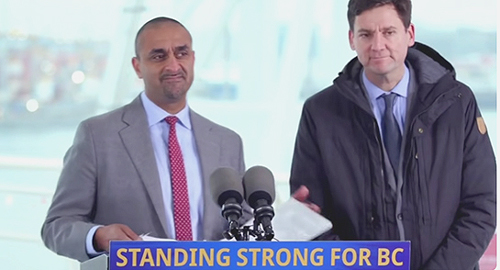
It sounds like Black would do much the same as what the BC NDP is doing now — “open trade and get deals in place” — as these are things that work. It takes “time, effort and focus which the current administration just does not have,” says Black. He insists that Eby and Kahlon’s recent trade mission to India was “as much about changing the dial off of a disastrous situation on the Indigenous file as it is anything else”. Though it could be said that governments can do more than one thing at a time and that the recent Eby/Kahlon trip was expedited as part of keeping pace with the urgency of trade diversification.
Another key area of focus for Black — if he were to lead the BC Conservatives — would be dealing with the “enormous regulatory creep”.
“One of the key differences between an NDP administration and something like what BC Conservatives would bring to table is that we have a very clear belief as Conservatives that government’s job is to pave the way and set fair rules and then get out of the way,” says Black. “And not pick winners and losers,” he adds. the way to do that is “to get rid of a ton of regulations,” says Black. He claims that in the first four years of the Campbell BC Liberal administration that 50,000 regulations were taken “off the books”.
Black says BC Government permits are not being issued fast enough. He would do things “very differently”. Even though LNG facilities, Site C and other energy-related projects have been coming on stream in the NDP government period since 2017, Black points out that those projects started under the BC Liberal governments (both Gordon Campbell and Christy Clark). “We have to get faster at this,” says Black.
Black says that the current NDP strategy around LNG facilities in BC and the expansion of the North Coast Transmission Line “are not going where needed” but without providing detail at this point.

Priorities coming soon:
Black will announce three of four of his leadership campaign priorities in the days ahead. He says he has “a very clear command” of public policy, especially economic policy (highlighting his BC Liberal cabinet and treasury board experience).
Black feels the next BC election should be “sooner rather than later” and that he would be a good premier. Not like what is happening now, he suggests, in saying that in BC “we’ve abandoned everything that works”.
“We really slow down the small business community when we ask more of them,” says Black. Though he hasn’t been in government for a while, and may not be aware of digital streamlining of things like online interfaces with the corporate registry or remitting provincial sales tax.
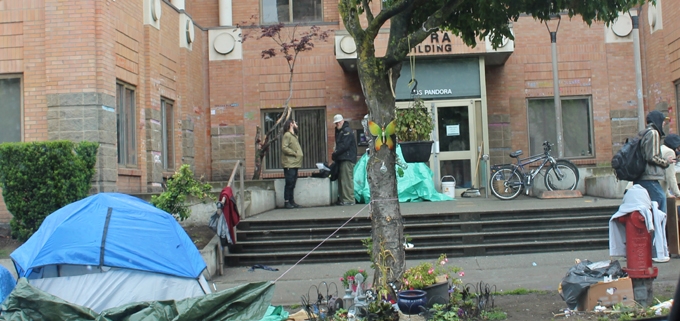
“Nothing is working at the moment,” says Black, in a broad indictment of the current BC NDP government. He points to homelessness as one example where not enough is being done — whether on the downtown East side in Vancouver or along Pandora Avenue in downtown Victoria.
Black says he would actively care about the small business community, in particular by reducing regulation. And he notes that workers in forestry have livelihoods that are “under threat”.
Though things can change rapidly; at last week’s BC Natural Resources Forum, BC’s Minister of Forests Ravi Parmar outlined a new path for restructuring BC’s forest industry in way that would aim to stabilize the sector going forward.

So it’s one thing for a leadership contender to critique in the present. By the time an election rolls around the BC economic landscape could be much different if not improved if the Eby government’s Look West strategy — led energetically by Jobs and Economic Growth Minister Ravi Kahlon — achieves strong results over the next year or two.

Campaign momentum:
Black feels people are engaging with his campaign because he will lead on protecting property rights, public safety, health, education and “untreated mental health”.
When asked about school infrastructure policy and if he would return to how the BC Liberals under the Christy Clark government did things (e.g. only build schools to current need not projected capacity), Black said says good planing should undertake “a sense of the trend”.
It sounds like he would look favourably on reversing the Employer Health Tax (EHT) which was brought in by the Horgan NDP government effective January 2019 so that individuals in BC would no longer have to direct-pay their own Medical Services Plan (MSP) premiums (which sometimes landed financially-strapped households in scenarios where they had to endure government-authorized collection agency pressures). He says that what he refers to as ‘payroll tax’ as “foolhardy” and indicative of a “disarrangement of employment”.
Clearly this candidate brings a business mindset. Black says he wants to impact peoples lives. “I know I can help,” he told Island Social Trends.

Others in the race:
The other five BC Conservative leadership contenders are presently Sheldon Clare, Caroline Elliott, Yuri Fulmer, Warren Hamm, and Peter Milobar.
The BC Conservative Interim Leader is MLA Trevor Halford (who is not seeking the permanent leadership).
===== RELATED:
- Six contenders in BC Conservative leadership race toward May 30 (January 16, 2026)
- BC Conservative leadership race heats up (January 14, 2026)
- NEWS SECTIONS: BC CONSERVATIVES | 43rd BC PARLIAMENT | BC PROVINCIAL ELECTION 2028 | EDITORIALS