



Sunday December 28, 2025 | LANGFORD, BC [Updated December 29, 2025]
by Mary P Brooke | Island Social Trends
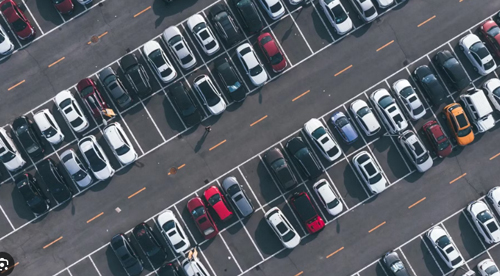
The high-energy search for parking spots in shopping mall parking lots is over for another holiday season.
ICBC says that about 30% of all collisions in December happen in parking lots (Dec 2024 stats).
Meanwhile, let’s take a look at how people park in multi-stall lots.
Enter/exit:
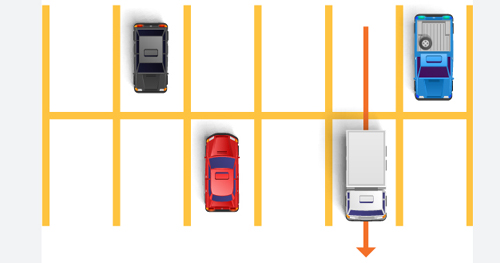
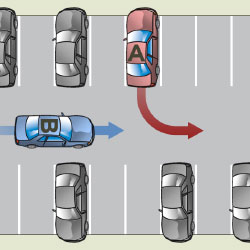
Here are some thoughts on the way some drivers choose to exit their parking spot by driving their vehicle forward and through to the parking spot in front of them.
- That’s presuming someone had pulled into a parking spot front-forward
- This does not apply to vehicles parked by backing the vehicle into the spot.
Some driving schools will tell their students that pulling a parked but now-moving vehicle forward into an empty spot ahead is illegal, or at least discourage it.
At the very least, there is limited or no visibility of an oncoming car — either for the driver pulling through into what is presumed to be an empty spot, or for someone who may be approaching in their vehicle with the intention of pulling into that spot.
Why take the risk?
Making the smarter choice:
Choosing to exit a parking spot by driving into the spot ahead, is not illegal nor eligible for a fine.
However, to pull forward into a spot that appears vacant (until suddenly it is not) can cause unexpected minor collisions, or near-collisions. This has probably happened to every driver at some point or another.
Front in first, or back in?
Turning into a 90-degree parking stall spot in a mall or office parking lot seems the natural thing to do. That also makes it easier to have access to the trunk of the car or provides room to pull down a truck tail gate.
However front-first parking does mean having to back out later.
To avoid the backing-out, some drivers choose to pull forward into the next spot.
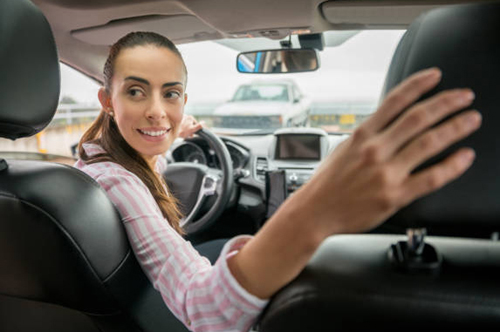
While some driving advisors may recommend backing into a 90-degree angle spot, that is frequently not simple to do in a busy parking lot. A driver behind may impede success in backing in by having their vehicle too close. It also seems like a non-intuitive way to interrupt the flow of traffic in a busy lot.
However, having backed into a parking stall means of course you’re almost certainly going to pull forward to execute your exit which is easier.
Backing into a parking stall requires turning and looking over one’s shoulder. That may not be comfortable for older people or anyone with a temporary back or neck injury.
ICBC says that 47% of drivers reverse-park into stalls.

Grey area:
“Parking lots are a bit of a grey area for rules of the road and enforcement,” says Cpl Nancy Saggar, media relations officer, West Shore RCMP.
“Most parking lots are privately owned yet open to the public, therefore the rules of the Motor Vehicle Act and Motor Vehicle Act Regulations apply, but are not specifically written for activities within the lot,” says Cpl Saggar.
“The owner of the lot determines the lines, lanes and other traffic control, not the Municipality or MOTI, as with a normal road,” says Saggar.

Crossing a solid line:
Travelling from one parking stall to the next involves crossing a solid white line.
However, the RCMP points out that the section that prohibits crossing a solid line, Section 151 of the Motor Vehicle Act, specifies the prohibition only applies to “a driver who is driving on a laned roadway”, therefore not a parking lot.
Sections 187 through 192 of the Motor Vehicle Act, and Division 18 of the Motor Vehicle Act Regulations, regulate parking. “These sections do not address issues such as pulling through from one parking stall to the next,” says Saggar.

Emerging vehicle:
The Motor Vehicle Act includes sections about “Emerging Vehicles” but that does not include traffic within a parking lot (only when it is leaving a parking lot):
- Section 176(a) states that a driver emerging from an alley, driveway, building or private road (a parking lot would be included here) must yield to pedestrians
- Section 176(b) states that a driver emerging from an alley, driveway, building or private road (a parking lot would be included here) must yield to vehicles on a roadway
Driver behaviour:
There are other Sections of the MVA that can be applied to driving behaviour.
Suppose a driver was driving at high speed, driving through stalls, across lanes and doing donuts. In such a case, the RCMP could charge the driver with multiple offences such as Dangerous Driving under the Criminal Code or Drive Without Due Care and Attention under the motor Vehicle Act.
The evidence that the driver was driving through parking stalls and across lanes would support the greater charge, but a charge would not specifically be laid for driving through parking stalls.

Municipalities:
Municipalities may have bylaws which control traffic within a parking lot.

Collision insurance:
If the act of pulling through from one parking stall to the next causes a collision and damage, there may be civil liabilities.
In British Columbia, ICBC handles insurance claims for parking lot accidents the same way it does other vehicle collisions, including for crashes while reversing from a parking spot.

===== RELATED:
- Reader comments welcome
- NEWS SECTIONS: WEST SHORE RCMP | RETAIL | ROAD CRASHES & INJURIES