


Saturday December 20, 2025 | LANGFORD, BC [Posted at 11:38 am | Updated 12:50 pm]
Editorial analysis by Mary P Brooke | Island Social Trends
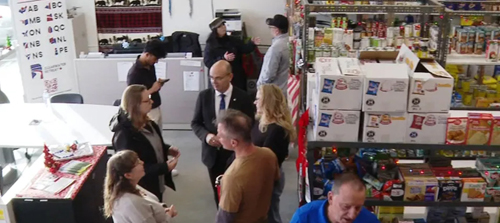
Local TV media reported yesterday on a new food bank that has been set up for veterans and first responders in the Langford area.
Located in a ground-level street-fronting warehouse space at #326-4342 Westshore Parkway in Langford, the Veterans Food Bank of Victoria operation apparently evolved out of a pride that some veterans seemed to express in last night’s TV coverage.
One veteran essentially said it would be seen as they and their comrades being ‘below’ the public. Another made a similar comment about being embarrassed to go to a regular food bank. One of the persons interviewed said he had been homeless for years.
Food banks are mainstay now:
Sadly, going to a food bank has become increasingly necessary for many families and households over the past couple of post-pandemic inflationary years. Probably no one wants to be there, but they go out of a need to support themselves or their household.
“Veterans are a proud bunch and they don’t want anyone to know when they have to come to a food bank,” said one person who was interviewed yesterday. Likely the feeling is the same for many who nowadays might or must use a food bank service.

Economic crisis:
This is a time of economic crisis which — clearly — governments and the economic framework of this country still have not tackled the root causes of, including:
- the investment-model in housing that ignores the right to having a roof over one’s head, and
- the still insufficient employment insurance program that provides eligibility to only about 40% of the adult population.
Most food banks are well established nowadays — a stark unfortunate statement on the broad dysfunction of Canada’s economy.
Most food banks are well-supplied by local grocery store food rescue and the public donation of food and funds.

Stigma:
Most food banks do try to make the act of registering or lining up for free food to be less stigmatized than in the past.
Some food banks (like Living Edge across Greater Victoria) have now shifted to a ‘market’ style of operation where no registration is required but where free tokens are handed out for use to ‘shop’ in the food-stocked area.
Surely no one is displeased at food banks supporting people in need. But the idea of developing a food bank that intentionally insulates Canada’s military from those in need within the mainstream society seems to be seeking to boost the morale of veterans who perhaps should be receiving more compensation.
As revealed (at least through the remarks heard in media reports yesterday) there is a cultural divide if not bias between those who serve and those who are served by Canada’s armed forces. In reality, the military does operate separate and apart from mainstream society — by some level of necessity.

Broader operation:
While yesterday’s report on the Veterans Food Bank of Victoria was local, this highlights a broader point about the indexing of veteran payments to cost of living.
The Veterans Food Bank of Victoria is owned and operated by the Canadian Veterans Services Society (CVSS) that was founded in 2018. This is the fifth branch now operating in Canada; the other four are in Kelowna, Calgary, Edmonton and Red Deer. According to the CVSS website they have plans for other locations across the country.
According to the CVSS website, their food bank supply is provided by donations of food and funds from individuals and businesses.

West shore support:
The Veterans Food Bank of Victoria in Langford reportedly started last month, with awareness spreading by word of mouth.
One of 10 people in the homeless population in Canada is a veteran according to the BC Command Legion Foundation determined that information from a point in time homeless count.
Conservative MP Jeff Kibble (Cowichan-Malahat-Langford) attended the veteran food bank media event. Kibble served in the navy.
Some members of City of Langford council attended.

===== RELATED:
NEWS SECTIONS: FOOD BANKS | POVERTY REDUCTION | INCOME EQUITY