



Tuesday December 9, 2025 | VANCOUVER, BC [Posted at 4:35 pm PT | Updated December 15, 2025]
by Mary P Brooke | Island Social Trends
“Nearly half of all Canadian women have experienced a form of intimate partner violence,” said BC Attorney General Niki Sharma today in a media availability in Vancouver.

She added that there were more than 100 intimate partner related homicides across Canada last year, saying that”s a sharp increase from the year before.
This was Sharma’s lead-in to expressing her satisfaction with how the federal government has heeded many contributions and suggestions from Sharma and her team regarding changes to the law that would better support victims and survivors of intimate partner violence (IPV) and sexual violence.
In particular, in that the federal government has introduced Bill C-16.
“Every statistic represents a person, a family, a community,” the BC Attorney General said.

Recent tragedies fueled the need for change:
“Gender-based violence and homicides are not new challenges. Nor are they unique to BC,” said Sharma. “But recent tragedies here at home have reminded us that we cannot wait. We must act boldly and urgently,” she said today.
Sharma says that one of her top priorities as Attorney General has been to address gender-based and IPV.
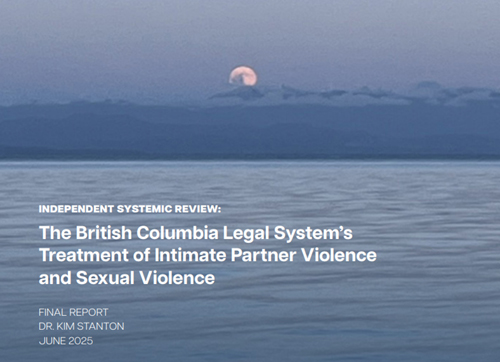
She appointed Dr Stanton to conduct an independent review and propose improvements to the province’s treatment of victims and survivors of intimate partner and sexual violence in our legal system; a 250-page report The British Columbia’s Legal System Treatment of Intimate Partner Violence and Sexual Violence was released in June 2025.
“Over the course of my tenure as Attorney General, it has become clear to me the significant criminal code reforms were also needed to keep people safe and make meaningful change,” Sharma said today.

For over a year now, the AG and her ministry have been engaging with their federal counterparts “to recommend reforms that we think are crucial”.
“In October, BC secured stronger protections for survivors of IPV like stricter bail for those accused and convicted of sexual offences. But it was clear that more was needed,” Sharma recounted today.

Success today:
“Now, today, in the House of Commons, the federal government tabled a landmark piece of legislation that includes many of the changes that BC has pushed for — most vitally — classifying homicides of an intimate partner as first degree murder where there is a pattern of abuse and steps to address court delays and Jordan’s Stays that disproportionately impact sexual offence cases. And adding criminal control as a criminal offence so we can get to the early stages of intimate partner violence before it becomes deadly.”

Sharma says the federal bill includes changes that will complement programs that BC already has in place. there are new rules to protect kids online, crackdowns on extortion, and helping victims seek justice for the harms caused by the non-consensual sharing of images.

Compassionate amendments we’ve advocated for — like allowing a victim or witness in a sexual assault case to have with them a support animal when they testify.
“These are historic changes that I believe will make a difference,” says BC’s attorney general. She thanked federal Minister of Justice and Attorney General Sean Fraser in particular for listening to the concerns of British Columbians and working with BC to meet their needs.
C-16 – Protecting Victims Act:
“There are certain problems in society that we want to solve,” said Attorney General Fraser in his press session in Ottawa today. He emphasized that the new Liberal government is “engaging directly engaging directly with folks who know how to solve the problems that exist”.
The Liberal government has tabled substantive new legislation that it says will protect victims and survivors of sexual and intimate partner violence and protect children from predators.
The Protecting Victims Act also challenges a 2016 Supreme Court ruling that allows cases to be stayed if they are significantly delayed.
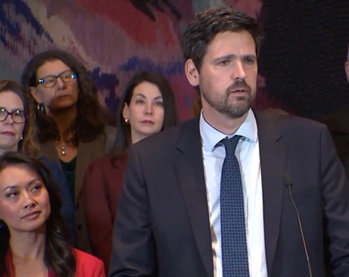
The legislation further proposes to increase penalties for sexual crimes such as distributing intimate images and sexual deepfakes and obtaining sexual services from a child.
The federal government calls Bill C-16 one of the most consequential Criminal Code updates in generations. It is outlined as:
Stop intimate partner violence and femicide
- Making murder motivated by hate first-degree, including femicide: The Criminal Code would classify murders driven by hate or that occur alongside controlling or coercive behaviour of an intimate partner, sexual violence or exploitation as first-degree murder, even when there was no planning and deliberation. These killings overwhelmingly target women, with intimate partner homicides rising 39% last year and 81% of victims being women.
- Criminalize coercive control to facilitate intervention before intimate partner violence turns lethal: Abuse often escalates through patterns of control long before physical violence occurs. A new offence would target patterns of coercive or controlling behaviour, giving the justice system the tools to intervene before violence escalates.
- Modernize sexual violence protections: The proposed legislation would prohibit the distribution of non-consensual sexual deepfakes, increase penalties for the distribution of intimate images without consent, prohibit threats to distribute such images, and increase penalties for sexual assault on summary conviction.
Keep our kids safe from predators
- Put child predators behind bars: This legislation would strengthen mandatory minimum penalties of imprisonment for predators who possess or access child sexual abuse and exploitation material, including restoring at least a dozen mandatory minimum penalties of imprisonment for a range of child sexual offences that were previously struck down by courts. These changes would ensure that those who prey on our kids face prison time for the most heinous crimes imaginable.
- Crack down on online sextortion: Kids are being targeted online in a world with threats that are very different compared to a decade ago. This legislation proposes stronger measures to address online sexploitation and child luring, including by criminalizing threatening to distribute child sexual abuse and exploitation material and distributing bestiality depictions, which are known to be used to manipulate children for sexual purposes. The proposed changes would also strengthen Canada’s ability to prosecute predators who sexually exploit children abroad. To give law enforcement and prosecutors the tools they need to stop these crimes and bring perpetrators to justice, the limitation period for the prosecution of offences under the Mandatory Reporting Act would be extended from 2 to 5 years. Online platforms would also be required to preserve data longer, from 21 days to one year.
- Protect youth from being exploited into criminal activity: Criminal organizations are increasingly pressuring, recruiting, or grooming kids to commit serious crimes on their behalf. This legislation would create a new offence of recruiting youth into crime and toughen sentencing laws so that those who recruit, encourage, or counsel a kid to commit a crime would face a strong response.
Minister Fraser said that today in an interview on Power and Politics (on CBC) that the federal legislation seeks the challenges of undue delay to be considered which includes addressing procedural changes should things “drag on”.
“The criminal code and the legal system must clearly and unequivocally effect the seriousness of hiring an intimate partner. It’s been clear that not only is intimate partner violence among the most serious of crimes a person can commit, but that a pattern of sexual violence, control and abuse accumulates in murder, the perpetrator cannot get away with a more lenient punishment that the murder itself was not planned or premeditated,” said Sharma today.
“A record of abuse should be considered evidence of premeditation,” says Attorney General Sharma. “This is a key step in ensuring that families of victims receive the justice they deserve.”

Courts need clear guidance:
“I’m also pleased that the federal government heard our concerns that courts need clear guidance on how to deal with delays, especially in sexual assault cases.”
She recounted how too often it’s the case that women come forward to testify only to have their case dismissed due to Jordan Delays, which Sharma says is “heart-breaking and should not be allowed to continue”.
Note: “Jordan delay” refers to the landmark 2016 Canadian Supreme Court ruling, R. v. Jordan, which set presumptive time limits (18 months for provincial, 30 for superior court) for criminal cases to move from charge to conclusion, aiming to enforce the Charter right to a trial within a reasonable time, with delays beyond these ceilings leading to a stay of proceedings unless the Crown justifies them.
Sharma is hopeful that with these clarifications from the federal government that the court system will have clear instructions. It needs to treat cases involving sexual violence with the care, nuance and empathy that victims deserve.

Dr Stanton’s report & recommendations:
“We believe these cases should be foundational, to work we were already doing to implement recommendations put forward by Dr Stanton in her review of BC’s legal system,” said Sharma.
“Dr Stanton’s final report (released in June 2025) provided us with a clear road map to address systemic and legal barriers that prevent a change here in BC,” said Sharma today.
Dr. Kim Stanton’s June 2025 Final Report called Independent Systemic Review: The British Columbia Legal System’s Treatment of Intimate Partner Violence and Sexual Violence included system-wide recommendations.
“Six months after receiving the report we have advanced work on 13 of her recommendations,” said Sharma [see list below] A detailed public update is available online — outlining progress made on key priorities and our immediate actions.”
- RECOMMENDATION 1 – The Review recommends that the BC government declare that genderbased violence is a provincial epidemic.
- RECOMMENDATION 2 – The Review recommends that the BC government create a strong internal government accountability mechanism.
- RECOMMENDATION 4A – The Review recommends that the BC government prioritize support for prevention initiatives, including public education, to reduce and prevent violence before it escalates to the point of engaging the legal system.
- RECOMMENDATION 4B – The Review recommends that in addition to prioritizing support services for survivors (recognizing that sexual violence and intimate partner violence disproportionately affect women and gender-diverse people), the BC government support quality, accredited services for men who use violence.
- RECOMMENDATION 4C – The Review recommends strengthening the system-wide framework for education and training of institutional actors (including government agencies, police, Crown counsel, courts, and corrections) on the causes and dynamics of gender-based violence, unconscious bias, and the elements of effective trauma-informed practice. This framework should include:
A) a system of core competencies and certification; and
B) evaluation of whether education and training for system actors is being utilized, whether the programs are effective, and whether outcomes are improved. - RECOMMENDATION 5B – The Review recommends that survivor support services with stable and adequate core funding be available to survivors navigating the legal system, whether through civil or criminal processes. In particular, programs underway to support survivors in the family law system should be continued and strengthened.
- RECOMMENDATION 6A – The Review recommends that the BC government provide ongoing support for collaborative mechanisms between entities that address gender-based violence.
- RECOMMENDATION 7 – The Review recommends that the province create a standing Gende rBased Violence Death Review Committee (GBV-DRC).
- RECOMMENDATION 8 – The Review recommends the development of a broad and collaborative gender-based violence data strategy across government agencies and legal system institutions, with participation from academic and frontline experts.
- RECOMMENDATION 9 – The Review recommends that the BC government lead a process to update and reinvigorate the VAWIR policy to improve the legal system’s treatment of intimate partner violence and sexual violence.
- RECOMMENDATION 10A – The Review recommends that specified listed key amendments to the Family Law Act and associated policy changes be adopted without delay.
- RECOMMENDATION 10C – The Review recommends that specified additional amendments to the Family Law Act be implemented at the earliest opportunity.
- RECOMMENDATION 13A – The Review recommends expanding the scope and funding of legal aid for GBV survivors to cover family law services.
- RECOMMENDATION 16 – The Review recommends that Crown counsel policy be updated to clarify that when a decision not to prosecute has been made and the survivor, the public, or another significantly interested person is aware of the police investigation, it is in the public interest that the survivor, public, or other significantly interested person be given adequate reasons for the non-prosecution.
- RECOMMENDATION 18A – The Review recommends that a transparent, accessible process be provided for survivors (or their representatives) to make complaints about Crown counsel conduct and decisions.
- RECOMMENDATION 18B – The Review recommends that Crown counsel develop an automatic review mechanism of sexual violence and intimate partner violence files to identify areas for improvement or reinforcement.
- RECOMMENDATION 18C – The Review recommends that the BC Prosecution Service annual reports include reporting on the uptake and outcomes of both the complaints mechanism an the automatic review mechanism.
- RECOMMENDATION 21 – The Review recommends that the Ministry of Attorney General create a working group to explore the use of responses to sexual violence and intimate partner violence in BC.
Accountability mechanisms:
“We will be establishing a new comprehensive provincial policy framework that offers clear guidance to all actors within our legal system to help them better response in IPV and sexual violence,” said Sharma today.

“BC will be creating an internal government accountability mechanism to monitor the implementation of our reforms and to drive the province’s coordinated efforts,” Sharma told media today.
“We have heard calls from advocates for the need for consistent risk assessments across BC’s legal system, to help prevent repeat violence before further harm occurs. Our third priority will be focused on how to implement timely appropriate, timely and standardized risk assessments, screening and safety planning — both in criminal and family court processes,” she said.
Clear regular updates will be issued by the AG’s office as they move forward in 2026.

Partners outside of government:
Today Sharma also thanked “partners outside of government” for the “vital work they do every day on behalf of survivors and victims”.
“This work is complex but we are committed to doing it better,” said Sharma who has worked with survivors, advocates and Indigenous partners and communities across BC. She says the process is moving forward in a way that is sustainable and effective.
“What we are doing will have profound impacts on the BC justice system — making it safer more responsive and more effective for generations to come,” says AG Niki Sharma.

===== RELATED:
- Insights & declarations: National Day of Remembrance and Action on Violence Against Women (December 6, 2025)
- Dec 4 vigil at BC Parliament front steps for 36th Action on Violence against Women (December 4, 2025)
- Attorney General Sean Fraser in Victoria to highlight BC’s role in bail reform (October 27, 2025)
- Public safety: federal bail reform bill gets thumbs up in BC (October 24, 2025)
- NEWS SECTIONS: 45th PARLIAMENT OF CANADA | 43rd PARLIAMENT of BC | WOMEN IN SOCIETY