


Monday November 24, 2025 | VICTORIA, BC [Posted at 2:26 pm | Updated 2:58 & 3:19 & 3:48 pm]
Editorial news analysis by Mary P Brooke | Island Social Trends
NOTE: Agreement to be signed between the federal government and Alberta in Calgary on Thurs Nov 27, which reportedly includes a requirement for Alberta to engage with BC. [link to come on that date]
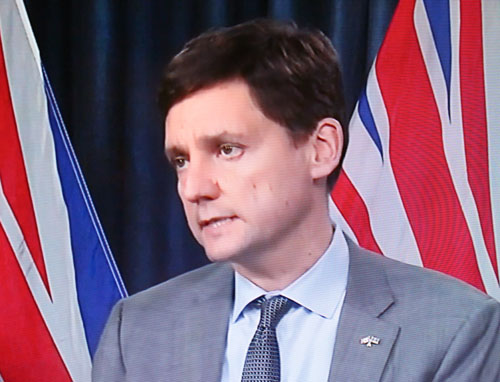
Bringing oil products by pipeline from Alberta to coastal tidewater on the BC northwest coast requires coastal First Nations support, says BC Premier David Eby.
The BC premier addressed reporters this afternoon at the BC Legislature regarding how BC had not been informed of or invited to talks between Alberta (and Saskatchewan) and the federal government regarding a pipeline project that is currently just an idea.
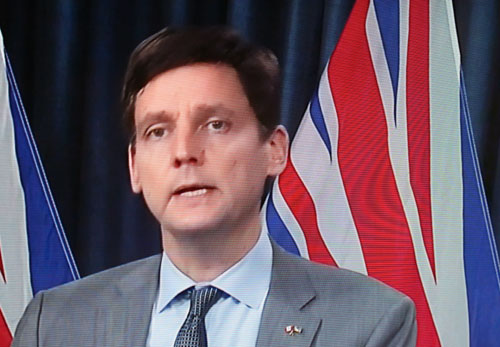
That idea will evidently be signed as a Memorandum of Understanding (MOU) to be made public on Thursday this week — as made known by Prime Minister Carney a few days ago during a media availability when he was at the G20.
Leaving out the premier of a province that would undoubtedly be implicated if not damaged politically and in terms of relations with Indigenous people is still a headshaker for most political observers. Last week it was understandable to hear Eby say he just about fell out of his chair when he heard about the talks that he was not involved in.
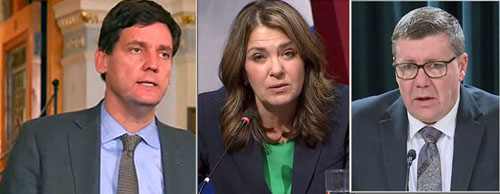
One wonders if Prime Minister Carney was just busy and preoccupied with his trade diversification efforts and the G20 overseas, or whether he has determined that pretty much ‘anything goes’ when it comes to revving up Canada’s economy against the United States. Shooting oneself in the foot as to relations with a key province like BC seems unnecessary.
After decades of BC being left out of equalization payments (that are received by Ontario and Quebec) is finally being highlighted by Premier Eby — over the past year or more.
As for the Alberta-led pipeline idea — will trade diversification and the economic growth of Canada at any cost be the hill that Carney’s continued political honeymoon with the Canadian public die on?

If $50 billion for one, then also for the other:
“I do not believe that Alberta should have access to a $50 billion taxpayer funded pipeline unless other provinces and territories have access to similar amounts of taxpayer funding. There is not a world in which — with the current price of oil — a company is going to step up and pay for this pipeline across the north. this is the reason why not one single pipeline company has said that the conditions are right, they will build it, if it’s built they would buy it. The reason for their silence is that they are not interested. Just like they’re not interested in buying the pipeline that we already have — that taxpayers own, that is for sale if anybody’s interested,” said Premier Eby, referring in that case to the TMX pipeline that loads piped crude oil and refined products into ships in the harbour at Burnaby Terminal.
“My message to the prime minister was that either there should be gap on the taxpayer dollars invested in this project, or there should be a prohibition on taxpayer dollars invested in this project, or that if it is going to be taxpayer funded that British Columbia get access to a $50 billion federally-funded project as well,” said Eby today.
“The third piece that I underlined for the prime minister was British Columbia’s support for the oil tanker ban off the coast. The Hecate Strait is wild water. it is an incredibly precarious shipping route, it is the reason why the ban on oil tankers has existed for generations across multiple administrations of different political stripe in Canada and in British Columbia.,” said Eby today.

About the route:
“The reason why these supports have been there for this — whether it was in law or not — formally or informally — is because of the dangerous waters in the northwest,” said Eby today.
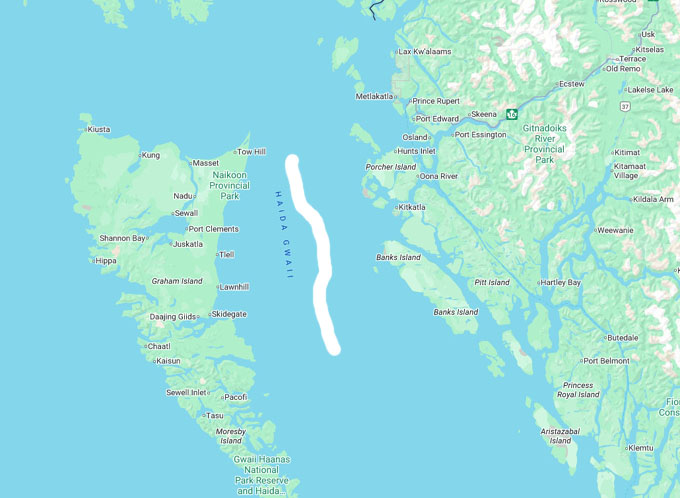
Hecate Strait is located between Haida Gwaii and the mainland of BC. It merges with Queen Charlotte Sound to the south and Dixon Entrance to the north. About 140 km (87 miles) wide at its southern end, Hecate Strait narrows in the north to about 48 km (30 miles). It is about 260 km (160 miles) in length. Being so shallow, Hecate Strait is especially susceptible to storms and violent weather.
The strait is listed by Environment Canada as the most dangerous body of water on the entire Canadian coast and the fourth most dangerous in the world. It is noted for strong winds, powerful tidal currents, frequent storms and shallow waters. During winter storms, waves can reach 10 to 20 meters and expose the sea floor.

BC’s ask of the prime minister:
“A heavy oil spill will decimate a $1.7 billion industry of fisheries, and tourism, and a way of life for people in the northwest. They’ve been living that way of life for millennia. I explained all those things. I asked the prime minister to incorporate those pieces into the agreement. He listened carefully, made no commitments on it,” Eby told media today.
“But I said at a minimum coastal First Nations in British Columbia needs to be at the table in these conversations about our province. So I look forward to seeing what the prime minister and premier Smith bring forward in the coming days, potentially, said BC Premier Eby.
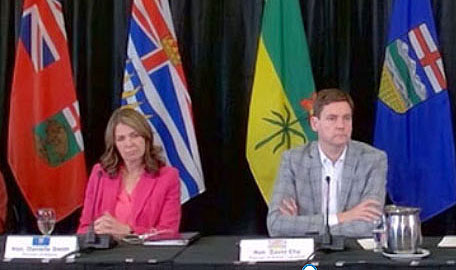
“I underlined to the prime minister how unacceptable it was to me to have Saskatchewan and Alberta speaking about matters in British Columbia without British Columbia at the table,”said Eby in his media scrum today. “This is not something that would happen to Quebec, this is not something that would happen to other provinces in the federation.”
“I don’t know why the thought was that it would be okay for it to happen to British Columbia,” said Eby.
Alberta Premier Danielle Smith said recently that discussions with the federal government about the pipeline have been going on for a couple of weeks now.
Not losing perspective:
“I’m not threatened by a project that doesn’t actually exist,” Eby also said. “The entire proposal from Premier Smith is a communications exercise.”
Eby adds: “The entire country seems to be particularly interested in this non-existent project when British Columbia is delivering tens of billions of dollars in real projects, thousands and thousands of jobs, billions of dollars of revenue that will flow to federal and provincial coffers if we can close these deals which are approaching final investment decision in the next 12 months.
Eby says he understands that the prime minister needs to engage with premiers from across the province but that he will “reserve judgement about the content of the agreement until I see it”.
“But as far as that agreement touches British Columbia and our interests and our province then British Columbia needs to be at the table for that conversation. I don’t think that’s unreasonable to ask,” says BC’s Premier.

Include BC going forward:
“But regardless, and I was very clear that my expectation is, that going forward that British Columbia be at the table — that we’re able to participate in these crucially important conversations,” said Eby today.
He added: “We don’t have to agree but it is absolutely crucial that the prospective knowledge and relationships of British Columbia are leveraged at that table to make sure that we reach the best solution for the people of Canada possible.”
The agreement is not finalized at this point, Eby learned from Carney. “My expectation, hope, is that BC’s feedback is incorporated into any final agreement and particularly BC’s participation going forward and respect for the role of coastal First Nations,” said BC’s premier today.

BC has the lion’s share of major projects:
“When I have the opportunity to meet with other premiers and I hear what they’re working on, I will say, with respect, that the vast majority of major project opportunities in this country right now — that are close to final investment decision — are in British Columbia,” said Eby.
“Regardless of the ‘small-p politics’ there is no other province that has tens of billions of dollars of projects at final investment decision with private proponents, permits in place, ready to go. So it has not been a surprise to me that British Columbia has four times more major projects on the board than any other province in Canada,” says Eby.
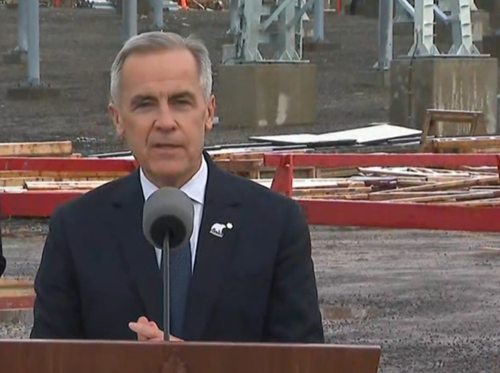
As such, he was repeating a stance of satisfaction that he has expressed over the past couple of weeks as the federal government’s major projects list has been rolled out (Part 1 on September 11 and Part 2 on November 14).
However, Eby added today: “What has been a surprise — and an unpleasant surprise to me — is the willingness with which Alberta and the federal government are willing to potentially jeopardize those projects by disrespecting the coastal First Nations and their very serious and legitimate concerns about eliminating the oil tanker ban off of the northwest coast.”
“Their support for these other projects is essential for them to be able to move forward,” said Premier Eby.
He added that he has “underlined on a number of occasions to the federal government and publicly” his “sincere desire that Ottawa not play politics with major projects”.
Projects for Canada to stand strong:
“If there are major projects with private proponents that are close to ready to go that will assist us as a country to stand on our own two feet, those projects should be prioritized,” said Eby today.
“We have equalization already in this country where other provinces in this country where other provinces are supported by British Columbia. Ottawa should be taking a perspective of ‘what can we deliver, how quickly can we deliver it, and with all due respect to the pipeline project — there’s no route, there’s no proponent, there’s no company, there’s no money.
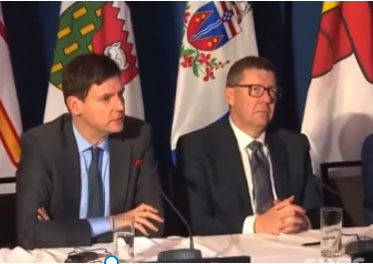
“And when you compare our proposals to Alberta they could not be more different,” says BC Premier Eby.
This afternoon on CBC’s Power and Politics, Saskatchewan Premier Scott Moe was politely critical of Eby’s “NDP” comments about the pipeline prospect. Moe says more discussions need to happen going forward.

Major projects list so far:
List announced in September:

- Phase two of LNG Canada in Kitimat, B.C., doubling its production of liquefied natural gas. [BC Premier David Eby held a hasty press conference at the LNG facility in Kitimat in July]
- The Darlington New Nuclear Project in Clarington, Ont., which will make small modular reactors. [For months, Ontario Premier Doug Ford has been promoting small nuclear as a prime example of key energy projects as a way to help with Canadian energy resilience]
- Contrecœur Terminal Container Project to expand the Port of Montreal. [Carney highlighted this project and other ports several weeks ago.]
- The McIlvenna Bay Foran Copper Mine Project in Saskatchewan. [Copper has been highlighted as a key mineral resource for months in federal economic discourse.]
- The expansion of the Red Chris Mine in northwestern B.C. [In July there was a mine rescue incident of some trapped inspectors at Red Chris Mine.]
List announced in November:
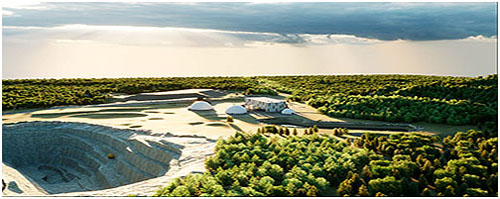
- North Coast Transmission Line (NCTL) – proponent: • BC Hydro
- Ksi Lisims LNG – proponents: • Western LNG • Nisg̱a’a Nation • Rockies LNG Partners
- Northcliff Resources’ Sisson Mine – proponent: • Northcliff Resources Ltd.
- Canada Nickel’s Crawford Project – proponent: • Canada Nickel Company
- The Iqaluit Nukkiksautiit Hydro Project – proponent: • Nunavut Nukkiksautiit Corporation
- Nouveau Monde Graphite’s Matawinie Mine – proponent: • Nouveau Monde Graphite
- The Northwest Critical Conservation Corridor – Current announced projects referred to MPO linked to this strategy • Red Chris Mine Expansion • North Coast Transmission Line • Ksi Lisims LNG
===== RELATED:
- Economy overrides politics in preliminary exclusion of BC Premier from northwest pipeline talks (November 21, 2025)
- Canada’s premiers got economic transformation update ahead of Liberal Budget vote (November 19, 2025)
- Eby pleased with more national major projects in BC (November 14, 2025)
- Carney’s second set of nation-building major projects (November 14, 2025)
- Carney announces five major projects to fast-track Canada’s economic transition (September 11, 2025)
- NEWS SECTIONS: 45th PARLIAMENT of CANADA | BUDGET 2025 | COUNCIL of the FEDERATION | MAJOR NATIONAL PROJECTS