



Saturday July 26, 2025 | VICTORIA, BC
by Mary P Brooke | ISand Social Trends | Forestry News Section
As US President Donald Trump continues his self-directed way of trade relations with many countries around the world, Canada continues to hope for customized trade relations given this country’s proximity to the United States and also our 40-year history of free trade agreements with the US.
“I could think Canada could be one where they just pay tariffs,” said Trump this week, perhaps indicating that an agreement like the current CUSMA/USMCA which includes bilateral advantages for Canada.
If Trump’s actions come to pass, US lumber will have a more than 35% duties applied, retroactive to 2023. This is obviously considered to be unsustainable.

It seems to be an unending trade dispute. The US has argued since the 1990s that Canada, particularly BC, has been unfairly subsidizing its lumber industry through stumpage fees (charges for harvesting timber on Crown land), giving Canadian producers an unfair advantage in the US market.
Trump’s economic trade war has the goal of seeing as much manufacturing as possible be taking place in the United States. While people see the high-profile challenge to the automobiile manufacturing sector because it seems new, the pressure to exclude Canada’s softwood lumber for the US market has been going on for decades, with specialized tariffs that have never been resolved through political action.
Pursue a fair durable agreement:
The BC Lumber Trade Council outlines that the U.S. Department of Commerce intends to raise anti-dumping duties on Canadian softwood lumber to 20.56%. “If the Department’s forthcoming determination in the countervailing duty review is consistent with the preliminary results, the combined rate will be well over 30%,” said Kurt Niquidet, President of the BC Lumber Trade Council in a statement on July 25.

“Rather than prolonging this decades-old dispute through costly litigation, we urge both governments to pursue a fair and durable agreement that delivers long-term certainty in the softwood lumber trade,” said Niquidet.

Rate increases:
Preliminary rate increases happened in March and April of this year.
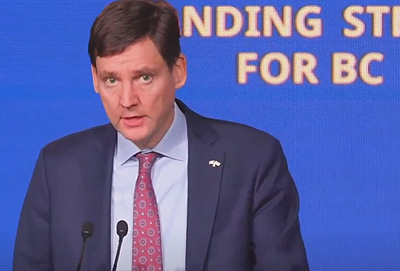
- March 3, 2025 – BC Premier’s news release on U.S. preliminary decision for antidumping duties
- April 5, 2025 – Premier’s statement on softwood lumber – response to the U.S. Department of Commerce announcement that it plans to raise softwood duties against Canadian producers to 34.45% | BC Premier: Softwood lumber duties are an attack on forestry workers (Island Social Trends)
- July 21, 2025 (latest update) – BC’s Response to Unjustified Tariffs
Anti-dumping and countervailing duties:
The rates for the anti-dumping and countervailing duties are shown below [Source: BC Ministry of Forests].
Any other tariffs imposed by President Trump, or any other trade actions under the Section 232 “National Security” investigation, would be on top of these rates.
| CURRENT AR 5 Final Rates | *NOT IN EFFECT UNTIL FINAL DETERMINATION AR 6 Preliminary Rates | |||||
| Countervailing Duties | Antidumping Duties | Total | Countervailing Duties | Antidumping Duties | Total | |
| Canfor | 6.14% | 10.44% | 16.58% | 11.87 | 35.56% | 47.43 |
| West Fraser | 6.85% | 5.04% | 11.89% | 16.57 | 9.65% | 26.22 |
| JD Irving | 3.88% | 7.66% | 11.54% | 14.38 | 20.56% | 34.94 |
| Tolko | 9.61% | 7.66% | 17.27% | 14.38 | 20.56% | 34.94 |
| All Others | 6.74% | 7.66% | 14.40% | 14.38 | 20.56% | 34.94 |
Years of uncertainty:
“It is no secret, the sector – one that employs tens of thousands of workers in our province – has faced years of uncertainty, driven by ongoing trade disputes, global market pressures, and the compounding effects of climate change,” said BC Forests Minister Ravi Parmar in a statement on Friday.
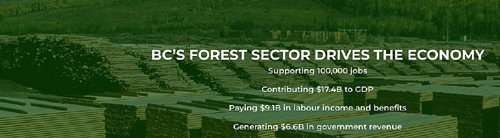
“Now, we face further challenges, with rising unfair and unjust duties imposed by the United States,” said Parmar.
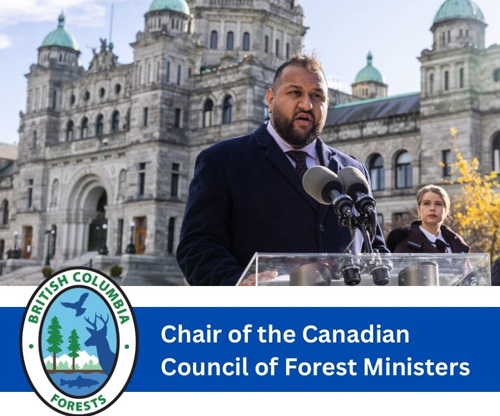
Parmar is the Chair of the Canadian Council of Forest Ministers for 2025-2026. He said on Friday that he will be convening his Softwood Lumber Advisory Council to advise and support the provincial government’s response and strategy.
Parmar has also appointed former deputy minister to the premier, Don Wright, as a strategic advisor on softwood lumber, “to ensure B.C.’s interests are well represented, and to help us align with federal and cross-provincial efforts”.

Forestry ministers in BC:
BC has had several Forests ministers over the years, with lumber duties being a thing to deal with in their portfolio:
- BC LIBERAL: 1989-1991 (Claude Richmond).
- BC NDP: 1992 (Dan Miller, replaced by Arthur Charbonneau for 1992; Dan Miller again 1993, Andrew Petter 1993-1996); 1997-1999 (John Allan).
- BC LIBERAL: 2001-2005 (Mike Harcourt), 2005-2008 (Forests and Range – Rich Coleman); 2008-2010 (Forests and Range – Pat Bell); 2010-2011 (Forests, Mines and Lands – Pat Bell); 2011-2017 (Forests, Lands and Natural Resource Operations – Steve Thomson).
- BC NDP: 2017-2020 (Forests, Lands and Natural Resource Operations – Doug Donaldson); 2021-2024 (Forests, Lands, Natural Resource Operations – Bruce Ralston); 2024 to present (Forests – Ravi Parmar).

US tries to block ‘cheap’ Canadian lumber:
In the current trade war, forestry seems like it will be hit particularly hard. Trump seems to be following in the footsteps of previous US administrations that for decades have had the intention to curtail what they would see as the ‘excessive’ sale of Canadian lumber into the US marketplace.
Part of the appeal of Canadian (much of it BC-produced) softwood lumber is its higher quality than what the US might already have domestically. And it seems that the price of Canadian lumber is lowest than US lumber products, before any tariffs that is.
A lesson in that is that Canadian lumber should be priced higher to begin with. Canada may in that regard have been perpetuating the approach of many Canadian resource sectors being ‘hewers of wood and drawers of water’, i.e. simply exporting raw resource instead of upgrading it to more specialized products.
Trump most recent position on tariffs for Canada is that he might apply 35% on all Canadian goods that do not fall under (i.e. are not protected by) the current USMCA.
Canada’s trade representatives led by Dominic Leblanc (Minister responsible for Canada-U.S. Trade, Intergovernmental Affairs and One Canadian Economy) are returning to Washington next week, which is considered a good sign for Canada’s trade deal outcome.

BC Forests Minister weighs in:
On Friday, BC Forests Minister Ravi Parmar expressed his concern about duties on softwood lumber that could nearly triple, and be retroactive to March 2025.
Today he appeared on CTV national news from his constituency office in Langford, to outline BC’s position on the US forest anti-dumping duties (aka tariffs):
BC condemns the raising of ad duy rates on the freost esector here in Canada. BC is the 2nd largegst epxorter of lumber porducts in the entire wordl, second to Russia.
“Yesterday afternoon, when many forest workers were just getting off their shift they received this news, it was a gut punch to them.”
“We know here in CAnada over the last number of weeks and months that Donald Trump is doing everything in his power to destroy our economy and there’s no sector that has faced this more than our forest sector these last number of years,” said Parmar.
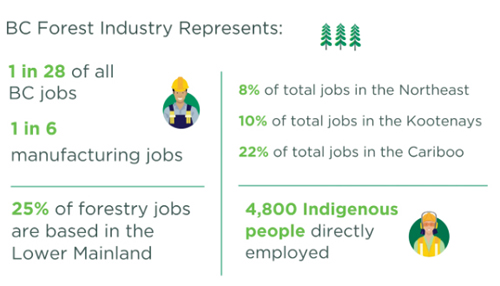
“Were talking about 50,000 direct jobs, 100,000 indirect jobs. I’ve traveled throughout this province visiting forest dependent communities. I’m sure many of them are wondering whether they’re going back to work on Monday. I’ve already spoken to an number of CEOs that are now talking about curtailment, potentially talking about closures because of the impact of these duties,” said Parmar.
“We still don’t have the countervailing duty rate which is set to go up very shortly, which will take us over 30%. We don’t have the Section 232 investigation. It’s ludicrous that Trump thinks lumber is a national security risk,” said Parmar.
Parmar points out that over recent months Prime Minister Mark Carney has referred to lumber “a top priority” in discussions with the Trump administration, says Parmar.

Parmar says he’s going to “continue to call on Ottawa to step up,” pointing out that when threats are made about the steel, aluminum and auto sectors that Ottawa responds and offers supports almost immediately but for lumber “it’s crickets” (very little response).
Minister Parmar said today that he hopes his colleagues and counterparts have the backs of British Columbian workers — in fact forestry workers from coast to coast to coast.
“We are exploring necesary steps here in British Columbia to support our workers, to support operations,” said Parmar. “I agree with the industry that we need to keep the lights on, we need to keep people working. We have world-class products that the entire world needs. This is a time to remind ourselves that we have to diversify, more and more,” said Parmar, who also serves as deputy government house leader for the BC NDP.

Parmar will be leading a trade mission at the end of 2025, looking to explore our emerging markets and where we can expand to new markets. This is a big deal.
I’m hopeful that Prime Minister Carney — the same way that he steps up for the auto sector — (also) steps up for the forest sector. For BC this is a big deal. We’re talking about 100,000 jobs.

COFI position on next steps:
The BC Council of Forest Industries (COFI) strongly condemns today’s decision by the U.S. Department of Commerce to once again increase anti-dumping duties on Canadian softwood lumber.
COFI wants the federal government to make resolution of the softwood lumber dispute a top national priority, to put Canada in the lead on next steps.

COFI states on their website that forestry is a value-added industry.
“To keep forestry workers employed and communities strong, BC must urgently strengthen the conditions to succeed here at home. That starts with treating forestry as a major project to reach a target harvest of 45 million cubic metres and taking immediate action to restore wood flow, protect jobs, and stabilize the sector—while laying the groundwork for long-term competitiveness,” said COFI in a statement on July 25.
The organization that represents forestry sector workers says the “best way to support forest workers is to keep mills operating and people working… we want to retain forestry workers, not retrain them”.
“With practical, coordinated action—like activating timber sales, fast-tracking permits, and cutting through regulatory gridlock—BC can send a clear signal: we are serious about rebuilding a competitive, sustainable forest sector that works for people, communities, and the planet,” says COFI communications director Travis Joern.
“The province has the tools—and COFI is ready to roll up our sleeves and work alongside government to put them to use,” says Joern in Friday’s news release.
The COFI call for action has five points:
- Accelerate the Path to 45 million cubic metres of annual harvest by unlocking near-term volume through fast-track permitting, BC Timber Sales (BCTS) auctions, and expanded salvage and thinning operations.
- Launch a dedicated permit triage and acceleration team—made up of experienced forestry professionals—to resolve the backlog of active permits and enable new applications. A functional single-window permitting system should be a long-term goal, but action is needed now.
- Break down cross-ministry barriers by aligning environmental, reconciliation, and economic priorities—reducing contradictory policies and delays that paralyze the sector.
- Immediately release ready-to-sell BCTS volumes to get wood flowing to mills today—not months from now.
- Support First Nations with the capacity and tools to expedite referrals, co-develop land use plans, and increase revenue sharing—so that partnerships can move at the speed of opportunity.
===== RELATED:
- Liberal promise for a new home-building sector in Canada would help boost BC forestry sector (April 8, 2025)
- BC Premier: Softwood lumber duties are an attack on forestry workers (April 5, 2025)
- NEWS SECTIONS: CANADA-NATIONAL | CANADA-USA | TARIFFS & TRADE | CANADIAN FEDERAL ELECTION 2025 | BC 43rd PARLIAMENT