


Thursday July 17, 2025 | VICTORIA, BC [Posted at 10:28 am & updated 10:56 am | Updated July 18 & 19, 2025]
by Mary P Brooke | Island Social Trends
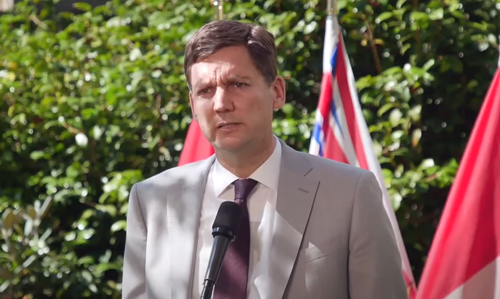
Premier David Eby has announced a strategic shift to his cabinet in order to centre jobs, the economy and the needs of British Columbians in their communities.
BC has a “new role as the engine of Canada’s economy”, said Eby today.
Many cabinet ministers have stayed in their current roles, but some have been shifted to other ministerial or parliamentary secretary roles.
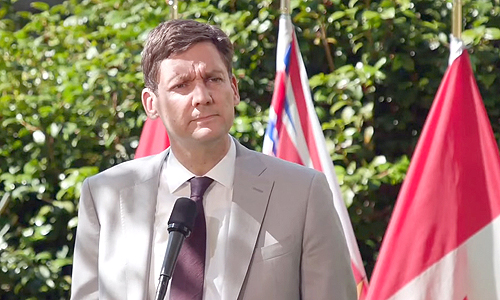
This is Premier Eby’s third cabinet. The first cabinet was sworn-in on December 7, 2022 and the second cabinet swearing-in was in November 2024.
The NDP have held government since July 18, 2017. That’s an eight-year run so far, first under Premier John Horgan (who orchestrated a supply and confidence agreement with the BC Greens in order to form a progressive government and then called a snap election in 2020 to extend the NDP stronghold). Eby became premier in November 2022 when Horgan decided to step back for health reasons.

Tipping point:
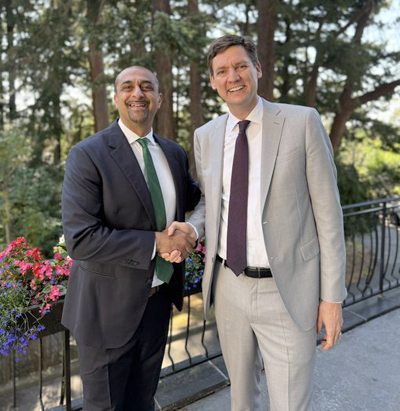
Who knows exactly what the tipping point was for this mini cabinet shuffle, but we note that now-former Housing Minister Ravi Kahlon said during a press conference earlier this month that he feels like he had been in the housing portfolio “forever”. And today Eby mentioned somewhere in his remarks that he “needs Ravi” to essentially help lead the cabinet’s work in these challenging economic times.
New mandate letters for the cabinet ministers will be released shortly, Eby told media today.
The right people in the right spots:
“Ensuring that I’ve got the right player in the right position… is what today is about,” said Eby during the media availability.
He highilighted the role of Rick Glumac as the new Minister of State for AI and New Technologies in developing the AI sector in BC. That portfolio lines up with the new federal ministry of AI.

Changing times:
“We need to be responsive to the changing needs of our province by growing our economy, seizing new opportunities, and making our essential services more resilient,” Premier Eby said.
He specifically mentioned economic threats upon BC and Canada by the United States.
“We have the skills and determination both at the cabinet table and in caucus to stand up for British Columbians, said Eby as a way to reassure that the new cabinet placements will be effective.

“The changes prioritize the specific skills and experience of ministers to meet the current moment,” it was stated by Eby today.
Earlier this year a cabinet committee for economic strategies was established.
New cabinet roles:
The new cabinet roles effective today July 17, 2025 are:
- Ravi Kahlon, Minister of Jobs and Economic Growth. He has moved from being Housing minister effectively since November 2022.
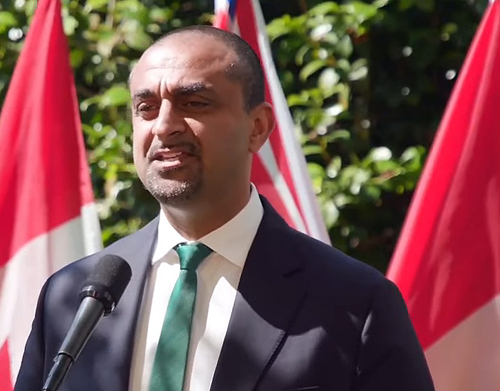
Kahlon said at the microphone that “there’s a lot that’s happened in the last year”.
“We’re in a unique time when it comes to the history of this province when it comes to the challenges our country is facing right now,” said Kahlon now in his new role a Minister of Jobs and Economic Growth.
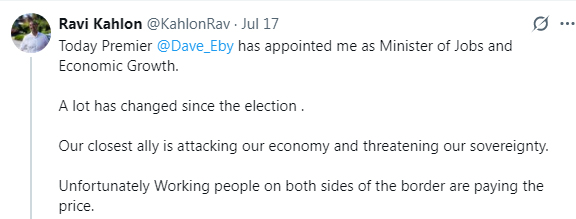
“President Trump … has launched an attack on our economy and threatened our independence, our sovereignty as a country,” said Kahlon in his opening remarks. “The people who are going to face the impacts of those tariffs are workers on both sides of the border,” he said.
Kahlon said that BC is in “a unique position” because BC has “everything we need to weather this storm and be more successful than we were before”, listing off resources, innovation and people.
He will focus on interprovincial trade and on “expanding trade infrastructure to facilitate the growth of the country”, Kahlon told media. “All the provinces are looking west. They’re looking to British Coilumbia because if they’re going to move their goods it’s going to have to come through British Columbia,” said Kahlon.
“We’re going to have to reach further across the world to build new relationships and to strength relationships that we have,” said Kahlon regarding trade diversification.

He is concerned about youth employment.
Kahlon sees AI as providing huge opportunities in the economy. “We need to ensure that our people have the skills to be able to harness the power of AI”. He says that will include training for students in schools in how to use AI and to identify the challenges. And the existing workforce needs to be retooled and reskilled,” said Kahlon.
There is no shortage of work when it comes to this industry that the Premier has asked me to take a vision of being the engine of growth for the country forward,” said Kahlon.
Kahlon said he continue to “work with her on that”, referring to now Christine Boyle carrying the housing file as Minister of Housing and Municipal Affairs.

- Nina Krieger, Minister of Public Safety and Solicitor General. She moves from being the Parliamentary Secretary for Arts and Film.
Krieger said during the day’s media availability called public safety “one of the central issues of our time”.

“British Columbians are looking to us to protect people and create safe, healthy communities,” said Krieger.
She already sees work happening “on a number of fronts”, highlighting “working with law enforcement to ensure that they have the tools and resources that they need to keep people safe”.
She wants to work with businesses in the “downtown communities across the province to combat petty crime and vandalism”. She wants to “combat hate”. She mentioned working closely with Terry Yung (Minister of State for Community Safety and Integrated Services) and Health Minister Josie Osborne to ensure coordination between health and addictions services with the work of public safety.

- Jessie Sunner, Minister of Post Secondary Education and Future Skills. She moves from being the Parliamentary Secretary for Anti-Racism Initiatives.

Minister Sunner said today during the media availability that post-secondary education and training is part of putting BC “in the best economic position”.
- Christine Boyle, Minister of Housing and Municipal Affairs. She moves from being the Minister of Indigenous Relations and Reconciliation.

- Diana Gibson, Minister of Citizens’ Services. She moves from being Minister of Jobs, Economic Development and Innovation.
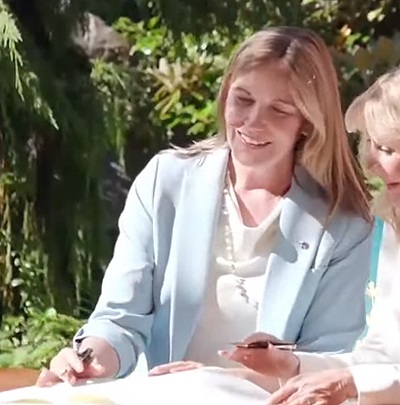
- Anne Kang, Minister of Tourism, Arts, Culture and Sport. She moves from being Minister of Post-Secondary Education and Future Skills.

- Spencer Chandra-Herbert, Minister of Indigenous Relations and Reconciliation. He moves from being Minister of Tourism, Arts, Culture and Sport.

- Rick Glumac, Minister of State for AI and New Technologies. He moves from being Minister of State for Trade.
Shifts:
These cabinet changes include what might be seen as promotions in particular for Krieger, Sunner and Glumac. Eby must have been impressed with the work and energy in their previous roles since the fall of 2024.
For Gibson the shift seems sideways, from a more global economic approach of jobs and the economy to more direct services for all British Columbians.
Kang has served a long time in key portfolios (including Advanced Education and also Municipal Affairs). She will be a versatile friendly face for arts and tourism and the upcoming FIFA World Cup.
Chandra-Herbert seems a good choice for Indigenous Relations and Reconciliation where he can apply his insightful people skills.
Kahlon has long-served on the challenging housing file. He is one of the most senior cabinet ministers who is essentially now heading up the economic thrust of improvements in BC.

Staying in place:
Key cabinet roles that have not changed include Brenda Bailey as Finance Minister, Adrian Dix as Minister of Energy and Climate Solutions, and Ravi Parmar as Minister of Forests. Several significant initiatives are underway in those files.
The Ministry of Children and Family Development continues to be led by Jodie Wickens.
Lisa Beare continues as Minister of Education and Child Care.
Lana Popham continues as Minister of Agriculture and Food. The Liquor and Cannabis Regulation Branch will now be a shared responsibility between Agriculture and the Ministry of Public Safety and Solicitor General.
Josie Osborne continues as Minister of Health.

Cabinet roles:
The cabinet is tasked with working on the province’s biggest challenges: growing the economy, seizing investment opportunities and strengthening public services. Supported by the government caucus, they will work to build a stronger province and a more resilient economy that’s less reliant on the United States.
This cabinet features a majority of women (19), holding some of the most significant and complex portfolios. It is balanced with seasoned experience and fresh perspectives, ensuring a government that reflects the diversity and values of British Columbians.
New faces are stepping up to bring the perspectives and priorities of the next generation to the cabinet table. Experienced ministers are tasked with driving forward major projects and economic prosperity and strengthening core service portfolios.
This cabinet includes MLAs from Vancouver Island, Lower Mainland, the North and Interior, reflecting the province’s diversity and ensuring local perspectives are part of the decision-making process.

New Parliamentary Secretaries:
The following MLAs are moving into new parliamentary secretary roles.
- Amna Shah, parliamentary secretary for anti-racism initiatives, mental health and addictions;
- Garry Begg, parliamentary secretary for Surrey infrastructure;
- George Chow, parliamentary secretary for the Downtown Eastside and Chinatown; and
- Paul Choi, parliamentary secretary for trade.

===== RELATED:
NEWS SECTIONS: BC & NATIONAL | 43rd PARLIAMENT of BC | BC NDP | BUSINESS & ECONOMY